A small sculpture arrives in a very large argument.
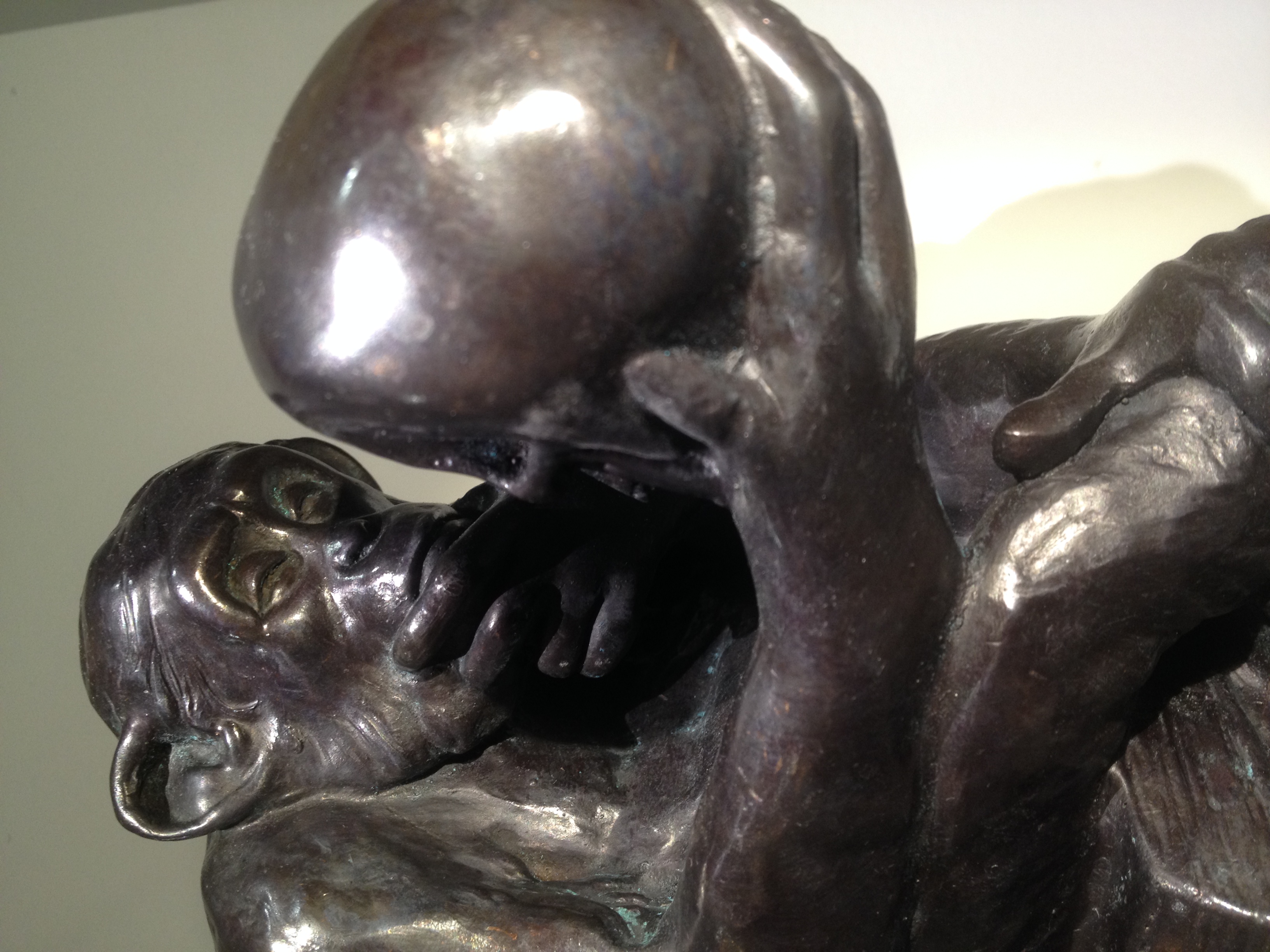
When Hugo Rheinhold exhibited his chimpanzee contemplating a human skull at the Große Berliner Kunstausstellung in 1893, Charles Darwin had been dead for little more than a decade. Evolutionary theory had already transformed the intellectual landscape, but its implications for human identity, religion and morality remained fiercely contested.
Rheinhold had come to sculpture comparatively late, following commercial work and philosophical study. His Affe mit Schädel emerged from this unusual combination of interests. Research by Jochen Richter and Axel Schmetzke traces the work to his artistic training in Berlin and identifies it as an examination piece from the preceding year.
The sculpture was approximately 30 centimetres high when first exhibited. Its modest dimensions concealed an unusually ambitious subject: the relationship between humanity, its animal ancestry and the knowledge by which human beings understood themselves.
From Berlin to the wider world
The early history of Affe mit Schädel is unusually well documented in some respects and frustratingly incomplete in others. Exhibition records, contemporary notices, foundry catalogues and surviving bronzes provide a sequence of evidence, although they do not answer every question about the sculpture's original reception or subsequent production.
An examination piece
Research by Richter and Schmetzke identifies the sculpture with Rheinhold's artistic examination work in Berlin. It was conceived before the bronze reproductions through which the work subsequently became widely known.
The Great Berlin Art Exhibition
The sculpture appeared at the Große Berliner Kunstausstellung under the descriptive title Affe, einen Schädel betrachtend, “An ape contemplating a skull”. The exhibition catalogue records it as no. 2359 in Saal 4. Contemporary accounts recognised its combination of humour and intellectual ambition.
The Gladenbeck bronzes
Hermann Gladenbeck & Sohn acquired the sculpture and the rights to reproduce it in bronze. Foundry catalogues subsequently offered versions in different sizes, allowing the work to circulate beyond the original exhibition. The surviving Gladenbeck bronzes remain important witnesses to Rheinhold's composition.
A contemporary printed reference
An advertisement or commercial notice in the Schwäbischer Merkur mentions Affe mit Schädel, providing an early documentary trace of the sculpture's circulation. Its exact commercial context requires care: the notice should not be treated as proof of a particular foundry edition, selling arrangement or surviving object's provenance.
Survival and rediscovery
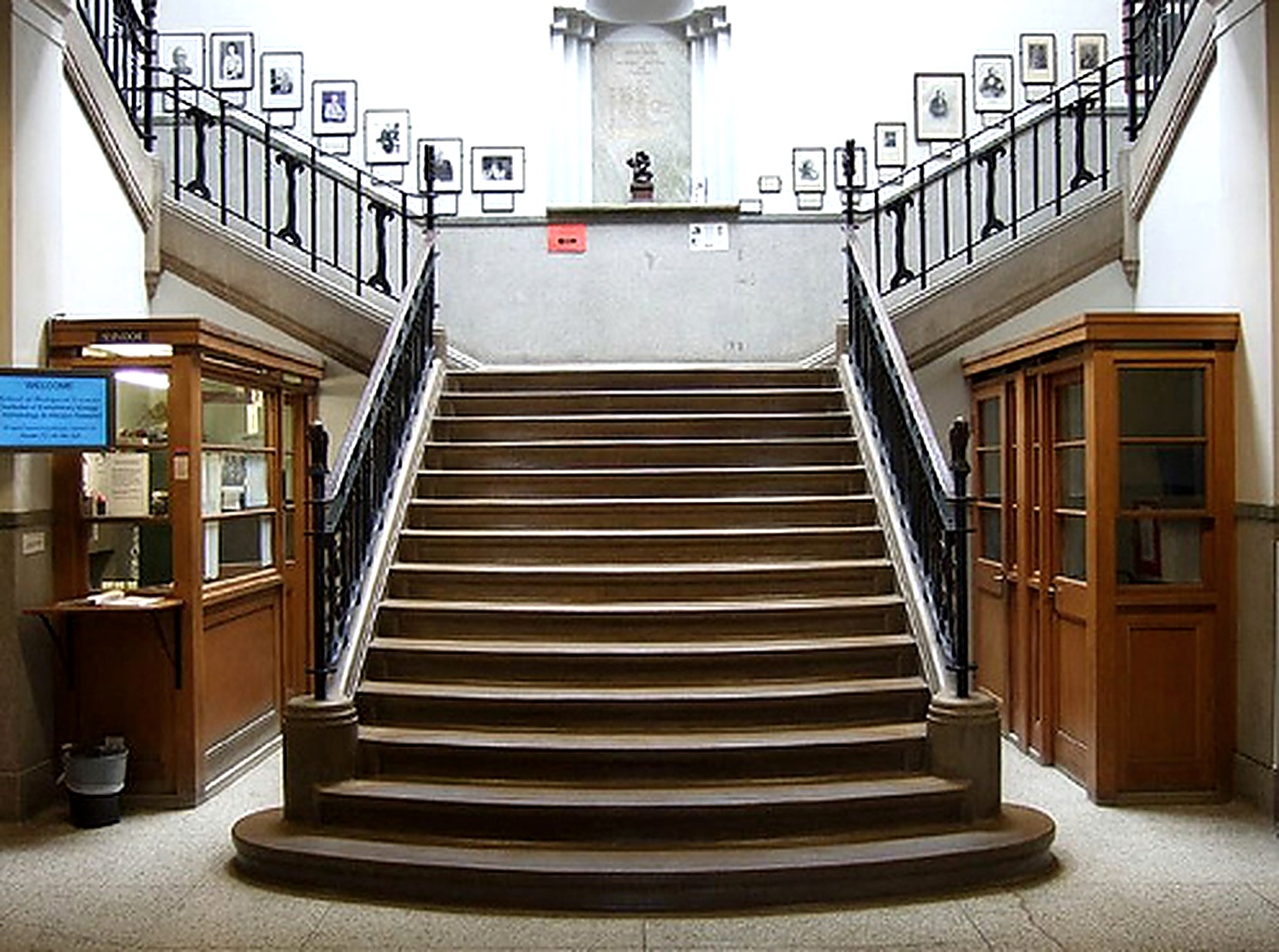
Examples found homes in private collections, universities, medical institutions and other settings. The sculpture's continuing visibility owes much to the survival of historic casts and to the research of those who have reconstructed its history.
What survived, and what disappeared
The original sculpture and the bronze editions that followed it have left an uneven material record. Historic casts survive, as do documentary references to Gladenbeck's production. A mould associated with the smaller version has been identified, while the fate of the mould used for the full-size Gladenbeck bronze remains uncertain.
This distinction matters. The existence of surviving bronzes does not mean that the original production equipment survived with them. Equally, an undocumented or missing mould should not be treated as proof of its destruction.
The history of Affe mit Schädel is therefore a mixture of remarkably tangible evidence and questions that remain unresolved.
No authorised interpretation survives
Rheinhold left no known explanation that definitively settles what he intended every element of the sculpture to mean. Its title describes what the ape is doing, but not what it is thinking.
That absence is important. The sculpture invites interpretation, yet no single reading should be presented as an authenticated statement of the artist's intention.
Its power may lie partly in the way several apparently incompatible meanings coexist within one compact composition.
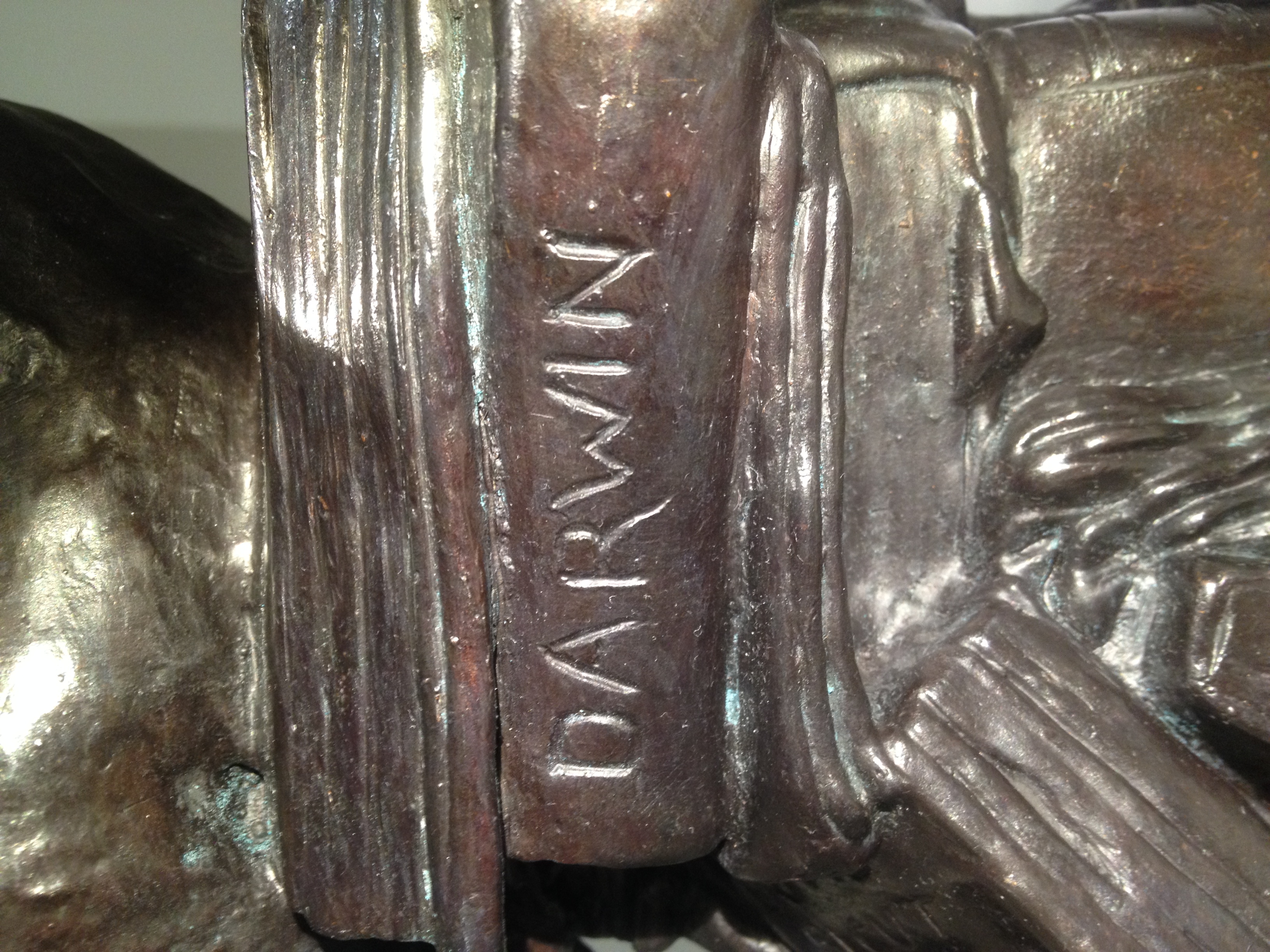
Darwin's unsettling inheritance
By 1893, Darwin's work had challenged the assumption that human beings stood wholly apart from the rest of the animal kingdom. The implications reached beyond biology. If humanity shared an evolutionary history with other animals, what became of the traditional distinctions between human reason and animal instinct, between moral consciousness and natural behaviour?
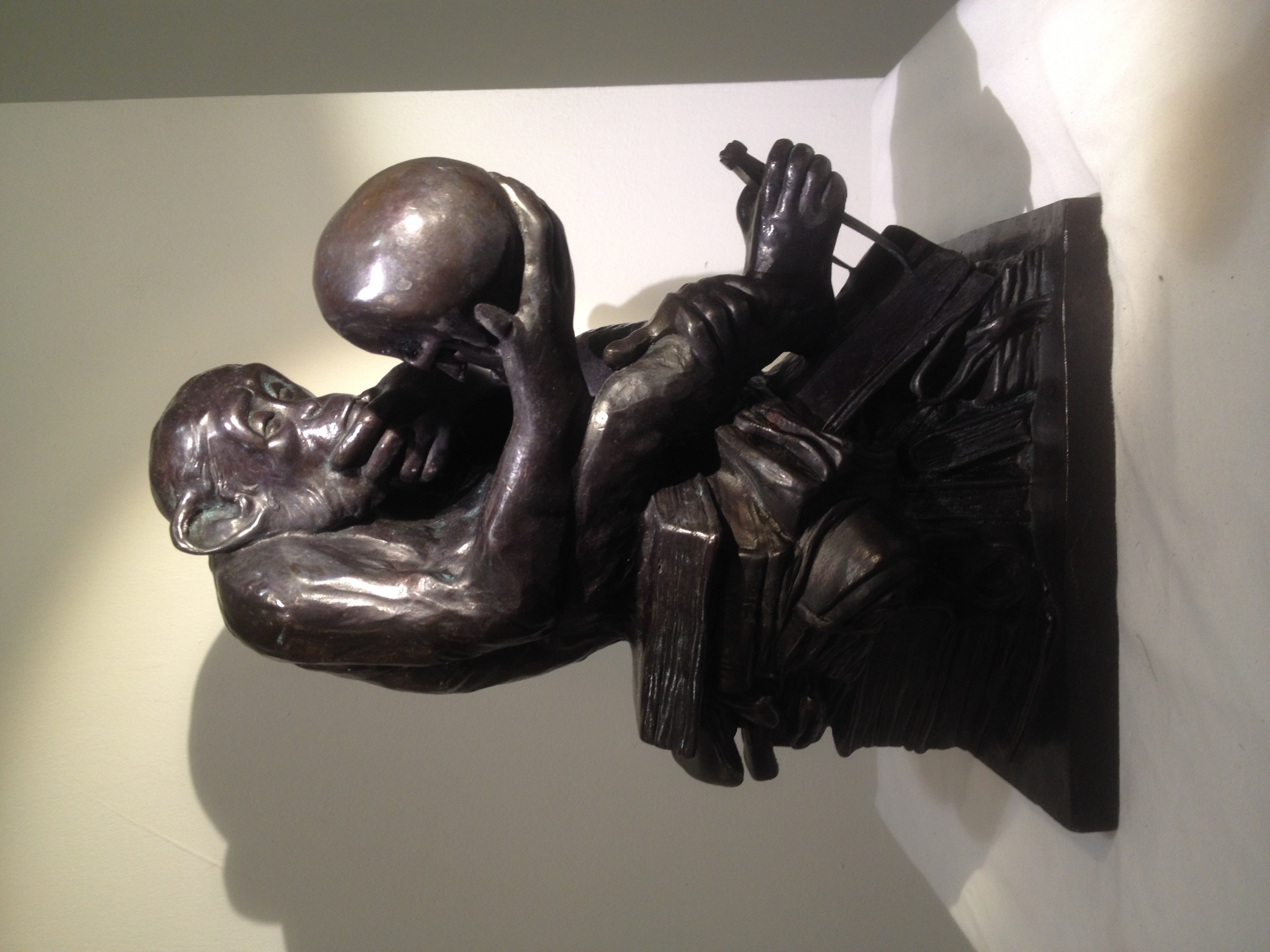
Rheinhold places an ape in a pose associated with philosophical contemplation and surrounds it with the instruments and literature of human inquiry. The scene can be read as an affectionate satire of human intellectual pretensions, as a reflection on evolutionary kinship, or as something more disquieting: the possibility that the boundary between observer and observed is less secure than we suppose.
None of these readings requires the sculpture to be an uncomplicated celebration of Darwinism. The animal's expression is too ambiguous, and the surrounding references too richly suggestive, for so simple a conclusion.
The promise, and the missing knowledge
One of the sculpture's most arresting details is the biblical quotation on the damaged page: ERITIS SICUT DEUS, “You shall be as God”. It alludes to Genesis 3:5, where the serpent promises that eating the forbidden fruit will open human eyes to a new form of knowledge.
The biblical sentence continues with the words scientes bonum et malum, “knowing good and evil”. Those words do not appear on the sculpted page. The omission is especially suggestive because it concerns moral knowledge, rather than knowledge in the abstract.
A viewer may therefore see the books and measuring instruments as emblems of intellectual achievement while recognising that the possession of knowledge does not necessarily confer wisdom or moral understanding.
It is a compelling interpretation, although we cannot establish that Rheinhold intended the torn page to carry precisely this philosophical message.
Who is contemplating whom?
The skull recalls a long tradition of European art in which human remains confront the living with their mortality. The association with Hamlet and Yorick is readily understood, although there is no need to assume that Rheinhold intended a literal illustration of Shakespeare.
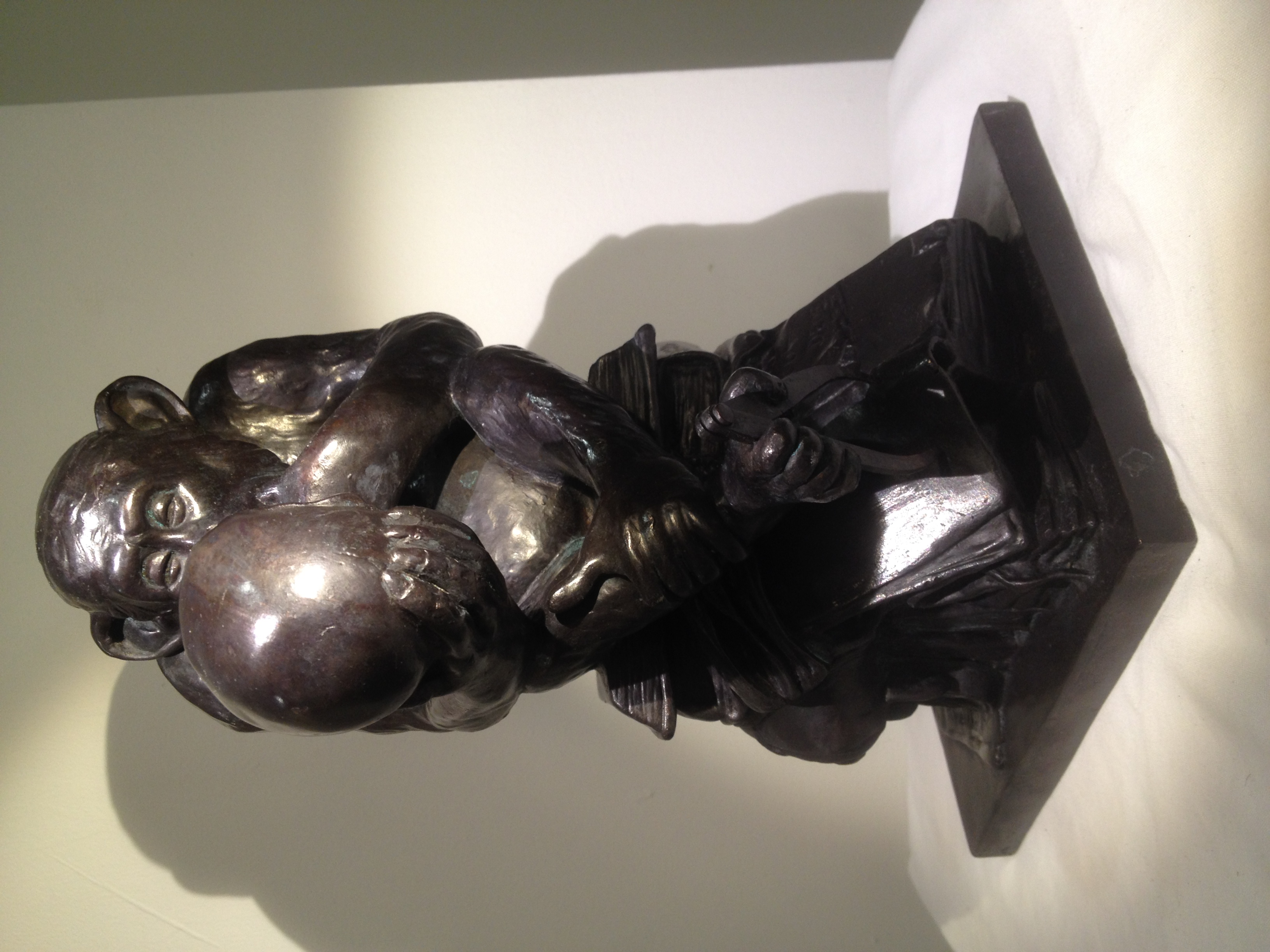
Here the familiar relationship has been reversed. An ape contemplates a human skull, while human viewers contemplate the ape. The animal becomes the philosopher, and humanity becomes the specimen.
There is humour in this reversal, but also a question of considerable seriousness. What does it mean for human beings to study their own origins, and what would it mean if another creature could examine us with equal detachment?
Knowledge is not the same as wisdom
The sculpture's various references bring scientific inquiry, biblical knowledge, human mortality and animal ancestry into the same small space. It is tempting to treat them as pieces of a puzzle with one correct solution.
Yet the more closely they are considered, the less certain that solution becomes. The instruments of measurement cannot settle the meaning of the skull. The biblical inscription promises knowledge while leaving its moral dimension absent. Darwin's name invokes evolutionary continuity, but the chimpanzee's thoughts remain inaccessible.
Rheinhold may be questioning human vanity, celebrating intellectual curiosity, warning against knowledge without conscience, or allowing several of these possibilities to coexist.
Whatever his precise intention, the sculpture refuses to surrender its mystery.