AFFE MIT SCHÄDEL · HUGO RHEINHOLD
The Sculpture
A chimpanzee, a human skull, a precarious library and the instruments of knowledge. Every detail asks to be examined.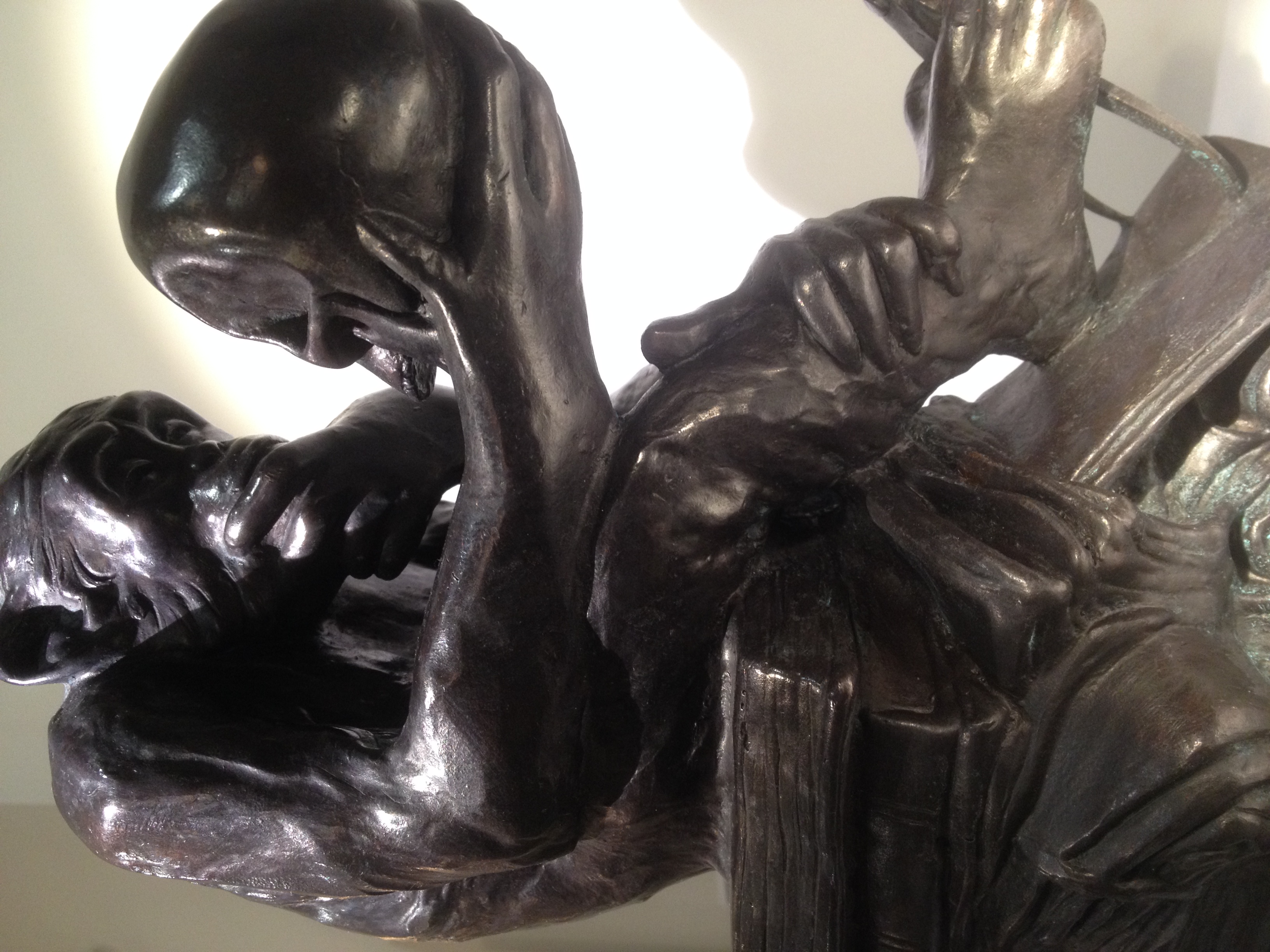
Nothing here is accidental.
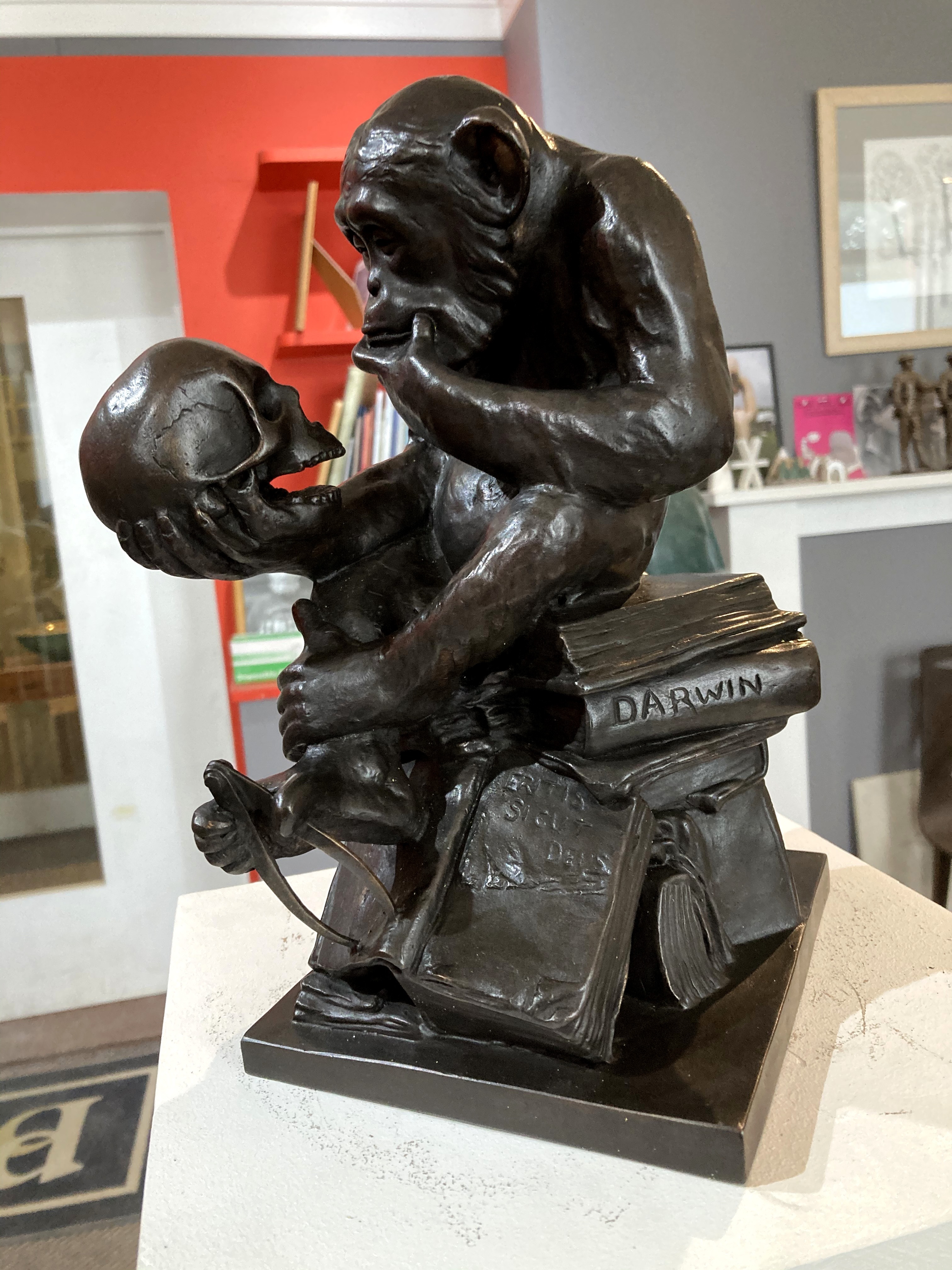
At first glance, Rheinhold's sculpture is disarmingly simple. A chimpanzee sits in contemplation, a human skull in one hand, its chin resting upon the other. But the longer one looks, the less straightforward the scene becomes.
The animal is surrounded by the objects of human learning. Books are piled beneath it, a biblical inscription lies at its feet, and a pair of callipers introduces the language of measurement. The familiar boundaries between humanity and the animal world begin to look less secure.
The sculpture is full of small discoveries. Some are immediately apparent; others emerge only when one moves around it.
A sculpture to walk around
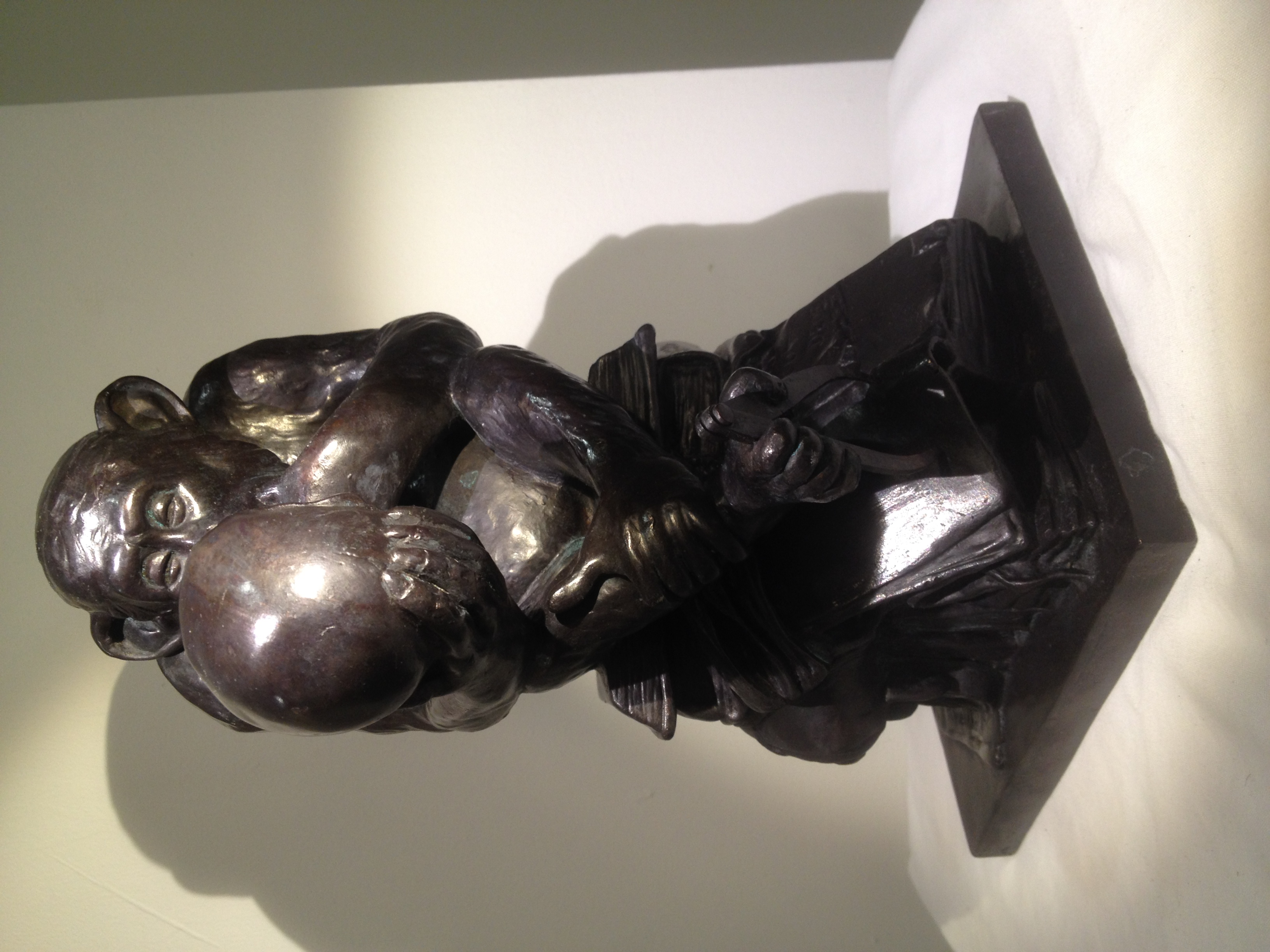
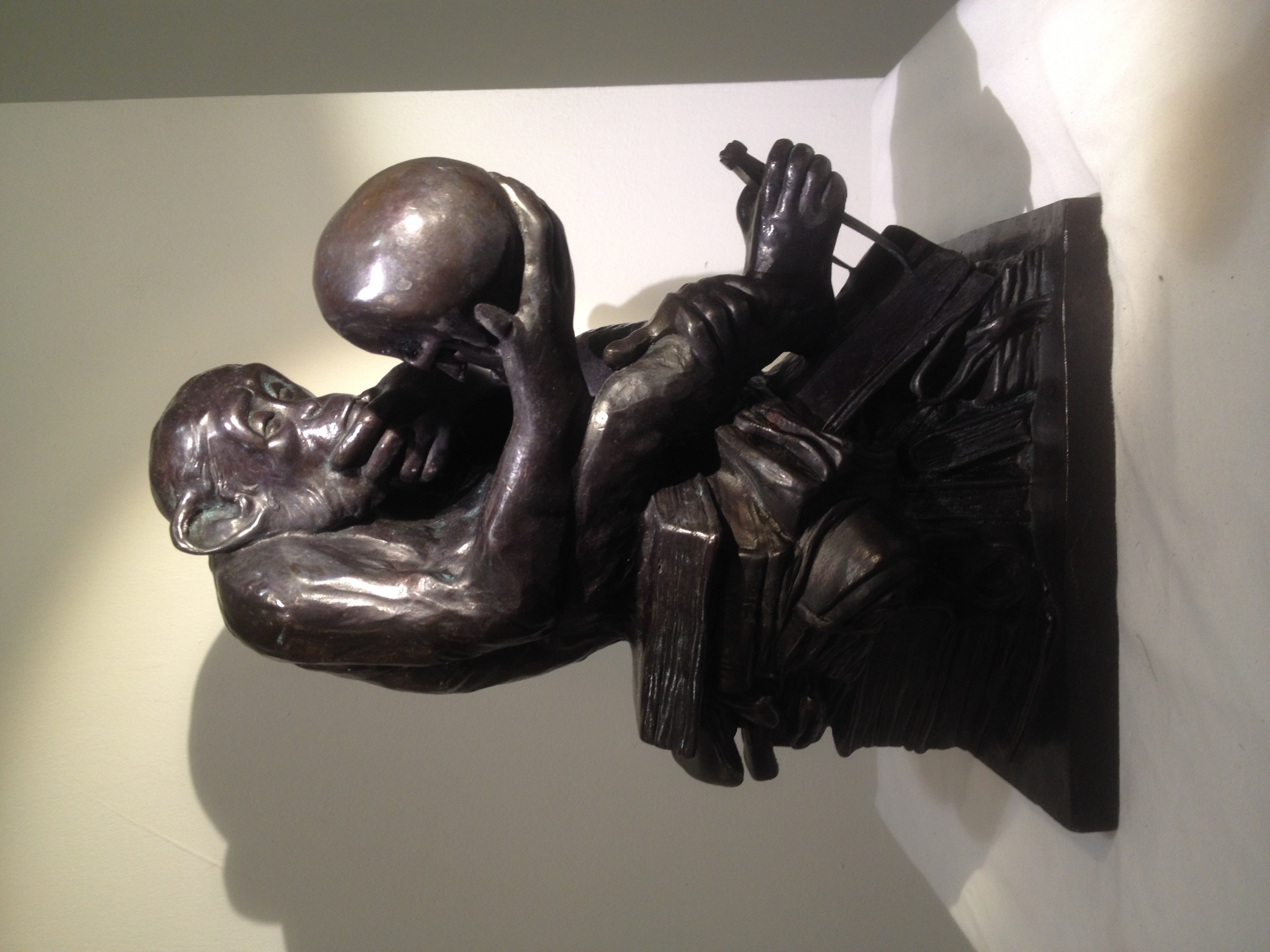
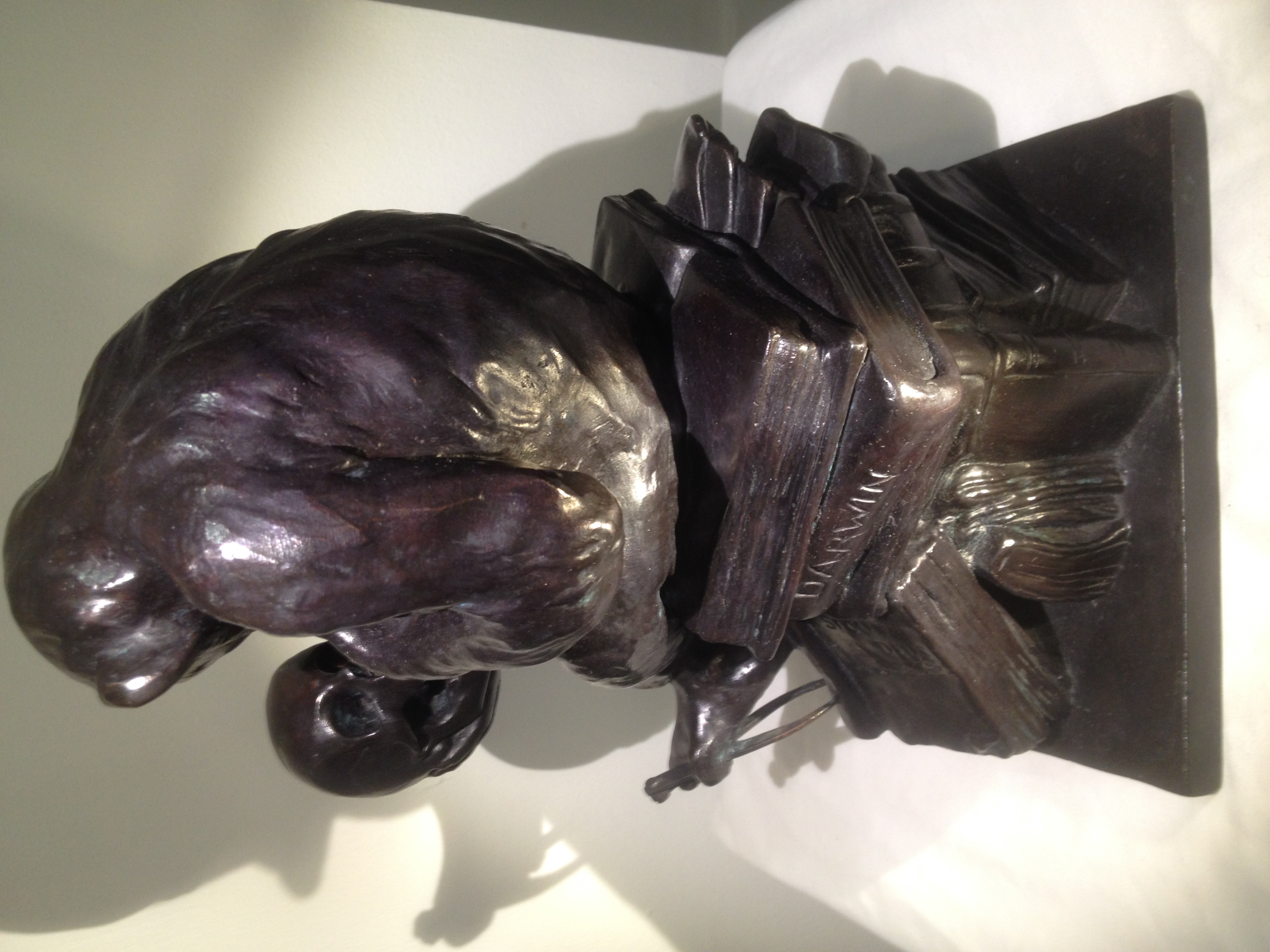
Affe mit Schädel is not a sculpture that yields everything from a single viewpoint. Seen from the front, the chimpanzee appears absorbed in thought. Move to the side and the curve of its back, the balance of its body and the precarious stack of books become more apparent. From behind, the animal’s physical presence can momentarily overwhelm the literary and philosophical references.
Each change of viewpoint alters the balance between the creature itself and the extraordinary objects surrounding it.
An ape lost in thought
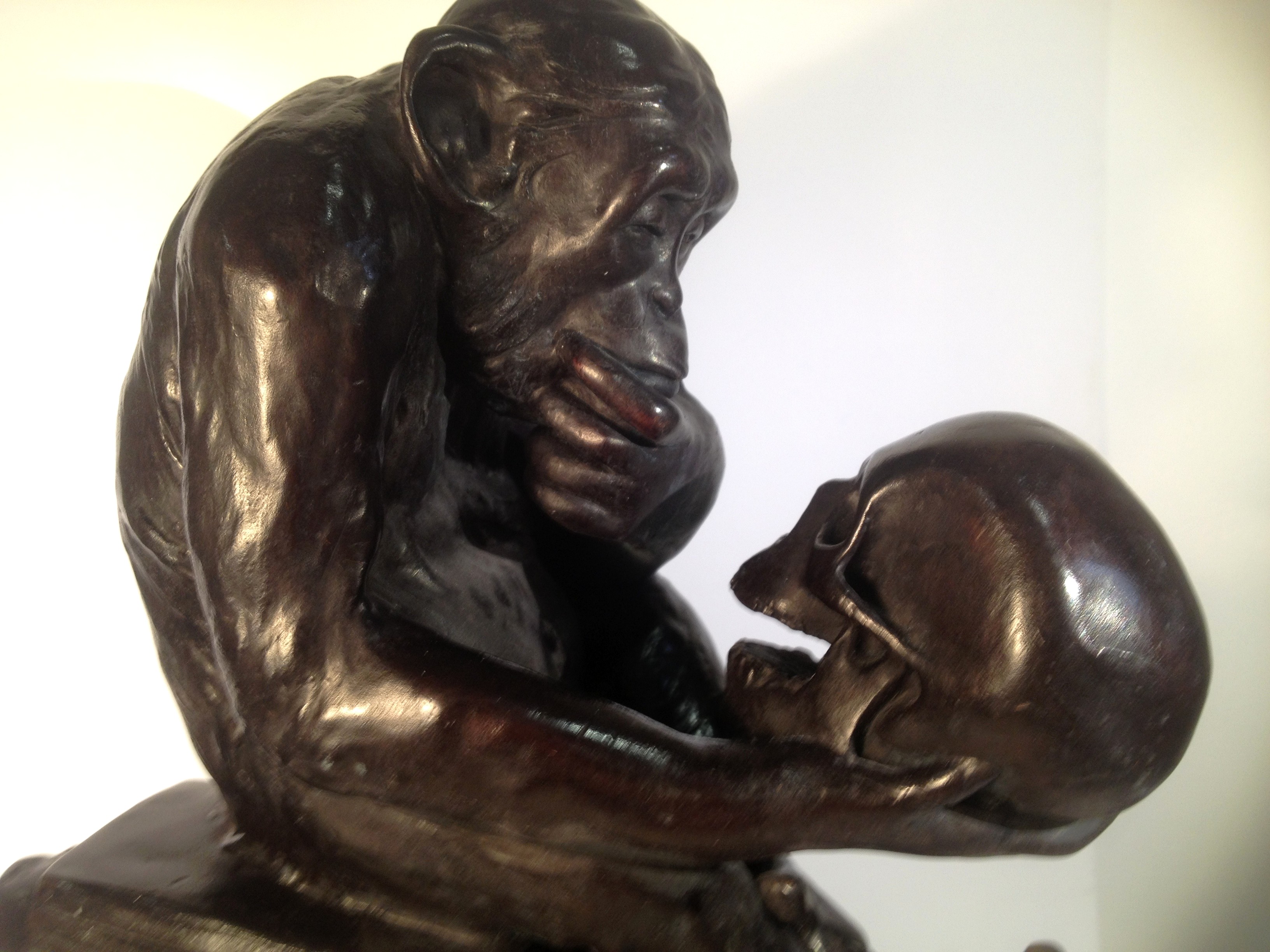
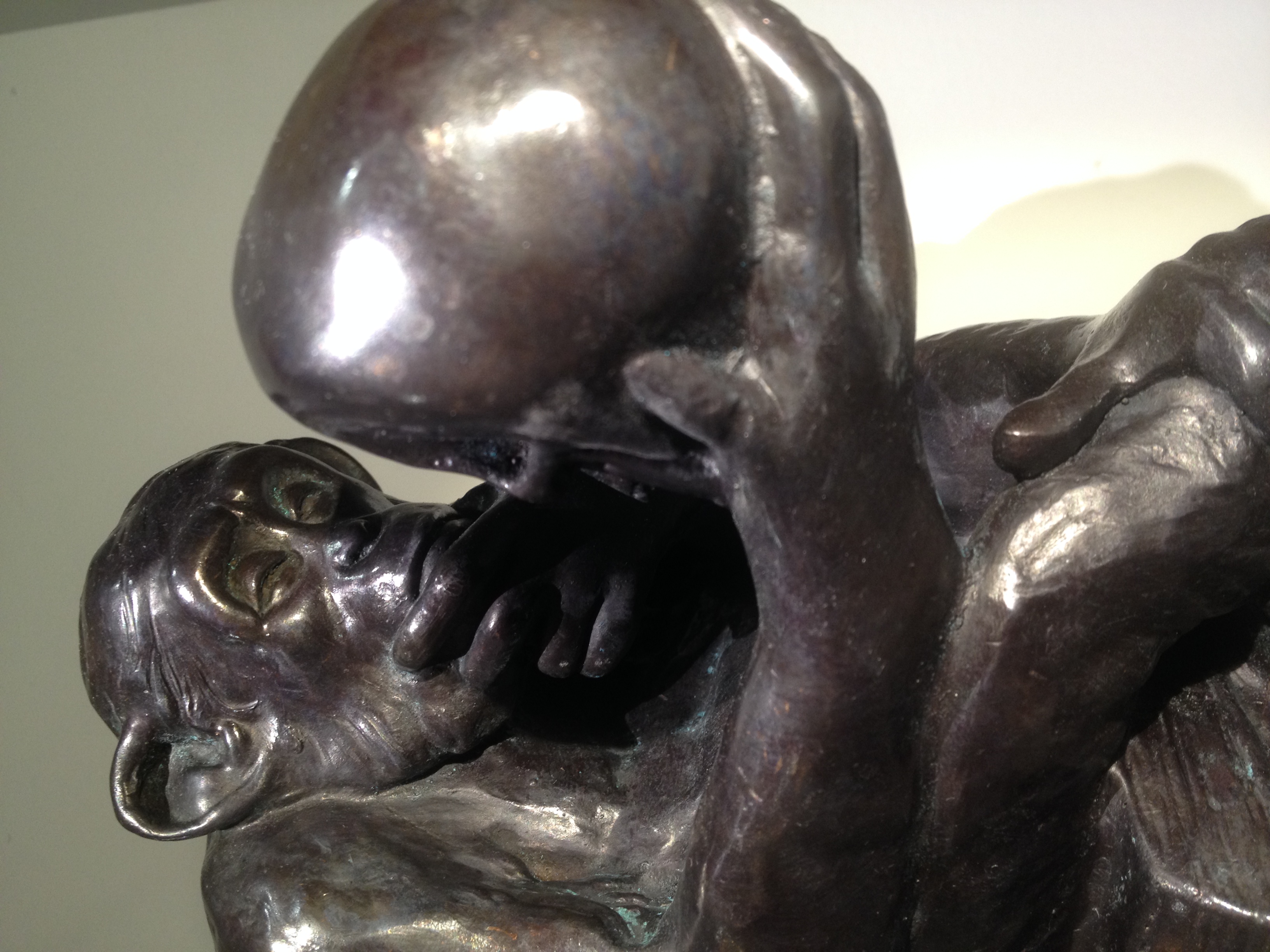
The chimpanzee's pose is immediately recognisable. One hand supports its chin, the head inclines towards the skull, and the whole body seems gathered into a moment of concentration. It is an unmistakably human gesture performed by an animal.
Yet Rheinhold has not simply dressed the chimpanzee as a person. Its powerful limbs, rounded back, grasping feet and expressive face remain emphatically those of an ape. The tension between the animal's anatomy and its apparently reflective state is central to the sculpture's fascination.
Is it puzzled, mournful, sceptical, amused? The modelling leaves room for all these impressions without settling upon any one of them.
The skull changes everything
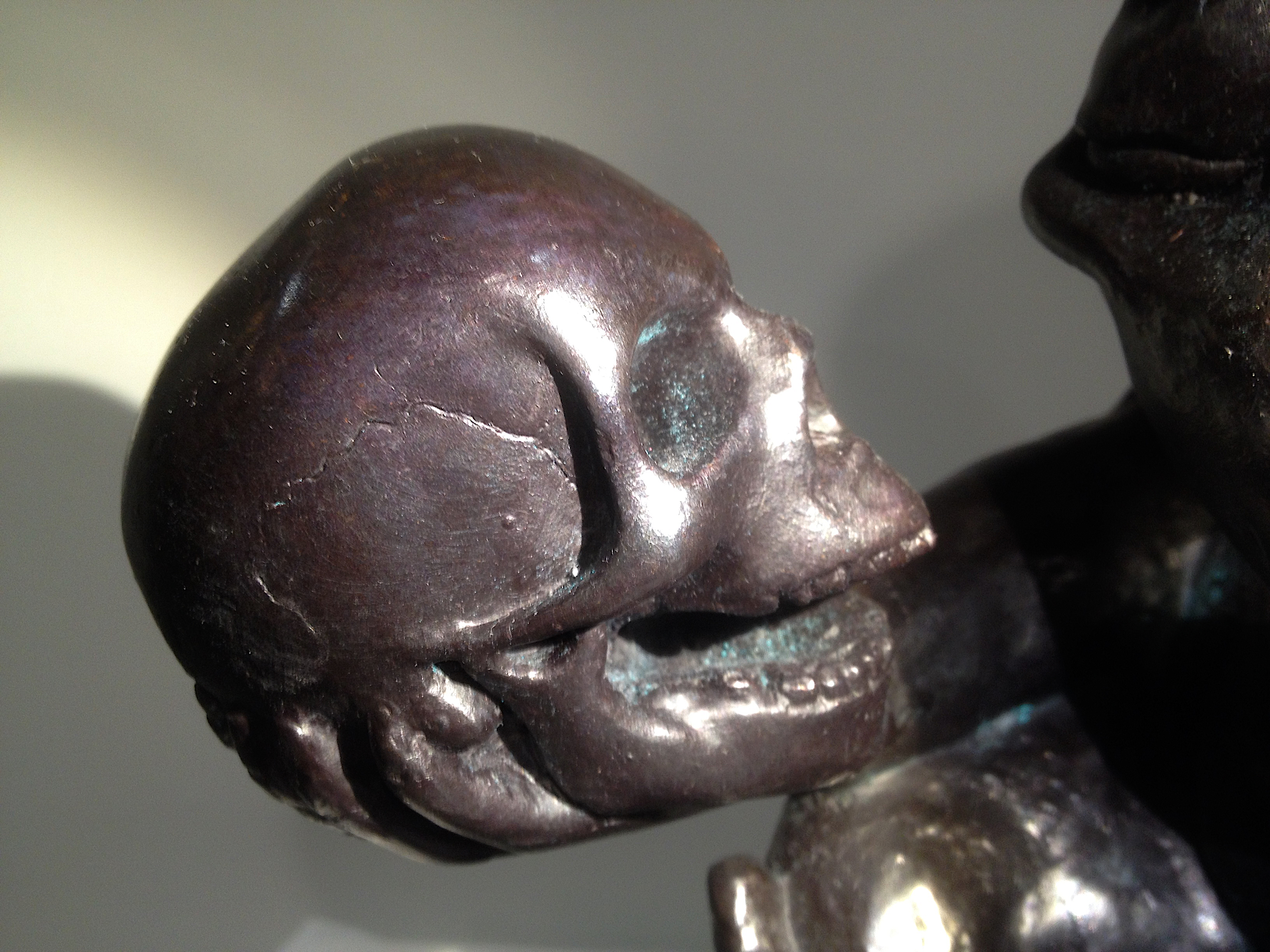
The object held so carefully by the chimpanzee is a human skull. It is small enough to be handled and examined, yet unmistakably recognisable. Its empty eye sockets face the living animal, turning their encounter into a curious exchange of gazes.
A skull has long served in art as a reminder of mortality. Here, however, it is not a human being contemplating death. The human remains have become the object of another creature’s attention.
Rheinhold gives the skull weight and presence without allowing it to dominate the composition. The chimpanzee’s response to it remains the greater mystery.
A throne made of books
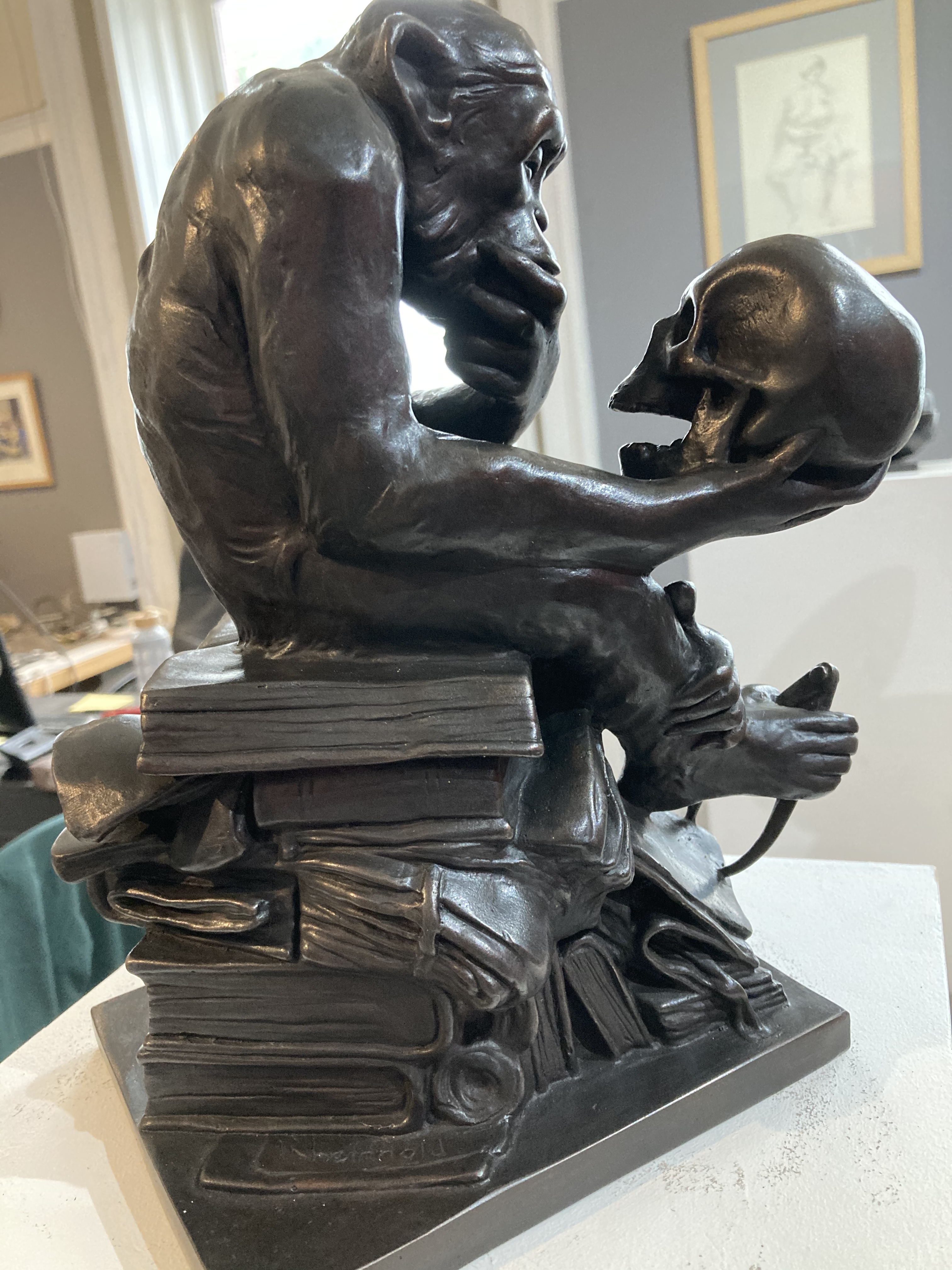
The chimpanzee is not perched on a rock, a tree stump or any natural support. It sits upon a pile of books and papers, their uneven arrangement forming a precarious pedestal.
The books are not treated as a neat architectural base. Their spines, covers and pages project at different angles. They have the irregularity of objects accumulated, handled and studied.
Rheinhold has made the products of human learning literally support the animal. The idea is simple enough to grasp at a glance, but the physical arrangement rewards much closer inspection.
A name among the books
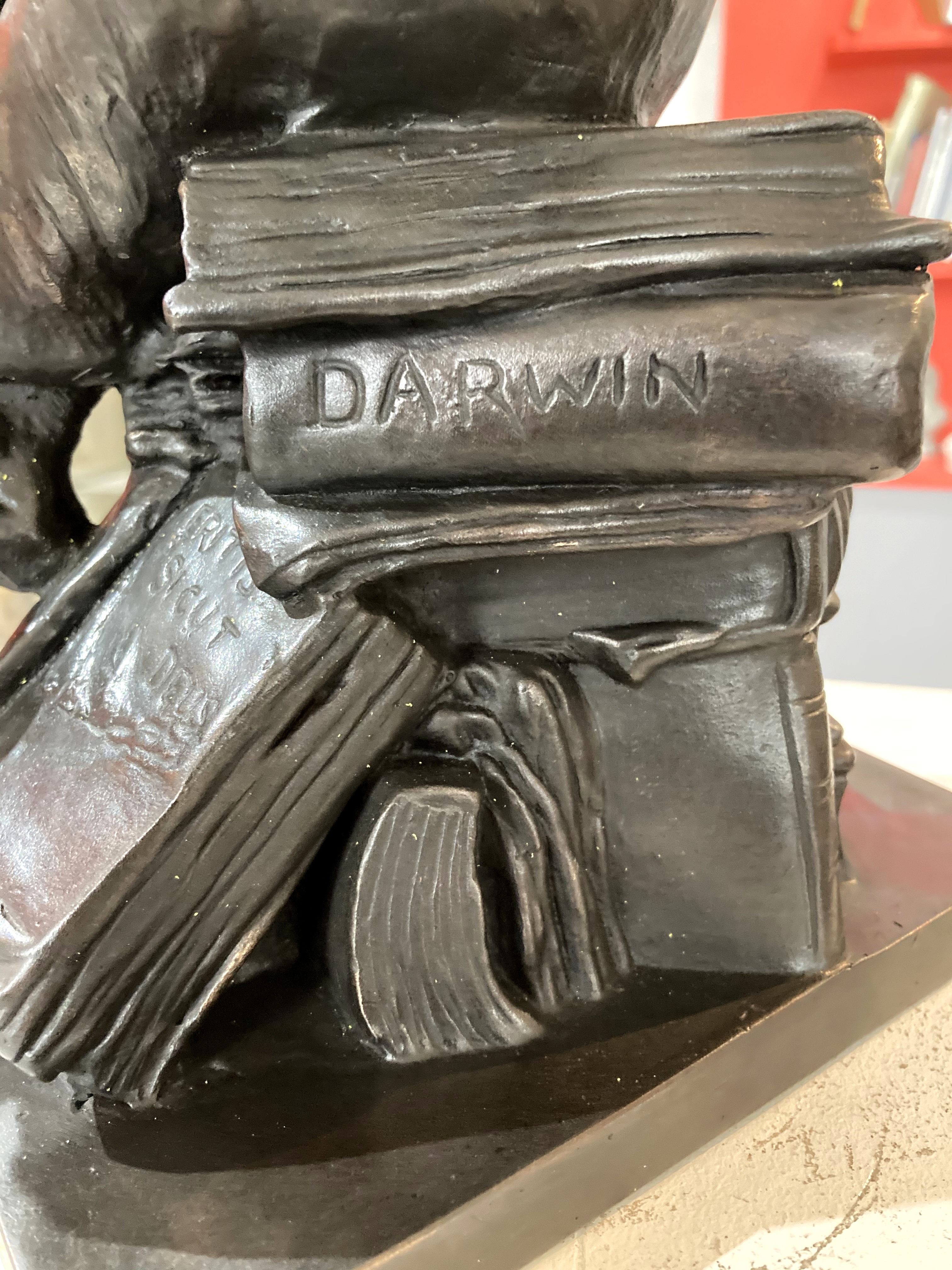
One of the volumes carries a name that immediately changes the way we look at the scene: DARWIN.
It is not a discreet inscription hidden on the sculpture’s underside. It belongs to the visible architecture of the composition, inviting the viewer to connect the chimpanzee with the scientific reconsideration of humanity’s place in nature.
The name is unmistakable. Exactly how Rheinhold intended every element of the composition to be understood is another matter.
A sentence left unfinished
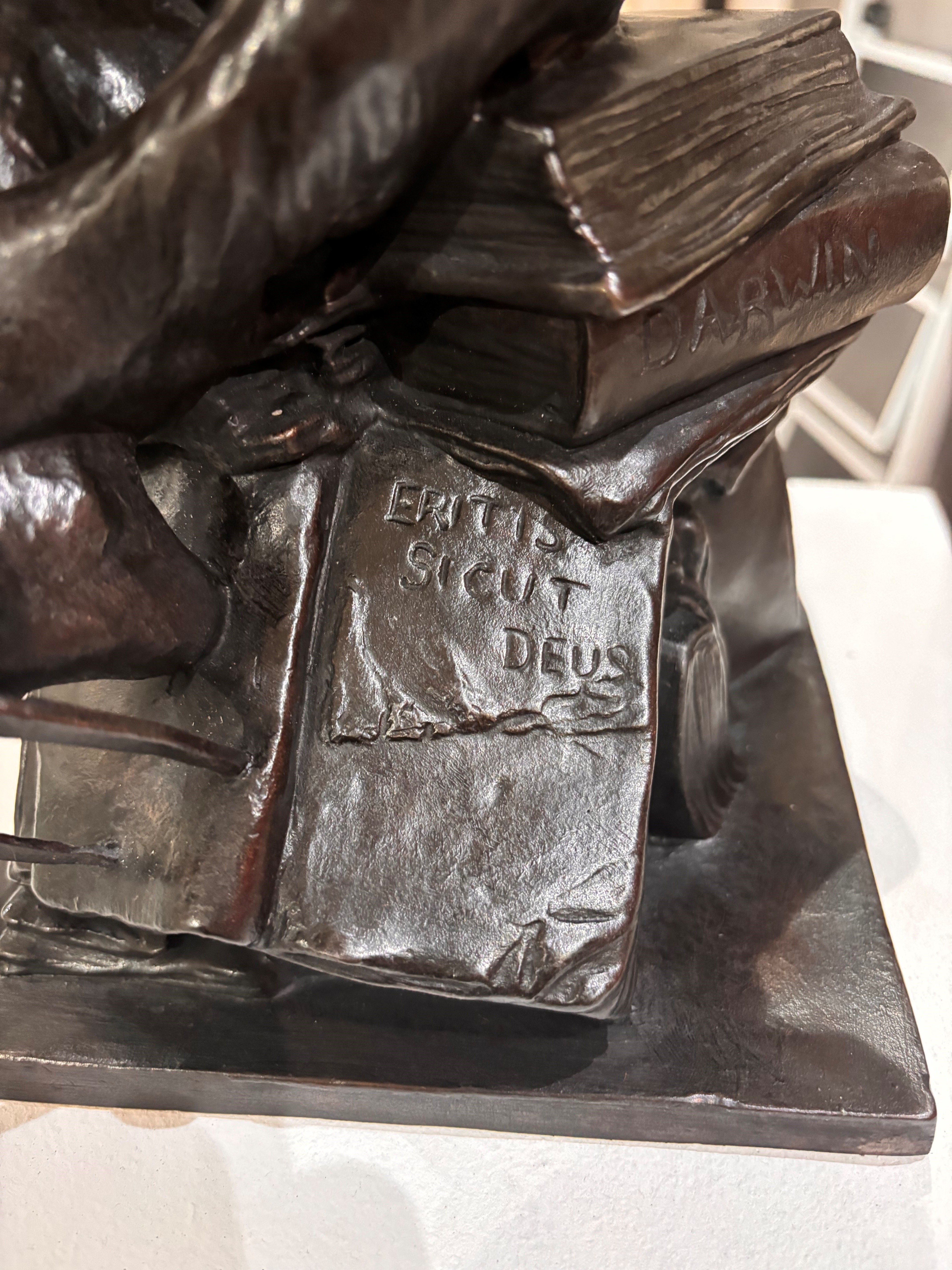
At the chimpanzee’s feet lies an open volume bearing the words ERITIS SICUT DEUS, “You shall be as God”, from Genesis 3:5.
The visible words are only part of the biblical sentence. Its continuation, SCIENTES BONUM ET MALUM (‘knowing good and evil’), is missing from the torn page. Rheinhold has preserved the promise of godlike knowledge while physically removing the words that complete it.
Whether one reads this as an irony, a warning or an invitation to further thought, it is a detail easily missed when viewing the sculpture from a distance.
The instrument at its feet
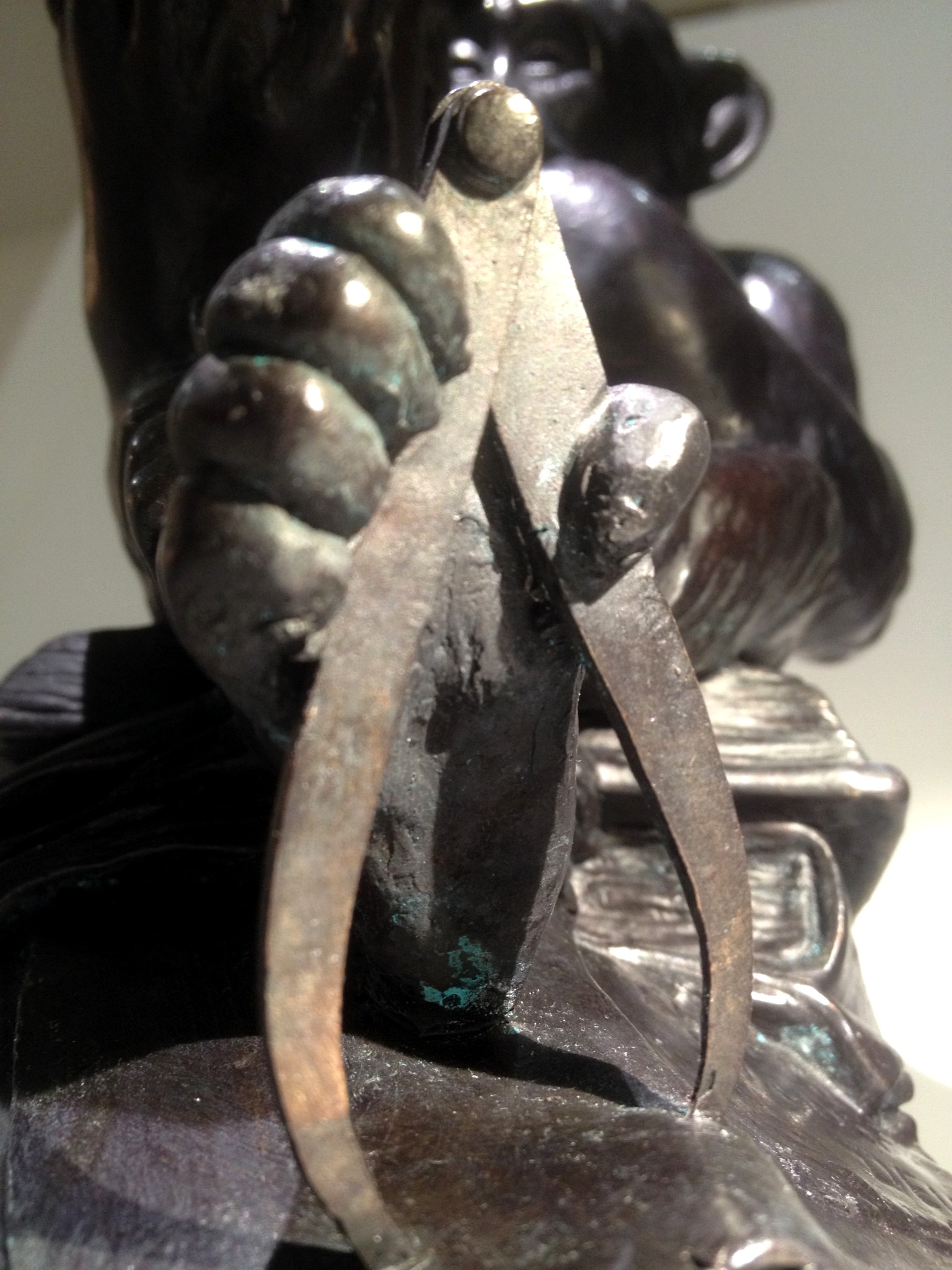
Among the books lies a pair of callipers, held by the chimpanzee’s foot. Their presence introduces something quite different from the skull or the biblical text: a practical instrument for comparing dimensions.
The callipers are an unexpectedly precise object in an otherwise enigmatic scene. They suggest observation, measurement and the attempt to understand the world through physical evidence.
The contrast is particularly striking. One part of the chimpanzee’s body adopts the familiar gesture of contemplation, while another holds an instrument associated with investigation.
The whole is stranger than its parts
Considered separately, the sculpture’s objects are familiar enough: a skull, a book, a biblical phrase, an instrument of measurement. Even the contemplative pose has a long history in art.
Rheinhold’s achievement lies in bringing them together around a chimpanzee. The objects do not simply illustrate a single message. They interact, producing associations that change as the viewer notices another detail or approaches the sculpture from another direction.
The result is a work that can be serious and playful, learned and unsettling, all at once. Its apparent simplicity is deceptive.
LOOK AGAIN
There is always something else to notice.
A turn of the head, a change of viewpoint, a word half concealed beneath the chimpanzee’s foot. Affe mit Schädel rewards the patient observer, and few encounters with it end quite where they began.