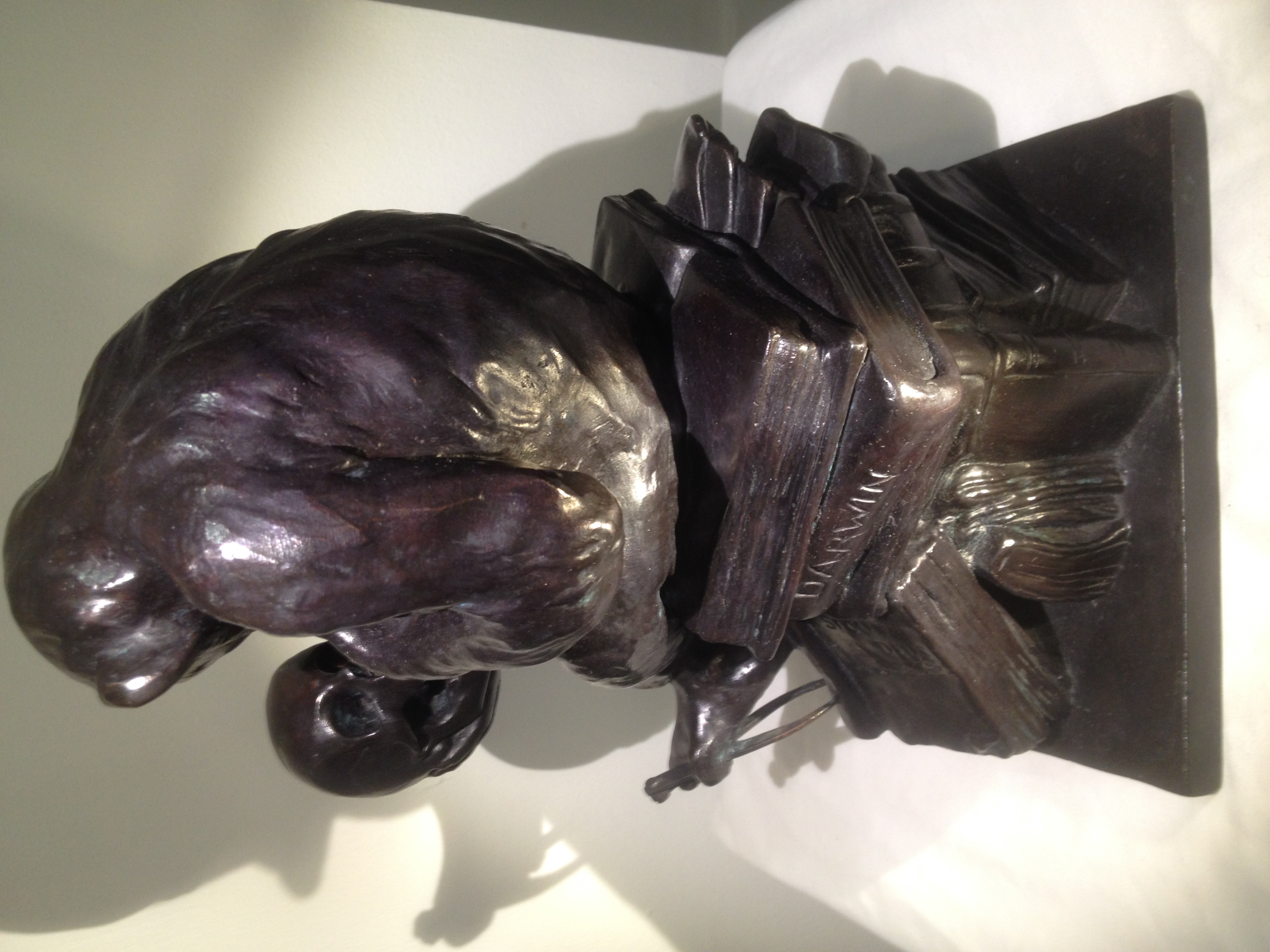
DARWIN MONKEY

AFFE MIT SCHÄDEL · HUGO RHEINHOLD

Making the Bronze

From wax and fire to a finished work of bronze. An intricate process in which every stage demands a different skill.
POWDERHALL BRONZE · EDINBURGH

From a fragile wax to a permanent bronze.

Bronze sculpture has an apparent permanence that conceals the extraordinary complexity of its manufacture. A finished casting seems solid and inevitable, yet it begins with a fragile wax form that must be carefully prepared, enclosed in a refractory mould and then completely removed. Only when the wax has disappeared can molten bronze take its place.

This is the principle of lost-wax casting, a method with a history extending back thousands of years. Its essential idea has changed remarkably little, although modern materials, equipment and techniques allow far greater control over the process.

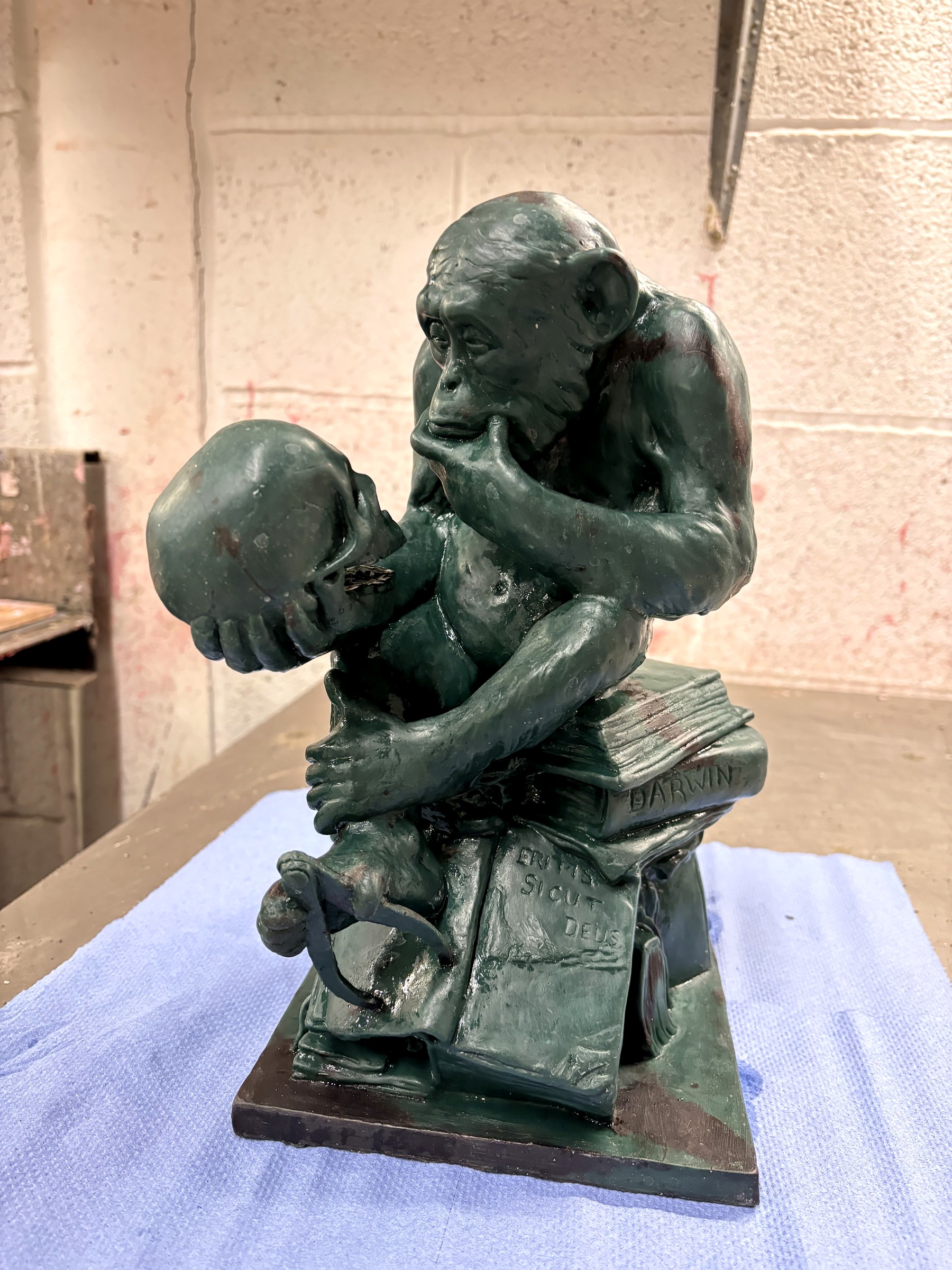
At Powderhall Bronze in Edinburgh, the casting of Affe mit Schädel brings together mould-making, wax work, metal casting, welding, chasing and patination. Each stage has its own difficulties. Some demand technical calculation, others an experienced eye and a sensitive hand. The finished sculpture depends on all of them.

The photographs illustrate the traditional lost-wax process as practised at Powderhall Bronze, including work on Affe mit Schädel and other fine-art commissions.
A working fine-art foundry

A fine-art foundry is not simply a place where molten metal is poured into moulds. It is a workshop in which an artist's modelling is translated into a different material without losing the qualities that make it sculpture.

At Powderhall Bronze, that work involves a succession of specialised crafts. Mould-makers must understand how to capture a complicated surface. Wax workers prepare forms that will survive handling and investment. Foundry workers devise the channels through which molten metal will flow. Metalworkers assemble and refine the casting, while patination specialists develop its final colour and character.

The work is collaborative, but it is also intensely individual. A successful casting depends upon the accumulated experience of the people who handle it. The process must preserve not only the broad form of Affe mit Schädel, but the expression of the ape, the anatomy of the skull, the books, the callipers and the smallest details of Rheinhold's modelling.

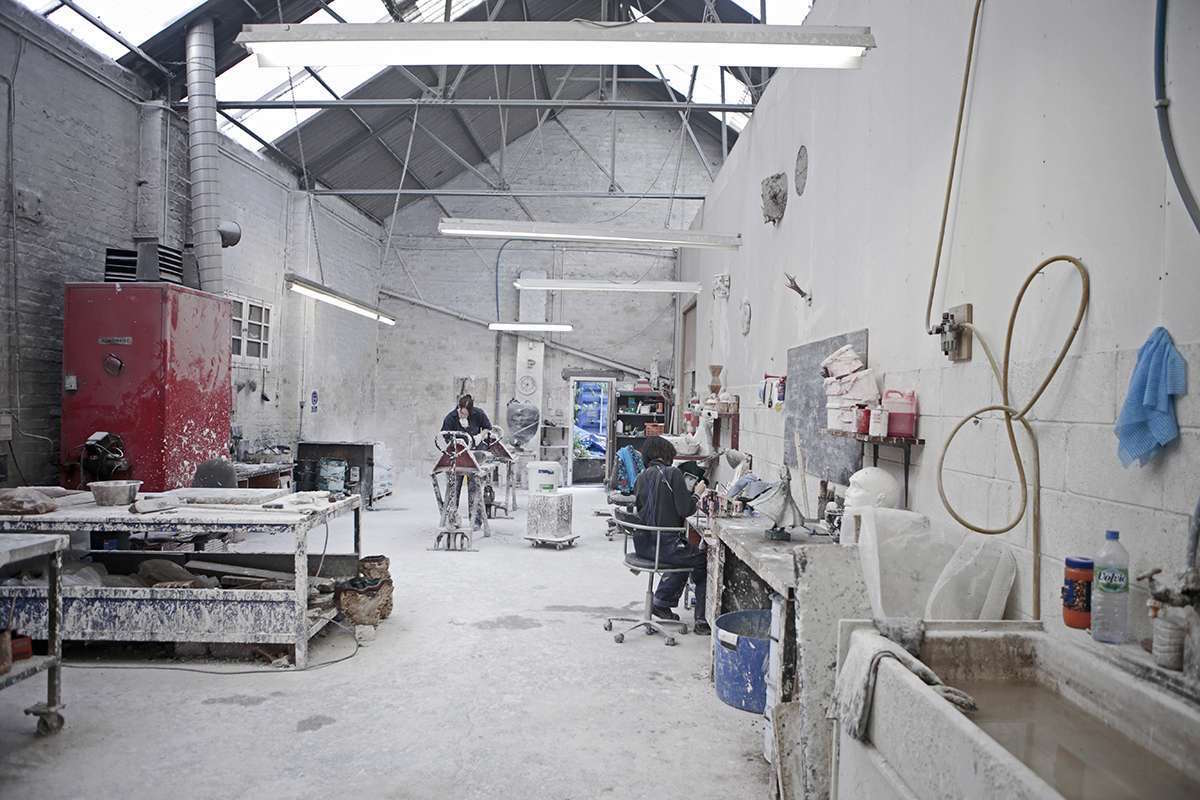
Interior of the Powderhall Bronze workshop, with workbenches and sculptures in progress
The Powderhall workshop in Edinburgh.

I. The form in wax

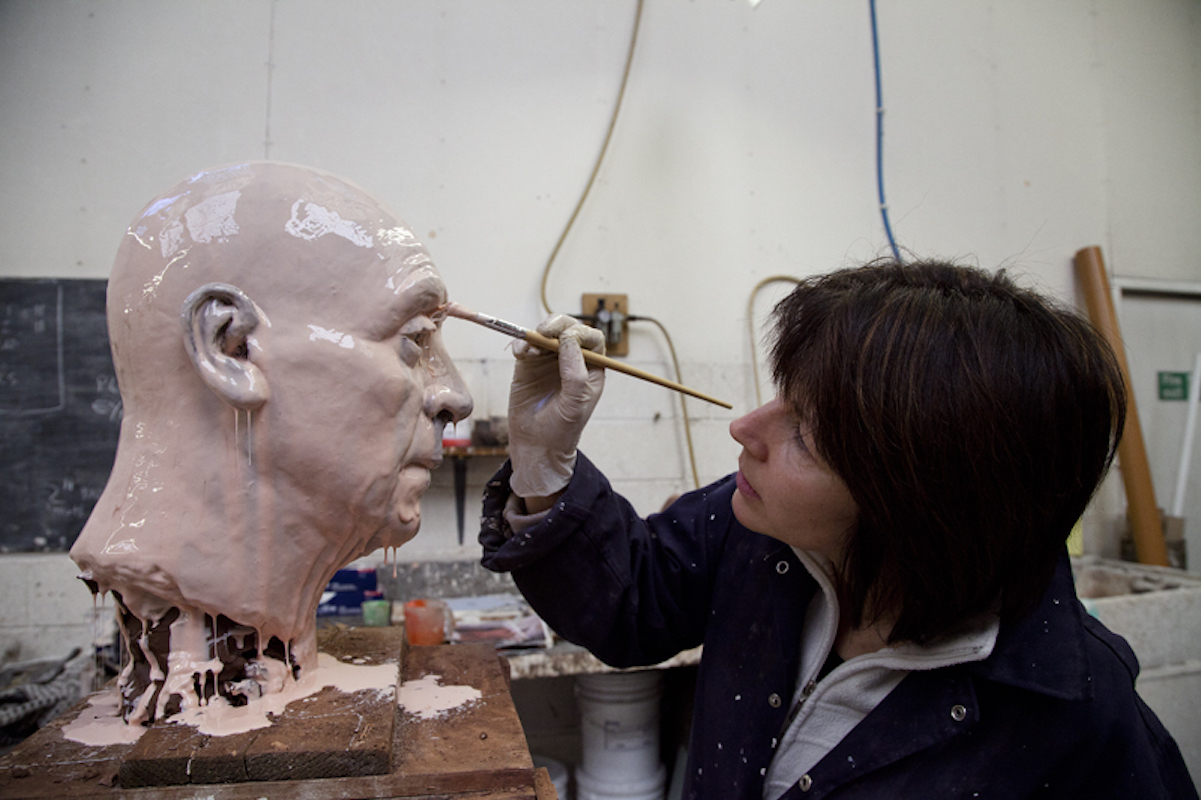
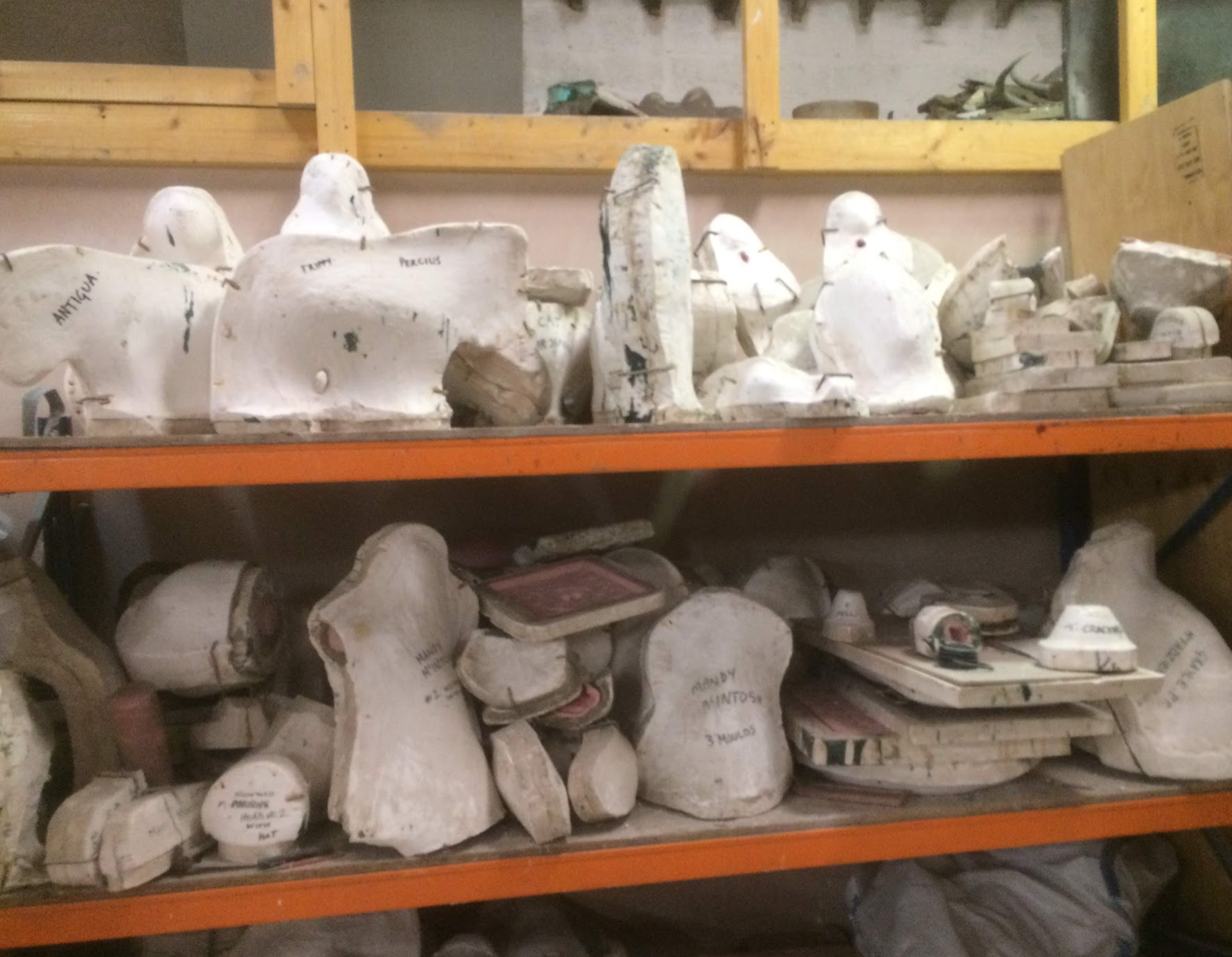
The first challenge is to reproduce the sculptural form accurately in wax. A flexible mould captures the surface of the model, including fine contours and undercut details that would be difficult or impossible to release from a rigid mould.

Wax is introduced into the mould to produce a positive copy of the sculpture. Depending upon the size and complexity of the work, the casting may be divided into several sections. These must be examined, cleaned and prepared before the next stage.

Wax is an unforgiving material in its own way. It can bend, crack, soften under warmth or suffer accidental damage during handling. Small imperfections must be corrected before investment, because whatever is present on the wax surface may be reproduced in metal.

II. Preparing for the pour

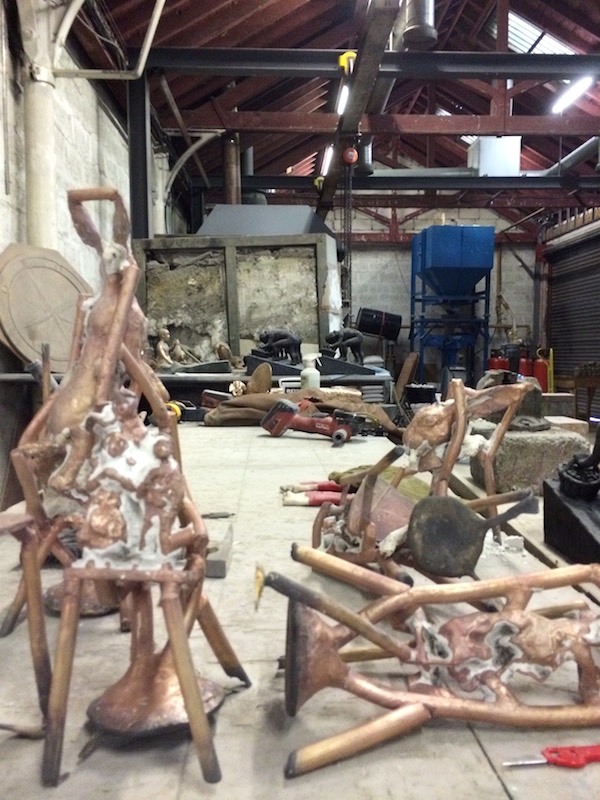
A wax sculpture cannot simply be enclosed in a mould and filled with bronze. Molten metal must reach every part of the form, while air and gases must have routes to escape. The metal will also contract as it cools, creating another difficulty for the foundry worker.

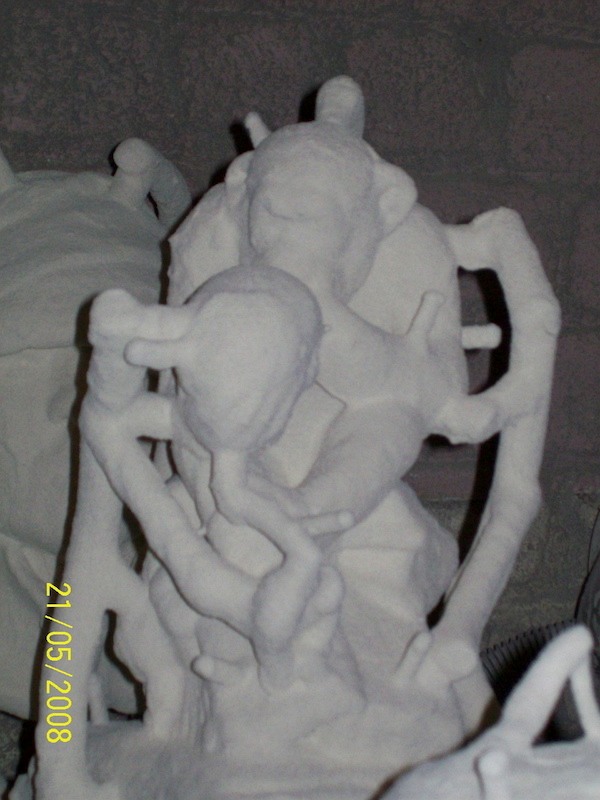
To control these problems, a system of wax rods is attached to the sculpture. These become the sprues, runners, gates and vents through which metal and gases will move during casting.

Their arrangement is one of the most important technical decisions in the entire process. A poorly designed system can result in incomplete filling, trapped gas, unwanted cavities or other casting defects. The foundry worker must consider the sculpture's geometry, the thickness of its sections and the behaviour of the molten bronze.

III. Bronze from the furnace

Bronze is an alloy based principally on copper, commonly with tin and sometimes other elements according to the alloy used. It must be heated until sufficiently fluid to fill the prepared mould.

Pouring is a brief but demanding operation. The metal must be hot enough to flow through the channels and reach the extremities of the sculpture, but the temperature and handling must remain controlled. The foundry team works with considerable heat, heavy equipment and limited time.

As the metal cools, it solidifies inside the mould. The casting cannot be judged fully until the investment is removed and the newly formed bronze is exposed.

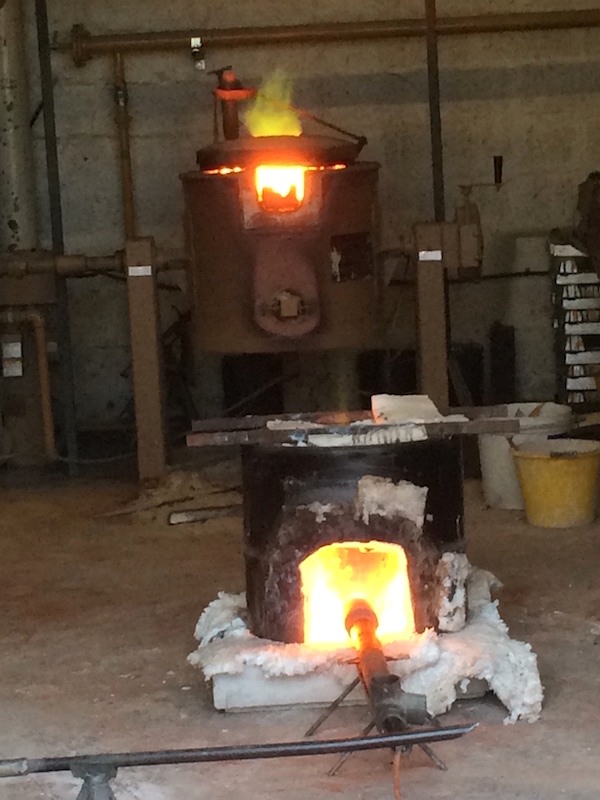
Hot furnace during bronze casting at Powderhall Bronze
6 · CastingThe furnace brings bronze to casting temperature. The molten alloy is transferred to the prepared mould, where it flows through the gating system and solidifies in the spaces previously occupied by wax.
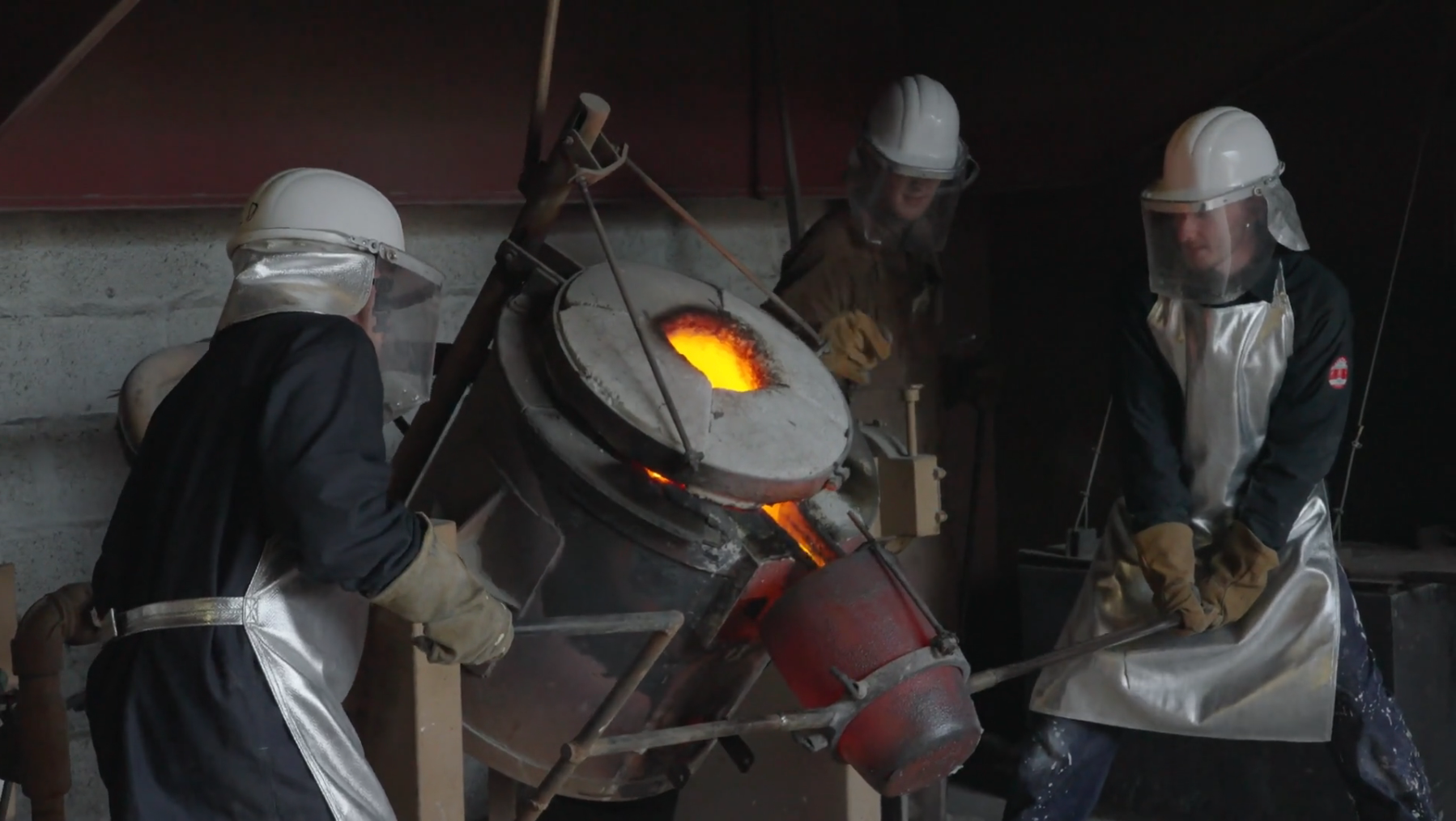
Three foundry workers wearing protective equipment tilt a crucible of glowing molten bronze during a pour
Pouring the bronze. Foundry workers in protective clothing control the crucible as the molten metal is poured.

7 · Freshly cleaned raw bronze

After the metal has cooled sufficiently, the investment is broken away. The casting emerges with its feeding channels still attached and may carry remnants of the mould, surface scale and other traces of the process.

Removing the investment reveals the first metal version of the sculpture. The foundry workers can now inspect the casting, identify any defects and decide what corrective work may be needed. The gating system is cut away, and the surface is progressively cleaned.

Freshly exposed bronze often has a warm golden colour, quite unlike the darker patinated surface familiar from finished sculpture. This stage offers a rare opportunity to see the metal before its final appearance has been developed.

A raw casting can be technically successful without being visually finished. Small surface irregularities, joins and areas requiring additional attention must still be resolved. The transformation from casting to sculpture continues at the workbench.

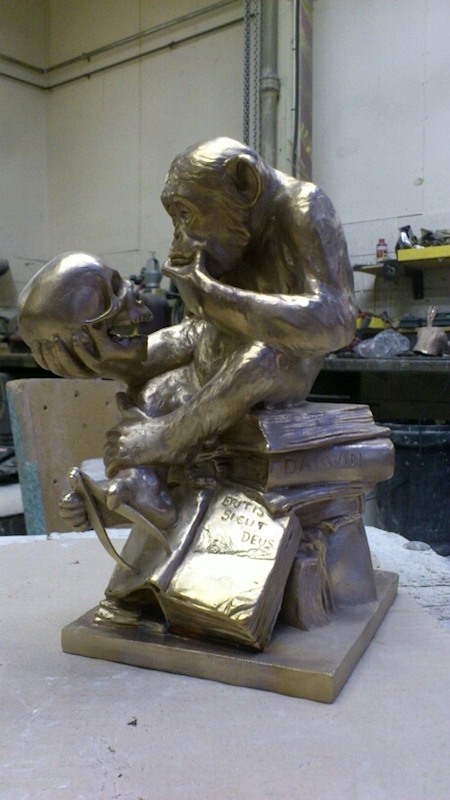
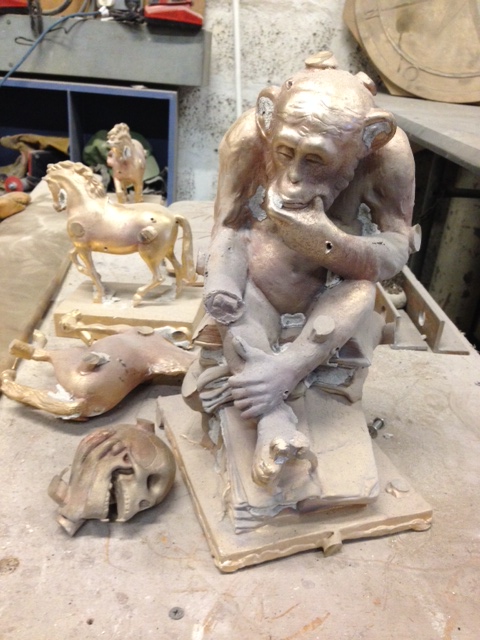
Freshly cleaned golden bronze casting of Affe mit Schädel
The freshly cleaned Affe mit Schädel casting, before final chasing and patination.
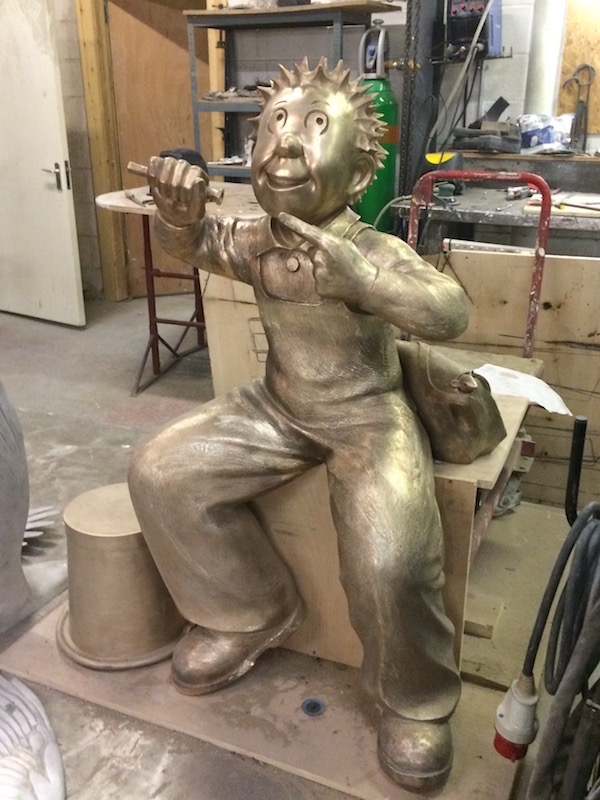
Golden unfinished bronze figure of a seated character in the workshop
An unfinished bronze figure in the workshop, its bright metal surface visible before final treatment.
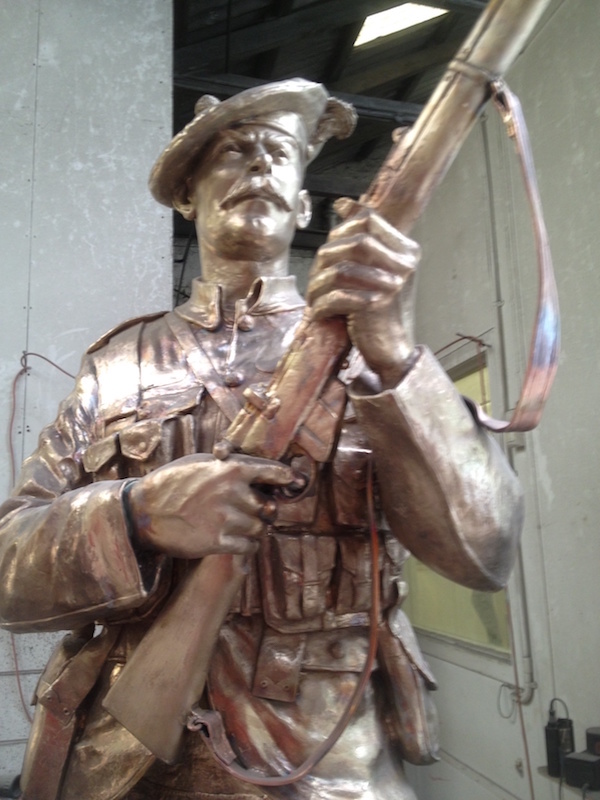
Bright bronze statue of a standing soldier in the workshop
Another bronze commission in its bright-metal condition, showing the surfaces that require assessment and finishing.

IV. The hand of the craftsperson

The casting process has now produced a bronze object, but it has not yet produced a finished work of art. The next operations are among the most labour-intensive and demanding.

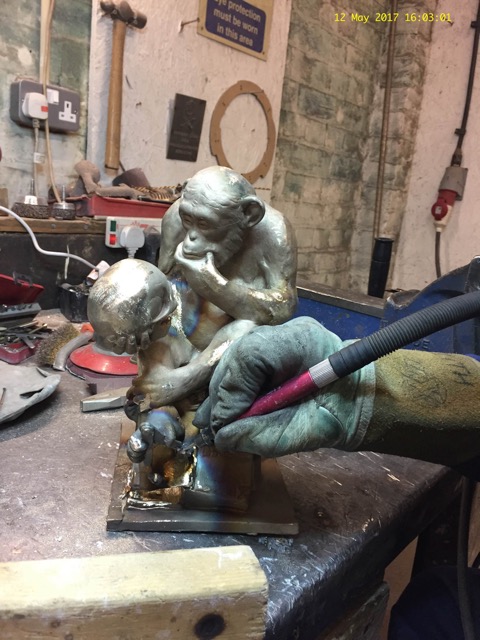
Where a sculpture has been cast in separate sections, those pieces must be accurately aligned and joined. Welding introduces its own challenges: the joint must be structurally sound, but the surrounding surface must also be restored so that the assembly does not interrupt the modelling.

The removal of sprues and gates leaves areas that require further attention. Metal may need to be ground away, filed, worked with chasing tools or carefully retextured. The objective is not to make every surface mechanically smooth. It is to preserve the intended sculptural character, including deliberate modelling marks and subtle variations in texture.

For Affe mit Schädel, this work ranges from broad anatomical surfaces to fine details of the skull, books and measuring instruments. Excessive finishing could erase important modelling, while insufficient finishing could leave distracting traces of manufacture. The craftsperson must know when to intervene and when to stop.

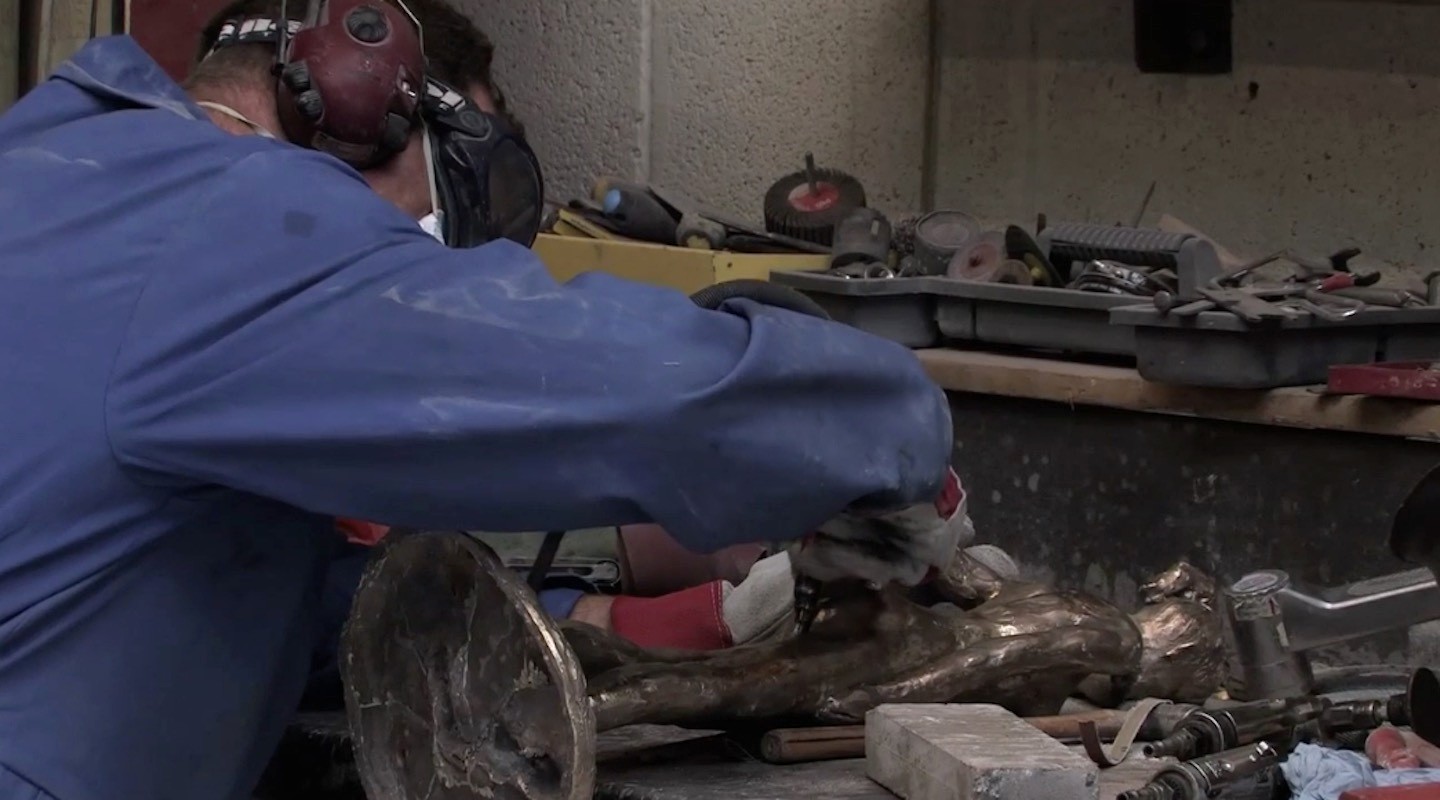
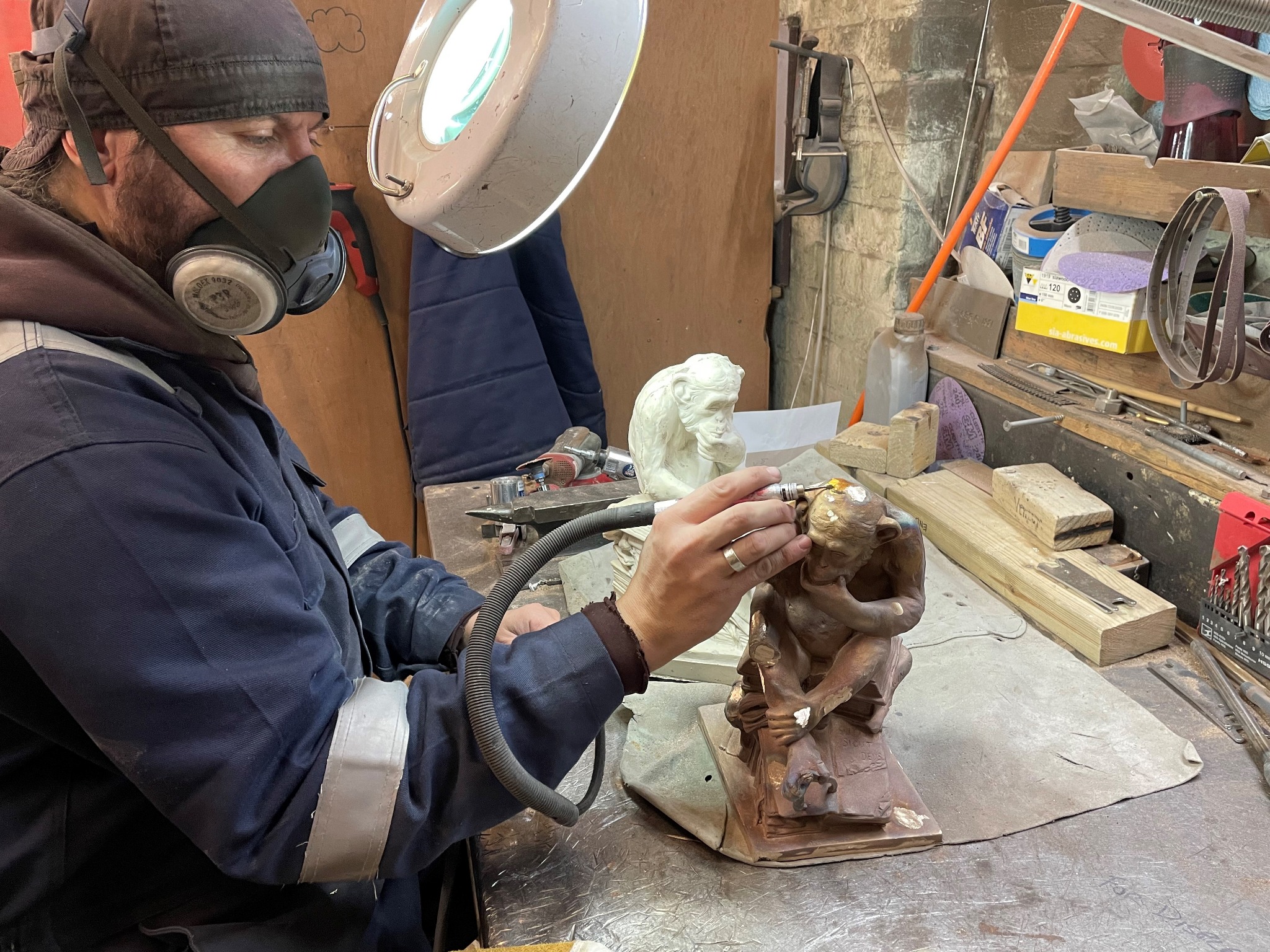
Craftsperson chasing and finishing bronze
8 · Chasing and assemblyMetalworkers remove the remnants of casting channels, assemble separately cast elements and refine the bronze surface. Welding, grinding, filing and chasing are used to make the finished form coherent while preserving the original modelling.
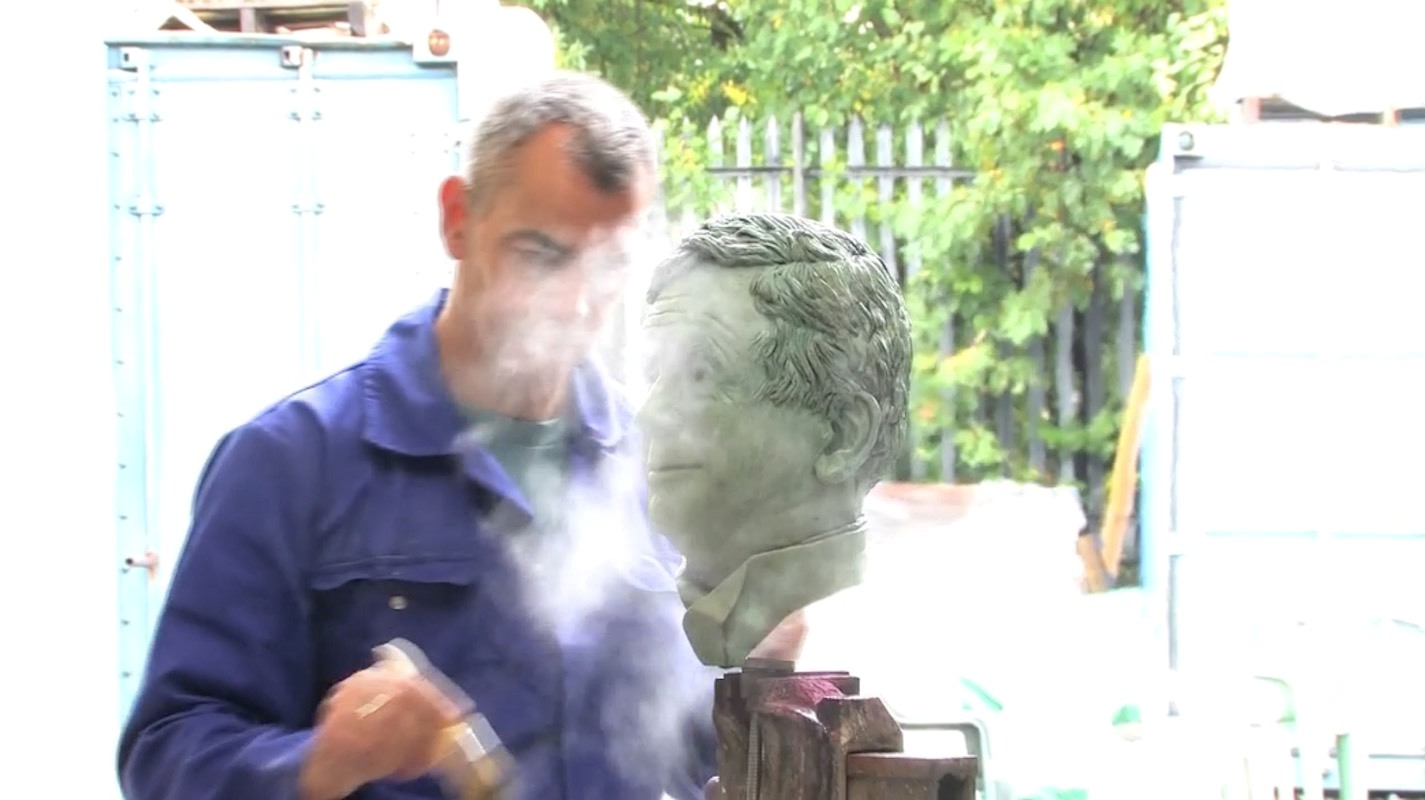
Craftsperson applying patina to bronze
9 · PatinationHeat and chemical treatments are used to develop the bronze's final colour and character. Patination requires careful control of the surface and an experienced judgement of the developing tones.

Patination: developing the surface

The final colour of a bronze sculpture is not necessarily the natural colour of freshly exposed metal. Patination uses controlled chemical reactions to develop a surface whose colour, tone and texture complement the form.

The bronze may be heated, and chemical solutions are applied in carefully judged stages. Different treatments and application methods can produce different effects, from warm browns to deep blacks and greens. The outcome depends upon the alloy, the preparation of the surface, the chemicals employed and the experience of the person applying them.

Patination also changes how the sculpture is perceived. Darker passages can emphasise recesses and modelling, while carefully controlled highlights can reveal the surfaces most likely to catch the light.

The aim is not to disguise the bronze but to bring the sculptural form into visual unity. A successful patina has depth and variation rather than the flat uniformity of an ordinary painted coating.

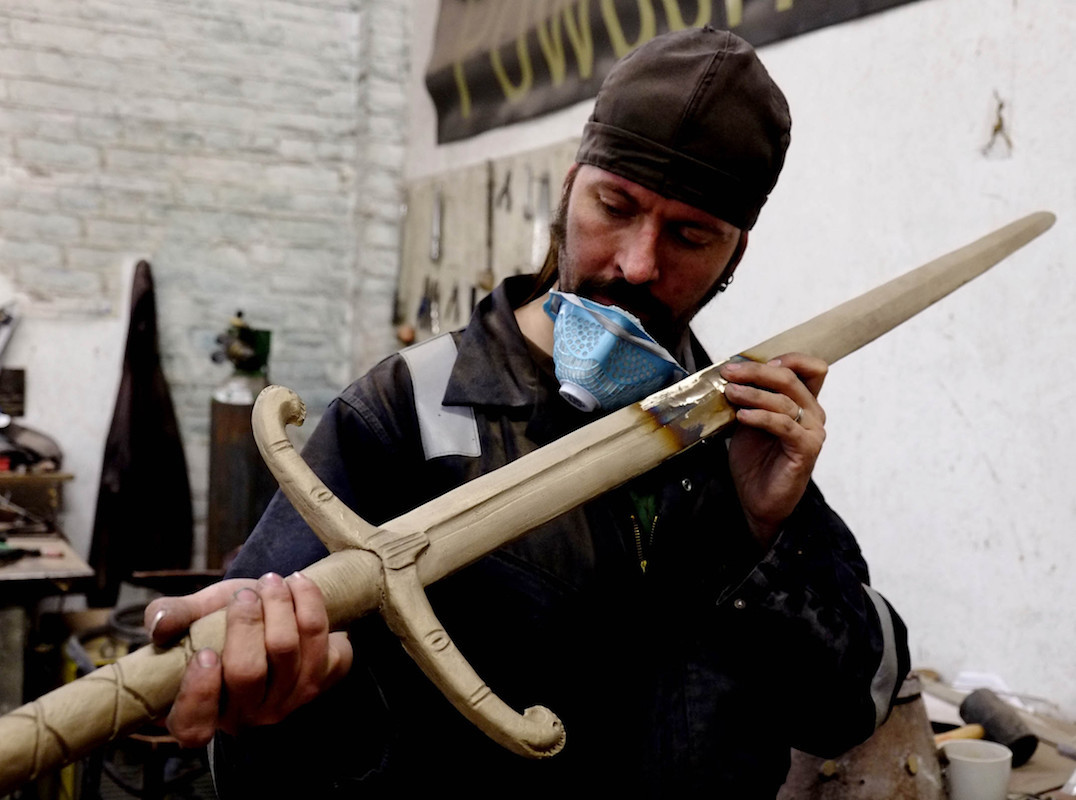
Craftsperson closely inspecting the surface of a long sculptural sword
A craftsperson inspects the surface of a sculptural sword at close range. Judgement about small details is central to finishing work.
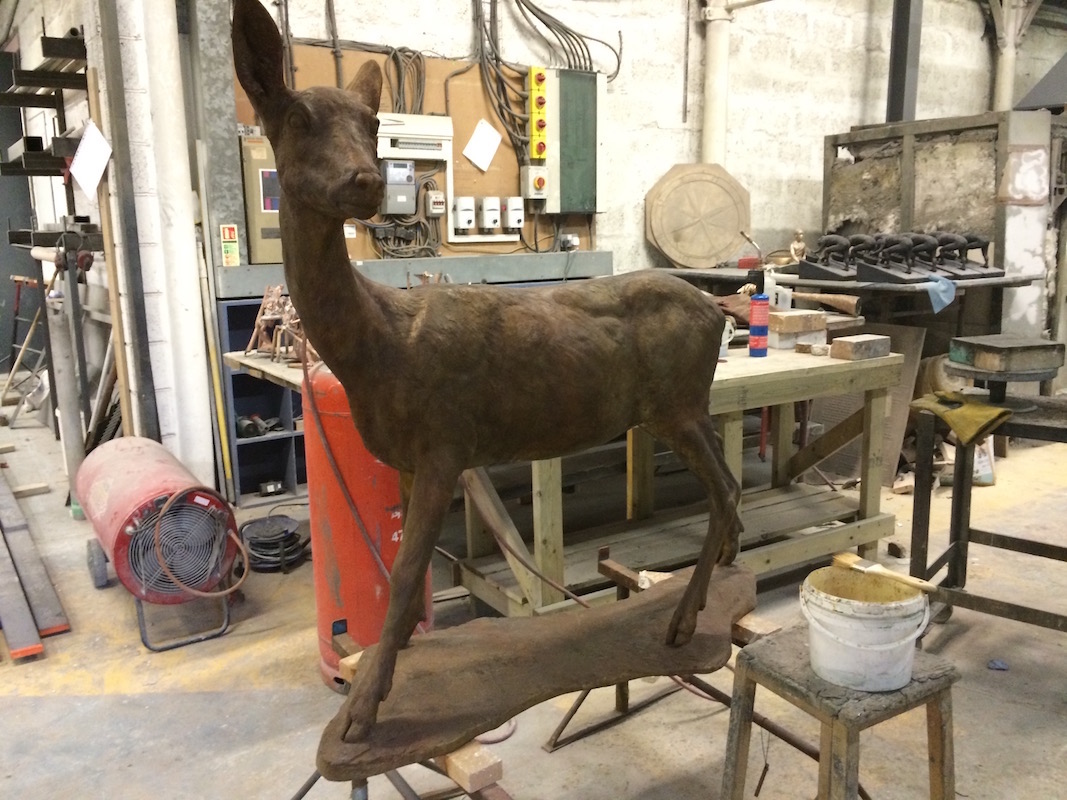
Deer sculpture standing amid tools and equipment in the foundry workshop
A deer sculpture in the workshop, illustrating the range of forms and surfaces handled during fine-art production.

The finished sculpture in the round

By the time the finished Affe mit Schädel leaves the foundry, the evidence of its manufacture has largely disappeared. The wax has been lost, the investment broken away, the feeding channels removed and the joins absorbed into the sculptural surface.

What remains is a bronze whose apparent unity conceals a succession of quite different crafts. Every curve, edge and detail has passed through several materials and processes before arriving at its final form.

This is what makes fine-art bronze casting more than mechanical reproduction. The foundry must translate a sculptural idea into permanent metal while retaining the qualities that gave the original its character.

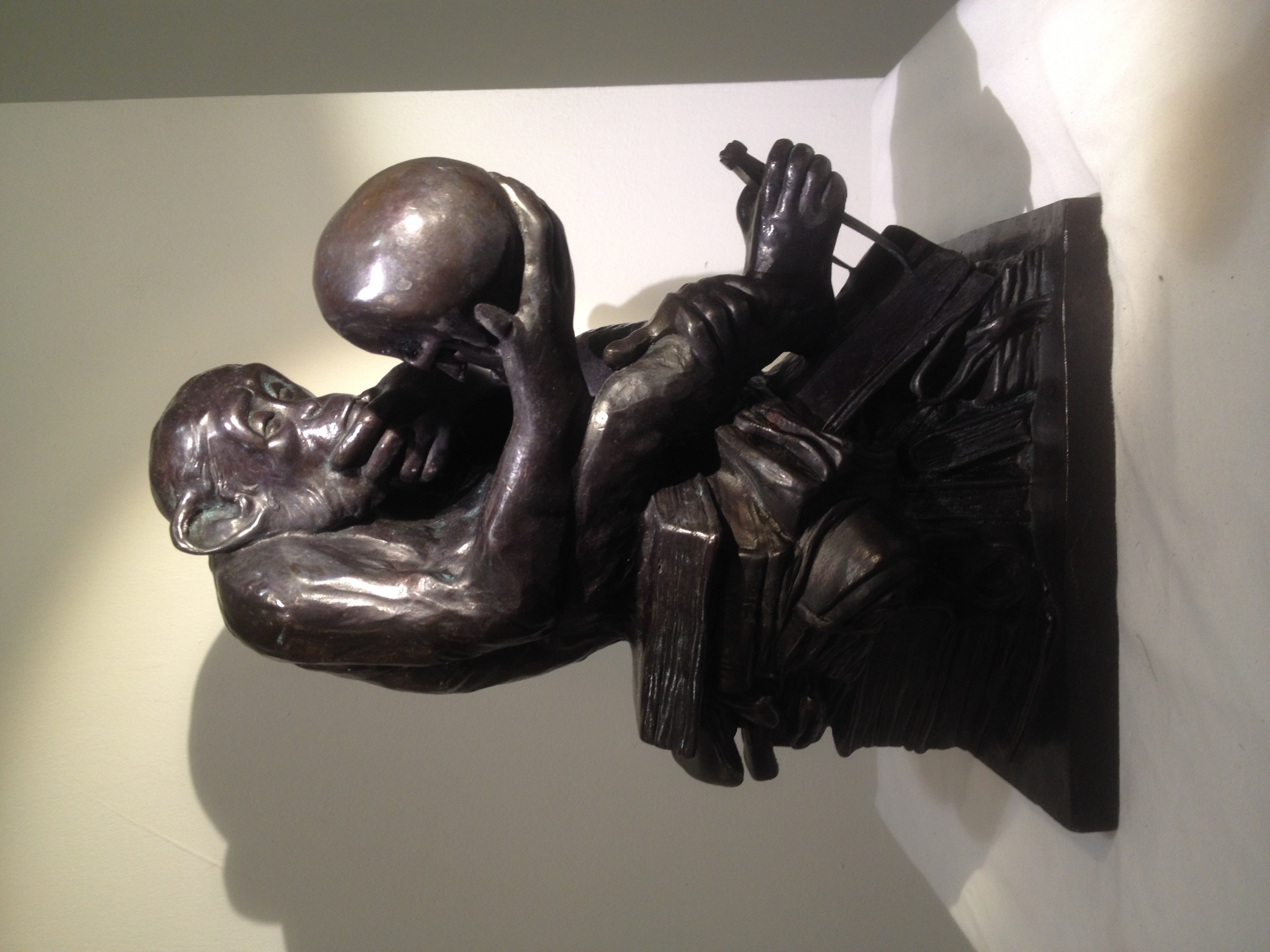
Later Edinburgh Affe mit Schädel complete side view
Side. The confrontation between ape and skull is clearest, with the callipers visible below.
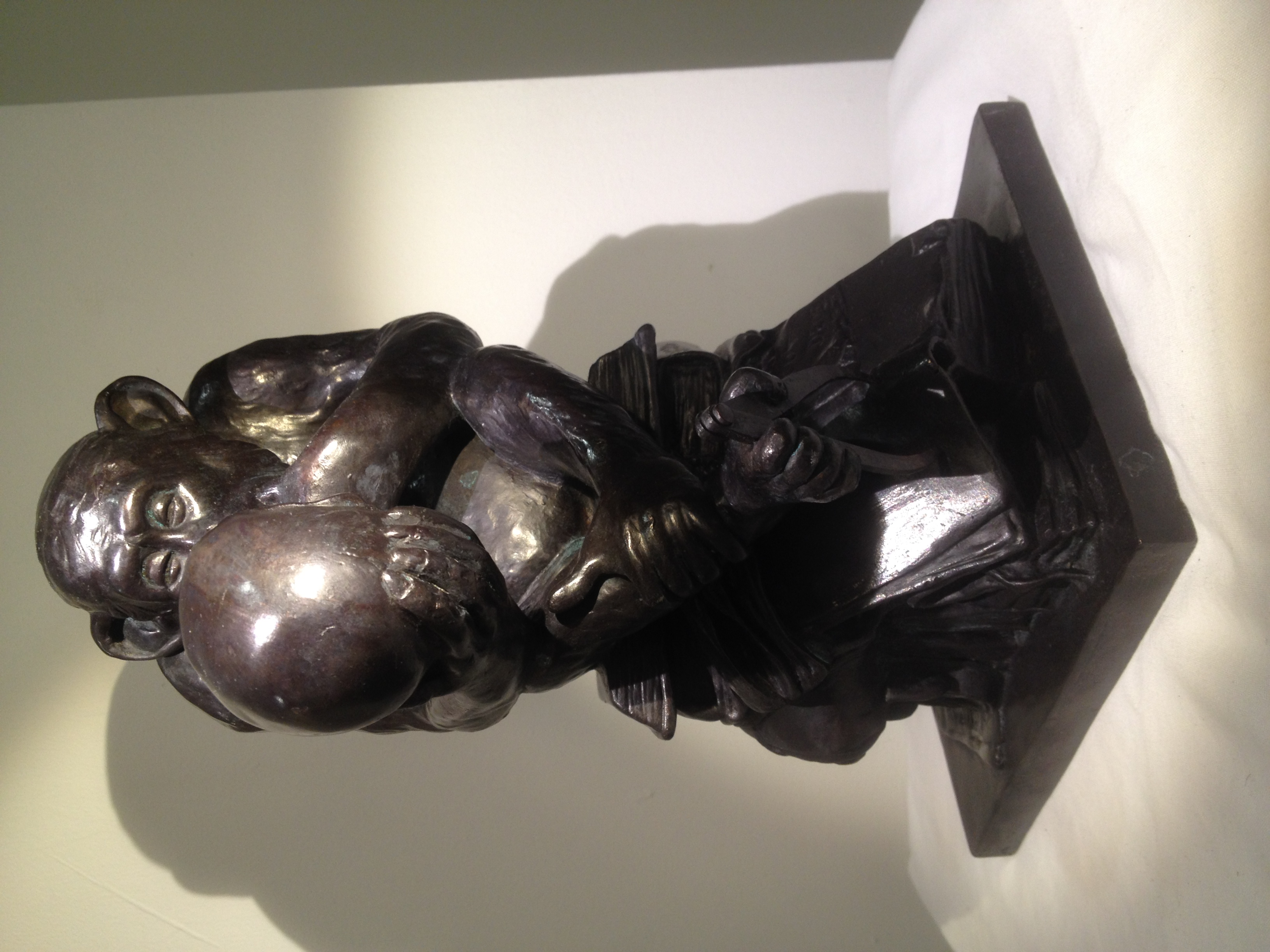
Later Edinburgh Affe mit Schädel front view
Front. The face, skull, books and measuring instruments resolve into the complete composition.
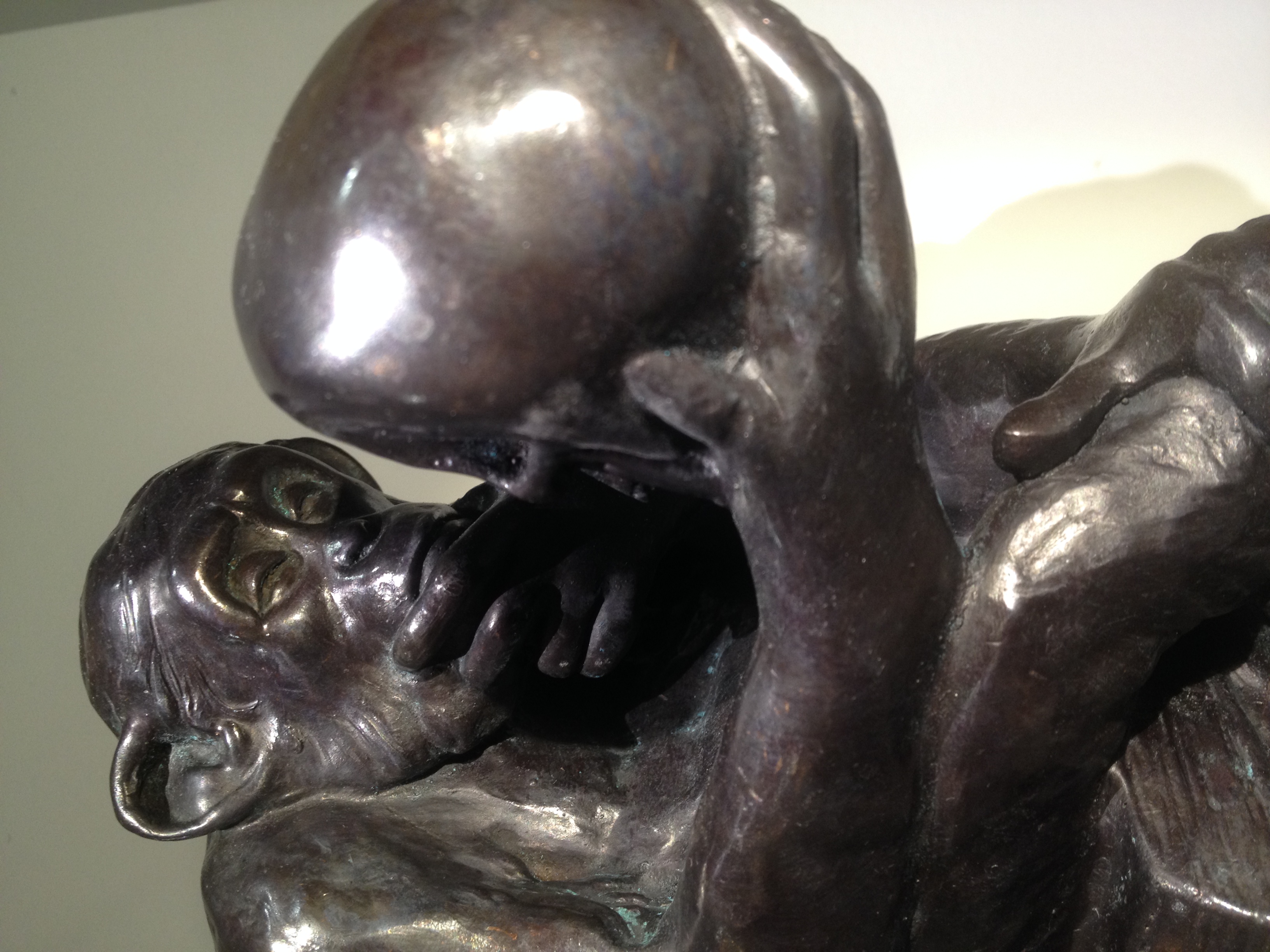
Later Edinburgh Affe mit Schädel front three-quarter detail
Front three-quarter (detail). A closer view of the ape’s expression and its encounter with the skull.
Later Edinburgh Affe mit Schädel rear three-quarter view
Rear three-quarter. The sculpture’s back and the structure of the book stack become more apparent.

Each Affe mit Schädel is made to commission at Powderhall Bronze in Edinburgh.