Original sources & translations · Original German and English
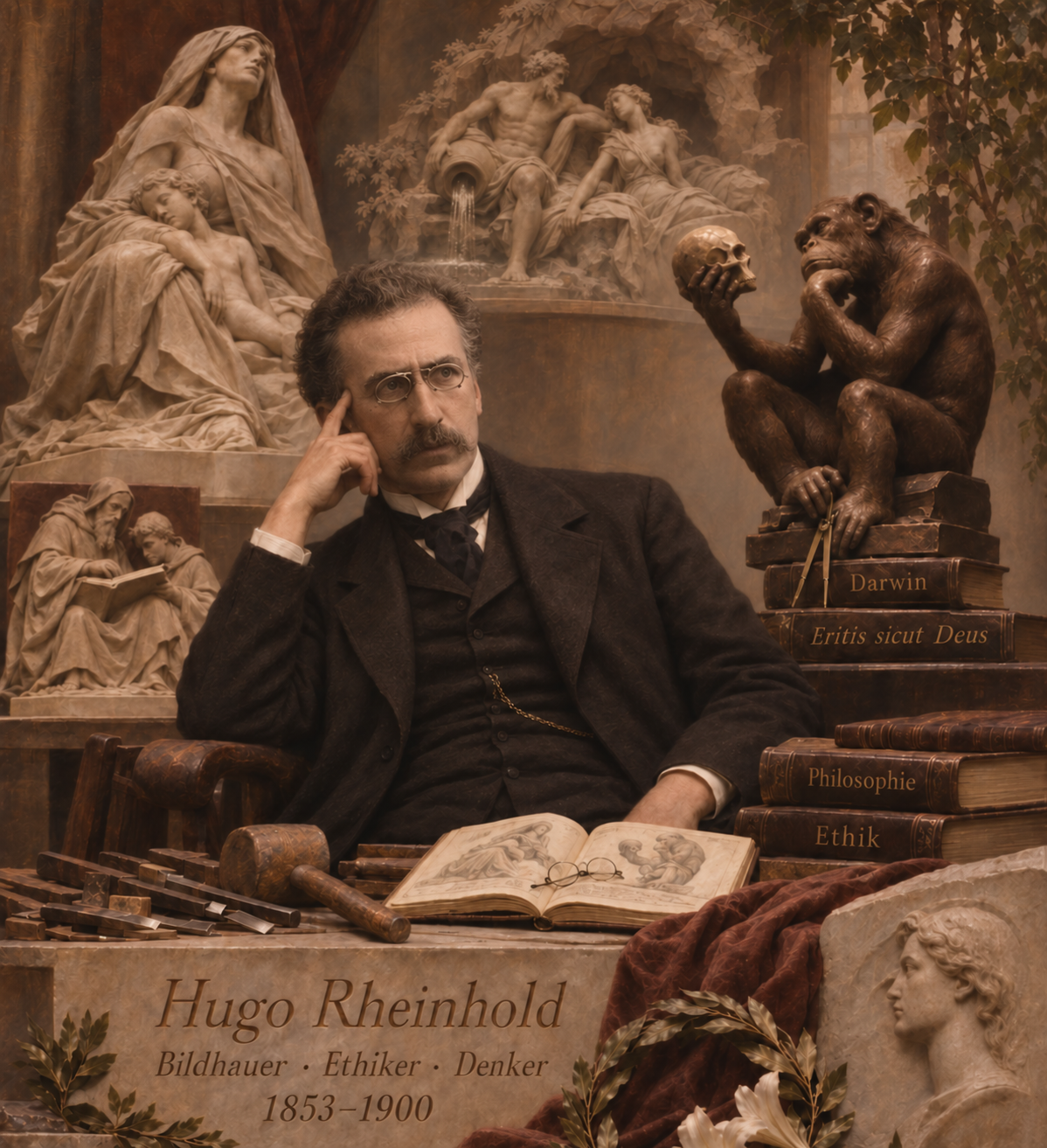
Hugo Rheinhold † — An Obituary from 1900
Published in Ethische Kultur: Wochenschrift für sozial-ethische Reformen, Berlin, 13 October 1900, VIII Jahrgang, Nr. 41.
This contemporary memorial to Hugo Rheinhold appeared shortly after his death in the reform journal Ethische Kultur. Signed “P.”, the memorial was probably written by Dr Rudolf Penzig, a prominent member of the German Ethical Culture movement and an editor of the journal. Jochen Richter and Axel Schmetzke identify the author as “[R.] P[enzig]” in their 2005 study.1 The obituary combines personal remembrance with a concise biographical sketch, reflections on Rheinhold’s ethical commitments and an assessment of his artistic work.
Presented here are the original printed page and a complete English translation. The translation aims at accuracy while remaining readable in English.

English translation
Hugo Rheinhold †
When people die, the judgement upon them is not so distant as Persian, Jewish and Christian mythology imagined. It begins at the moment when news of the loss reaches their friends; there the spirits are divided. There are people whose death does not surprise, because there was nothing surprising in their lives; many, all too many, whose memory is given only a brief life by death; others, whose passing genuinely saddens us and whose kindly remembrance we preserve as long as we ourselves live; a few, whose departure plunges us into deep grief and whose loss seems irreplaceable — and finally the very few: those people at whose death, despite the tears that rise unbidden, we say: whether living or dead, he is ours and remains ours.
In recent years the Ethical Society has suffered a whole series of such losses; to that line, in which alongside Georg von Gizycki only our Jeanette Schwerin and the venerable patriarch S. Kristeller need be named, there is now added: Hugo Rheinhold.
A wonderfully rich and full human life has here found its close — rich in suffering, disappointment and hard labour, but also rich in the blessedness of fruitful creation, not least the creation of one’s own harmonious personality.
Born in Oberlahnstein in 1853 and brought up chiefly under the guidance of his kind mother, Rheinhold first turned to a commercial career. After many reversals of fortune he succeeded, beyond the ocean, in laying secure foundations for his existence; and, returned to Hamburg, he joined his destiny to that of the beloved of his youth, long courted through the years. After scarcely a year he laid her in the grave, and with her all longing for personal happiness. Yet out of deep sorrow there grew in him the strength to live for others.
A mature man, he turned to the study of philosophy, to the deepest problems of human thought. And here it was “what unites mankind” — ethics, into whose depths he immersed himself. Bound in the purest friendship to the men who called the ethical movement to life in Germany, he entered the foremost ranks as a fighter for the new world-view, as a witty counsellor and tireless worker.
And yet the thirty-six-year-old, in the years that followed, placed his life once more upon another foundation. With iron diligence he brought to mastery the brilliant gift for the visual arts that he had discovered within himself. Others may speak of what he had to say as an artist. But a glance at his masterworks shows that his art everywhere stood in the service of the noblest striving toward the ethical ideal: the moving group Am Wege in the National Gallery, with the mother collapsed beneath the rigid image of the Holy Virgin; the mighty allegory of human culture set up in the Nobelhof in Hamburg, which compels even the demon of rock-rending force into its service; the splendid figure of the naked youth who wrestles inwardly with the tremendous question that tempts youthful strength — whether the sword can heal.
Greater even than the artist was the man. To the finest understanding of other people’s inner lives he joined a rare gift for seizing what was essential in a task or a problem, for grasping the unspoken element of a question or a request; and as wide-ranging as his understanding was his love of humanity. He united the happiest humour with the deepest seriousness of life. An example of this may be found in the little sketch “How I Became Another Man” (Ethische Kultur, vol. I, no. 34, 19 August 1893). And for his conception of the ethical movement, let these few lines from his essay “Was uns eint” (“What Unites Us”; E.K., vol. II, 1894, nos. 31, 32, 33) speak:
“Ethical societies should above all be fellowships devoted to the cultivation of the inner life. Not only charity, but all good in the world, begins at home. There has never yet been a successful reformer who did not begin with the reform of his own life.”
“Members of the ethical society should derive their theory from their moral action. I also believe that, for the individual, only those theories retain lasting value which have arisen out of his moral practice.”
“There is only one completely reliable way to serve the good of all: it is the same method that wise educators recommend to parents as the most effective means of education. Let each person work unceasingly at his own moral self-perfection in conviction and in deed.”
Hugo Rheinhold never grew weary of this work, not even in the hardest and most tormenting of his last days — “Whoever strives with all his might, / Him we can redeem,”2 sing the heavenly hosts of our great poet. A ray of that redemption falls also upon those left behind, who keep his image in their hearts.
P.
Notes
1. Jochen Richter and Axel Schmetzke attribute the signed obituary to “[R.] P[enzig]” in Der philosophische Affe und die Eule der Minerva, in Horst Kant and Annette Vogt (eds), Aus Wissenschaftsgeschichte und -theorie: Hubert Laitko zum 70. Geburtstag (Berlin, 2005), their note 45. .
2. The lines are from Johann Wolfgang von Goethe’s Faust, Part II, final scene, lines 11936–11937. They are spoken by the angels as they carry Faust’s immortal spirit to salvation; the obituary invokes the passage to honour Rheinhold’s lifelong striving. Read Goethe’s text.
“Hugo Rheinhold †,” Ethische Kultur: Wochenschrift für sozial-ethische Reformen, VIII (1900), no. 41, Berlin, 13 October 1900. Digitised in the Bibliothek für Bildungsgeschichtliche Forschung / DIPF viewer: consult the source.