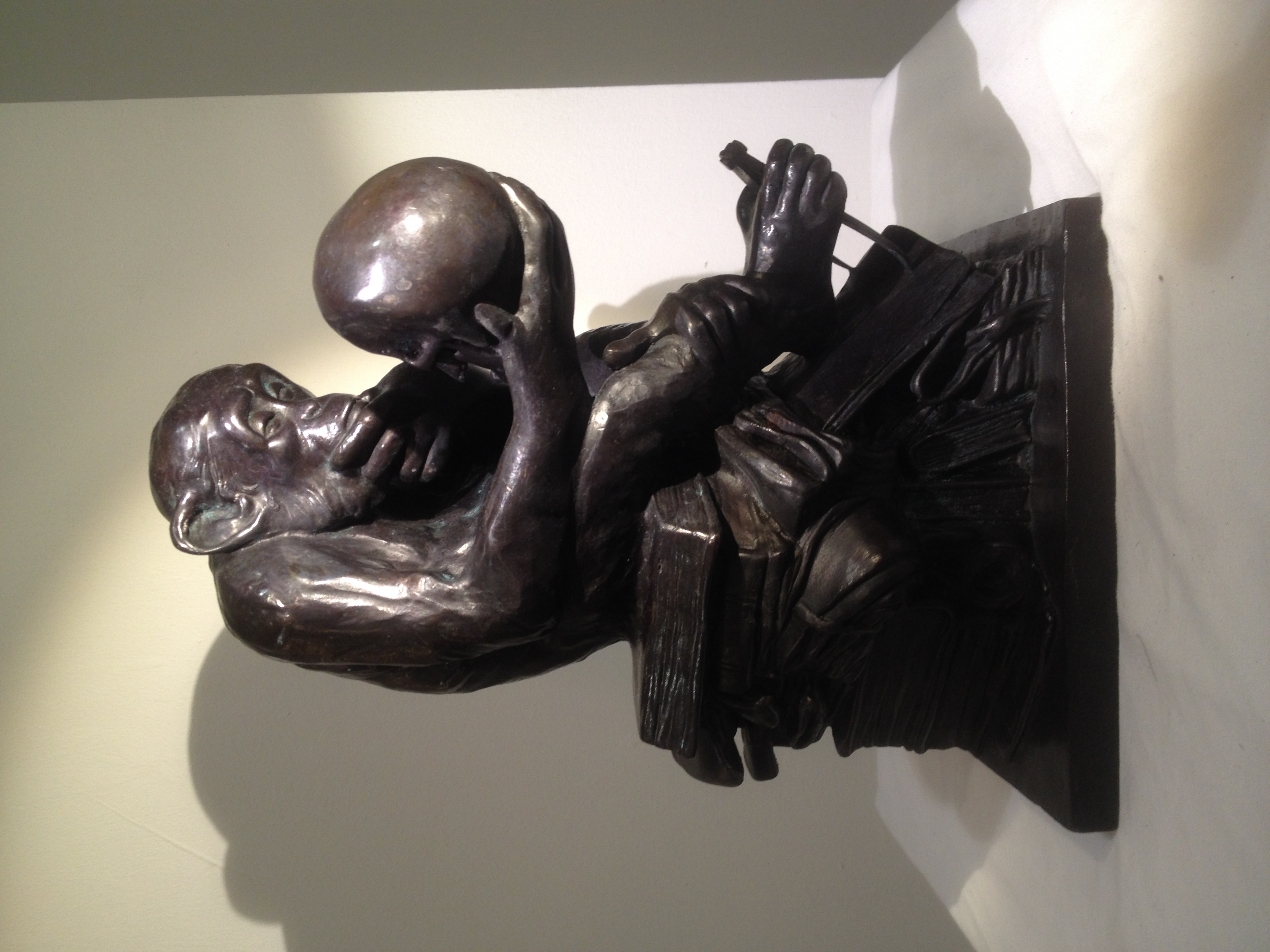
The year 1892 in Berlin is canonical for its institutional fractures, most notably the Munch-Affäre [1, 5], which shattered the consensus of the Verein Berliner Künstler and initiated the institutional path toward the alternative art market of the Berlin Secession. While art historical scholarship frequently prioritizes this crisis as a painterly rupture driven by Max Liebermann and the Vereinigung der XI, a parallel and epistemologically distinct crisis was unfolding within the three-dimensional parameters of the Königliche Akademische Hochschule für die bildenden Künste. At the center of this structural shift was Hugo Rheinhold, a master pupil of Ernst Herter who completed his graduation statuette, Affe mit Schädel (Ape with Skull), in the summer of 1892.
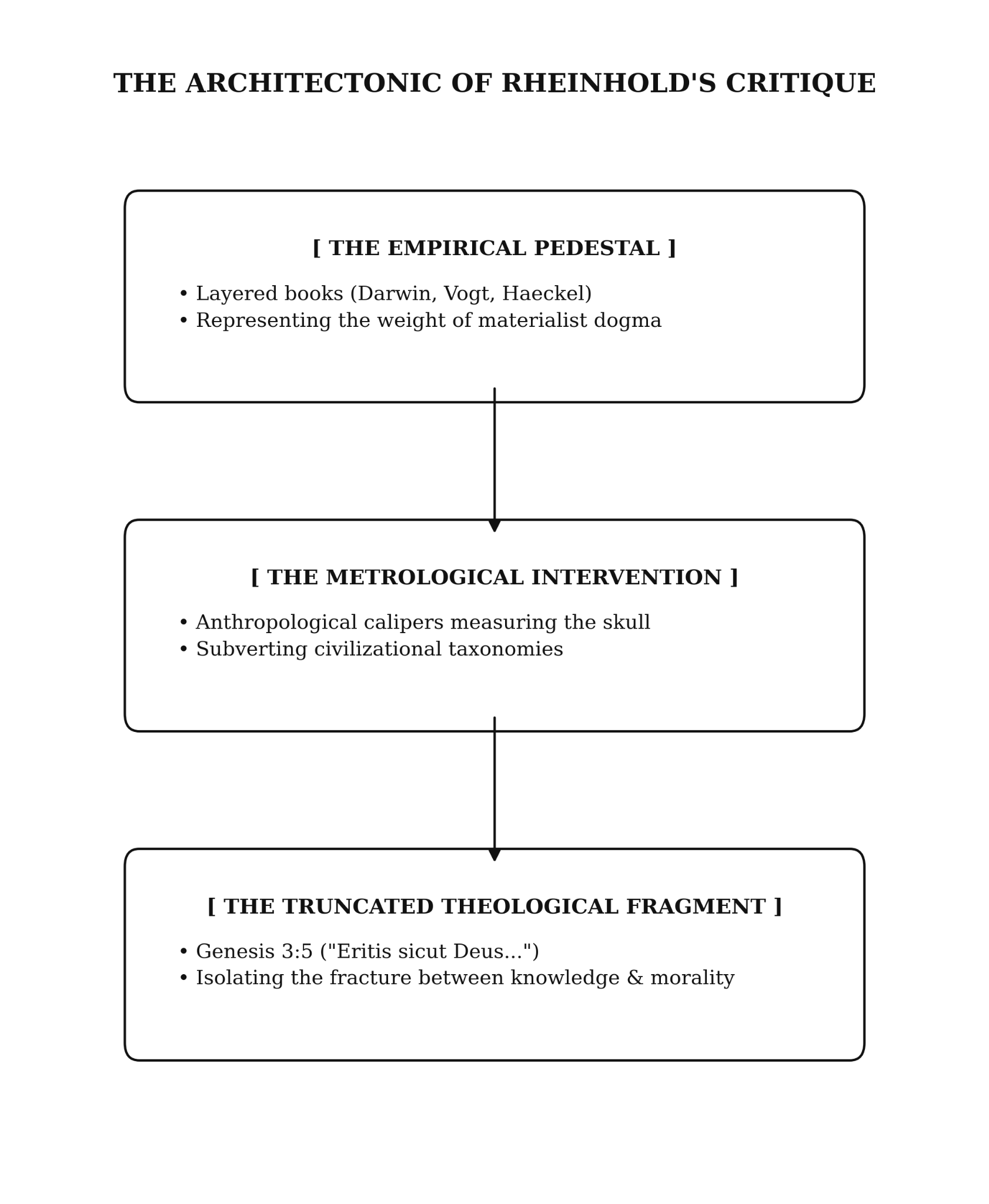
Hugo Rheinhold’s 1892 statuette Affe mit Schädel weaponized the rigid anatomical realism of the Wilhelmine Academy to mount a sophisticated critique of scientific positivism, materialist reductionism, and imperial gigantism [3, 4]. Rather than conforming to the monumental, state-sanctioned historicism of the Berliner Bildhauerschule—which culminated in the Kaiser-sponsored public propaganda of the Siegesallee [2, 4]—Rheinhold arguably utilized the Academy's strict demands for anatomical precision to stage a sophisticated critique of late-nineteenth-century positivism. By embedding an uncostumed chimpanzee within a highly dense network of material signifiers (calipers, evolutionary and scientific literature, and biblical fragments), Rheinhold bypassed the typical narrative structures of nineteenth-century animal genre sculpture. Instead, he positioned German sculpture as an active, theoretical participant in the debates surrounding human exceptionalism, materialist physics, and evolutionary ethics.
The Institutional Field: Sculptural Constraints in 1892
Wolfgang Hugo Rheinhold (1853–1900) came to sculpture by an unusually circuitous route. Born in Oberlahnstein, he worked in commerce, spent time in San Francisco, and established a business in Hamburg before turning toward intellectual study in Berlin after the death of his wife. His training with Max Kruse and Ernst Herter began in 1886, and he attended the Berlin Academy between 1888 and 1892. Thus the maker of Affe mit Schädel was not an adolescent discovering Darwin for the first time, but a mature newcomer to professional art whose earlier experience of trade, university study and secular intellectual life had prepared him to treat sculptural form as a vehicle for argument [3, 20, 21].
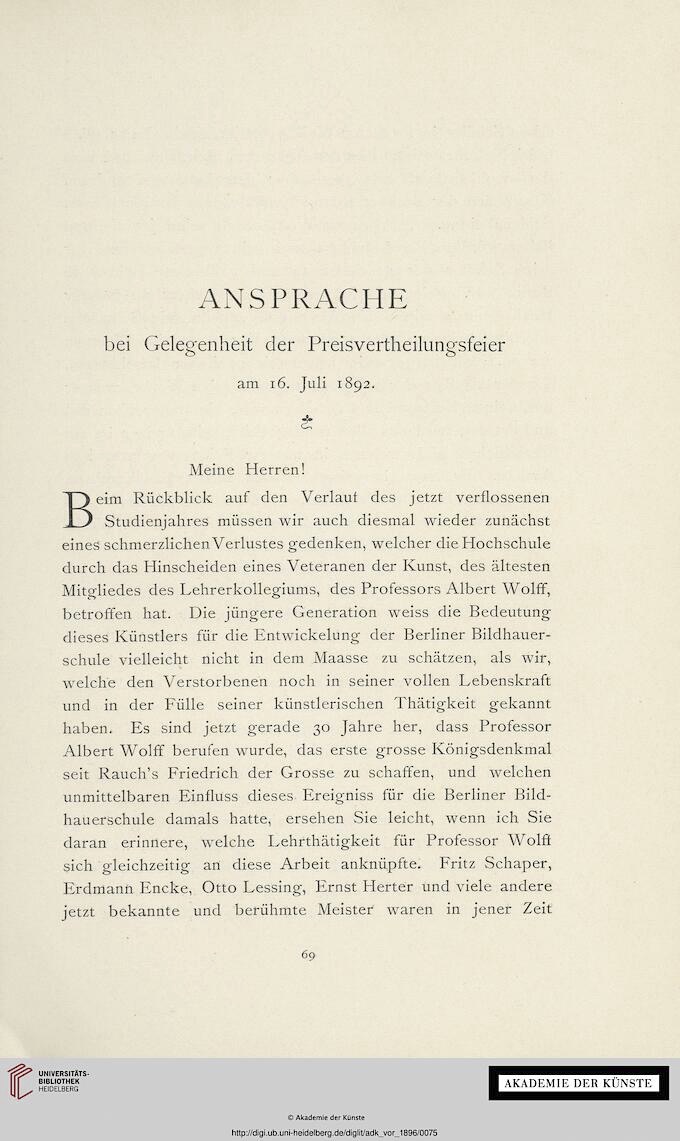
The aesthetic landscape of Wilhelmine Berlin was heavily policed by the Director of the Academy, Anton von Werner, who championed a literalist, highly nationalistic realism designed to validate the Hohenzollern autocracy. In the sculptural realm, this translated into massive commissions celebrating Prussian military dominance. However, by 1892, this emphasis on gigantism faced internal administrative pushback. In his address to students on 16 July 1892, Werner invoked the recently deceased sculptor Albert Wolff and traced the artistic lineage of the Berlin school through Wolff’s pupils, among them Ernst Herter. The address makes the prestige of academic training and monumental achievement unmistakable [6].
Rheinhold’s biographical status as a Spätberufener (late beginner)—having studied philosophy and science at the Friedrich-Wilhelms-Universität and participated in the founding milieu of the Deutsche Gesellschaft für ethische Kultur—gave him a distinctive position within this institutional order. Against the public prestige of the monument, Rheinhold chose the tactical concentration of a highly condensed examination statuette [3, 6, 16, 20]. By maintaining absolute fidelity to the Academy's pedagogical pillars—namely, rigorous life modeling and flawless animal anatomy—he immunized his work against charges of formal incompetence or avant-garde amateurism, an accusation frequently leveled at modernists by the imperial court [22].
The institutional comparison sharpens the formal paradox. Monumental sculpture depended upon a public hierarchy of patron, subject and spectator; Rheinhold’s small bronze instead creates an encounter at the scale of a desk or library shelf. It invites the viewer to lean in, inspect the instruments and read the books. That movement repeats the ape’s own investigative posture: the spectator becomes another observer of an observer. The statuette’s scale is therefore not simply an economy of bronze but a device that reorganizes the experience of looking [2, 3, 6].
The Metrics of the Soul: Calipers, Craniometry, and Anthropological Irony
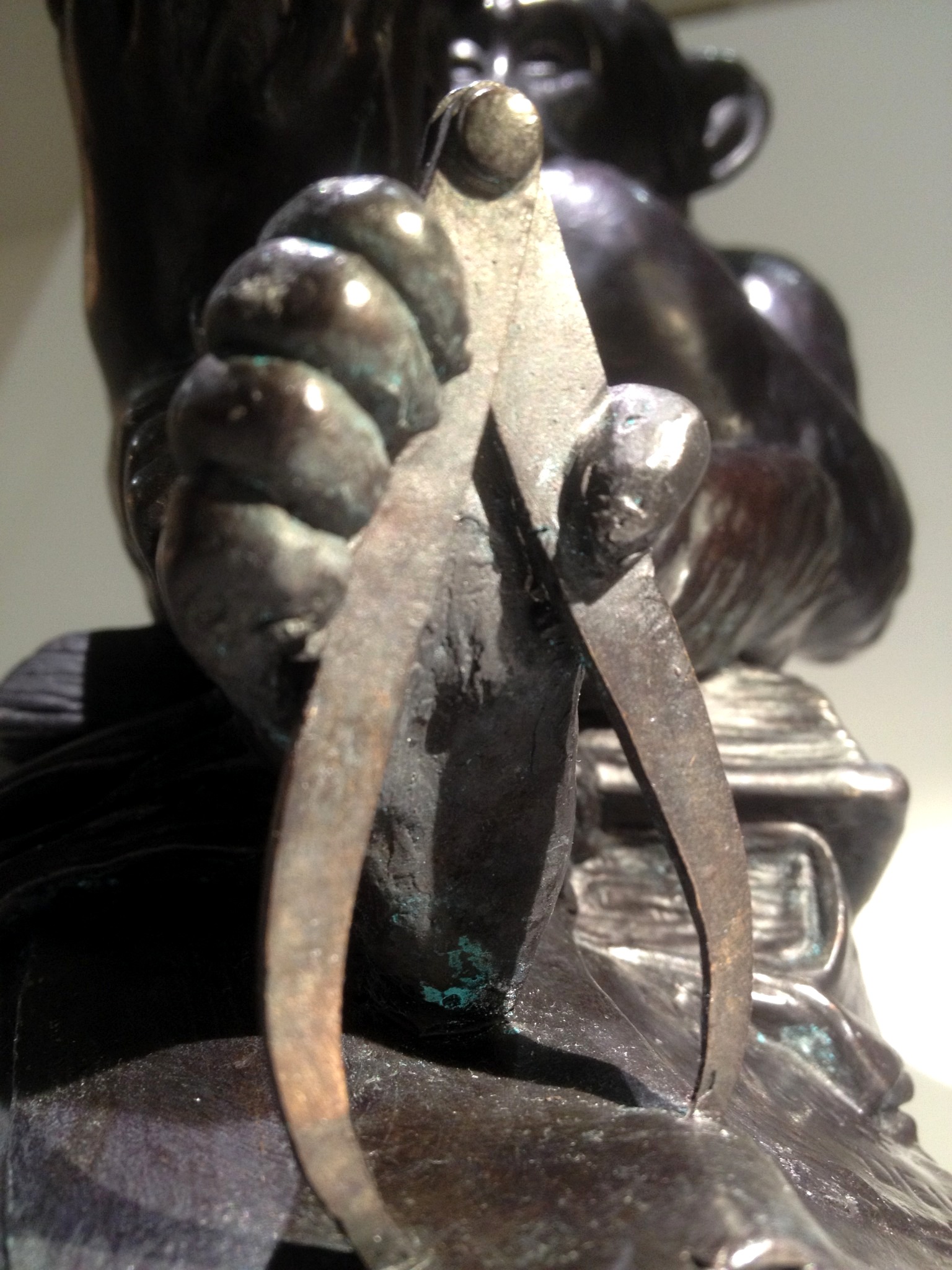
To fully appreciate the novelty of Rheinhold's conceptual strategy, his statuette must be decoupled from traditional art historical frameworks like singerie [11, 14] and repositioned within the specific context of late-nineteenth-century German physical anthropology [9, 10]. In 1892, Berlin was the absolute epicenter of international craniometry, dominated by Rudolph Virchow and the Berliner Gesellschaft für Anthropologie, Ethnologie und Urgeschichte. The caliper held by Rheinhold’s chimpanzee is not a generic workshop instrument; it is a highly specific tool of anthropometric measurement used by European scientists to construct racial hierarchies and establish an unbridgeable cognitive chasm between Homo sapiens and primates.
By placing this metrological instrument in the hand of an anatomically accurate chimpanzee, Rheinhold executes a radical semiotic inversion. The ape does not merely mimic the motions of a human researcher; it adopts the exact methodology used to reify human superiority to analyze the human container itself. In the intellectual landscape of 1892, this gesture directly reflected the anxieties generated by Ernst Haeckel’s monist philosophy [13], which reduced the human soul to a physiological byproduct of cellular mechanics. The skull within the ape’s grasp ceases to operate as a conventional memento mori symbol warning against individual vanity; instead, it functions as an objective specimen, exposing the vulnerability of human exceptionalism when subjected to its own empirical criteria.
The Textual Pedestal: Epistemic Disruption and Truncated Materialism
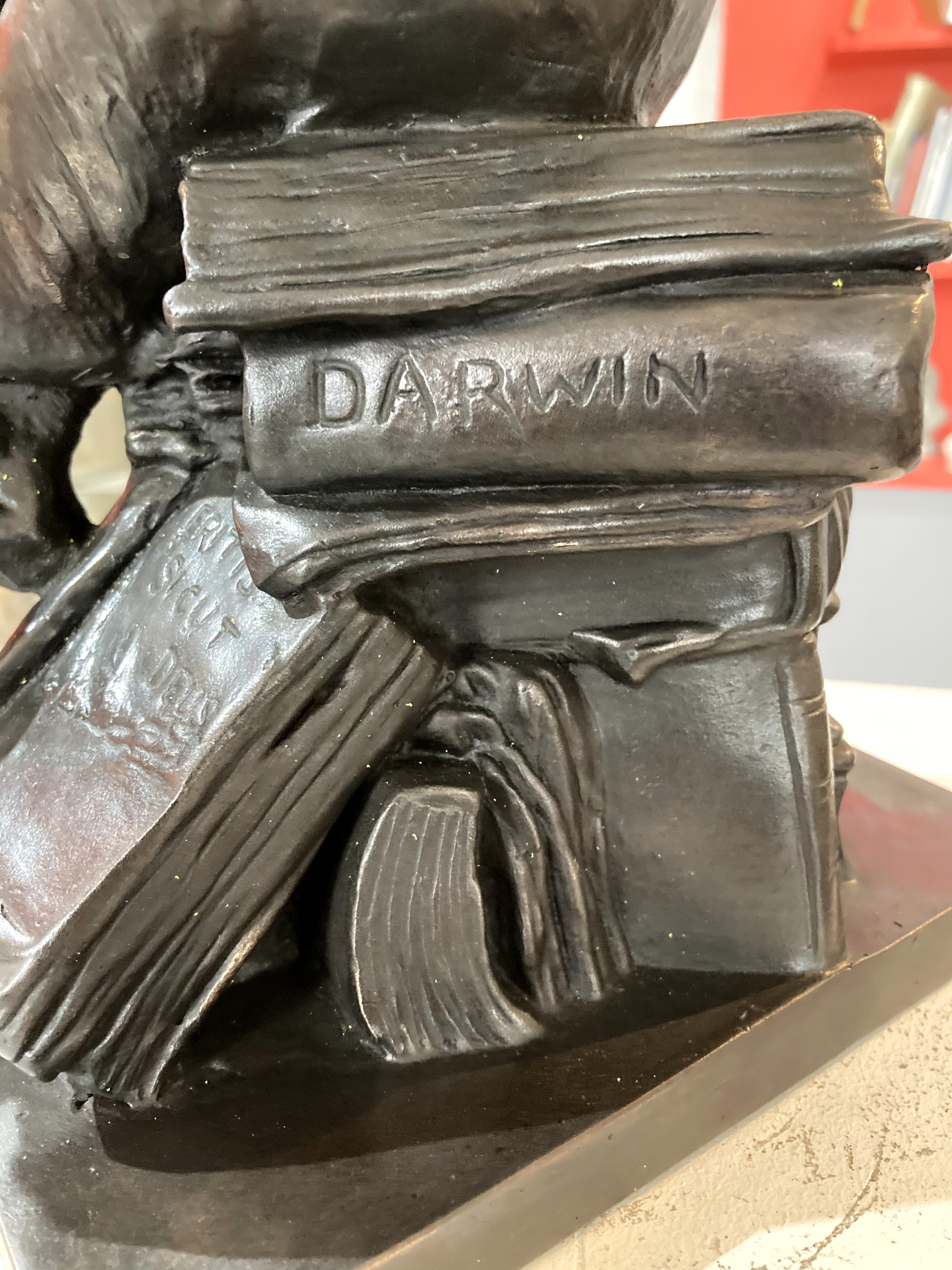
The physical foundation of Affe mit Schädel consists of a dense stack of books that serves as both a literal and philosophical pedestal for the primate. While one volume is explicitly inscribed with the name of Charles Darwin, the surrounding books can be read as representing the broader structural weight of nineteenth-century scientific literature—in the intellectual orbit of the materialist tracts of Ludwig Büchner and Carl Vogt, whose popularized scientific-materialist arguments shook the foundational certainties of the German middle class (Bildungsbürgertum) [8, 15].
Rheinhold’s most brilliant conceptual maneuver, however, is the inclusion of an open volume displaying a truncated passage from the Vulgate Bible: Genesis 3:5. The visible text reads “Eritis sicut Deus” ("You shall be as God"), yet the sculpture deliberately cuts off before the conclusion of the scriptural sentence: “scientes bonum et malum” ("knowing good and evil"). This material erasure goes far beyond a simplistic, anticlerical critique of dogma. By physically omitting the capacity for moral differentiation, Rheinhold points directly to the core ethical dilemma that preoccupied his contemporary intellectual circles, including his close associate, the ethicist Wilhelm Julius Foerster.
The statuette argues that while empirical science (symbolized by the Darwinian books and the calipers) has succeeded in elevating humanity to a position of godlike, technological mastery over nature, it has simultaneously stripped away the metaphysical frameworks required to define objective morality. The ape is left staring into the blank cavities of the skull, suspended in a state of unresolved structural doubt that mirrors the exact secular crisis confronting Imperial Germany at the dawn of the fin de siècle [3, 16].
| Semiotic Element | Traditional Iconographic Reading | Rheinhold's Anthropological Inversion (1892) |
|---|---|---|
| The Primate | A costumed, chaotic caricature of human folly (singerie). | An uncostumed, anatomically precise biological observer. |
| The Calipers | Generic instruments representing geometry or artistic practice. | Specific tools of craniometric taxonomy and racial science. |
| The Skull | Memento mori; reminder of mortal transience and religious piety. | An anatomical specimen validating physical reductionism. |
| Genesis 3:5 | Scriptural proof of original sin and the fall of humanity. | A truncated fragment exposing the moral limits of positivism. |
A further difficulty for the scientific observer lies in the structure of the inscription itself. The Latin phrase invokes the promise of becoming like God, but its omitted continuation—knowledge of good and evil—marks the difference between the capacity to know and the capacity to judge. Read alongside the calipers, the fragment turns the scene into a confrontation between measurement and ethical discrimination. The sculptor has arranged these objects so that neither scientific instruments nor sacred language can claim exclusive authority over the skull [3, 15, 16, 17].
The Sculptor as Ethicist: Post-1892 Trajectories
The long-term cultural legacy of Affe mit Schädel was profoundly shaped by its material dissemination. Acquired by the Hermann Gladenbeck & Sohn foundry following its display at the 1893 Große Berliner Kunstausstellung, the statuette was mass-produced in varying bronze sizes. This commercial distribution allowed the object to migrate out of the insular elite gallery spaces of Berlin and directly into the secular spaces of modern bourgeois life: university laboratories, psychoanalytic offices, and private libraries across Europe [3, 18]. Through this migration, the sculpture transitioned from an academy examination piece into a universal visual shorthand for the existential destabilization brought about by the natural sciences.
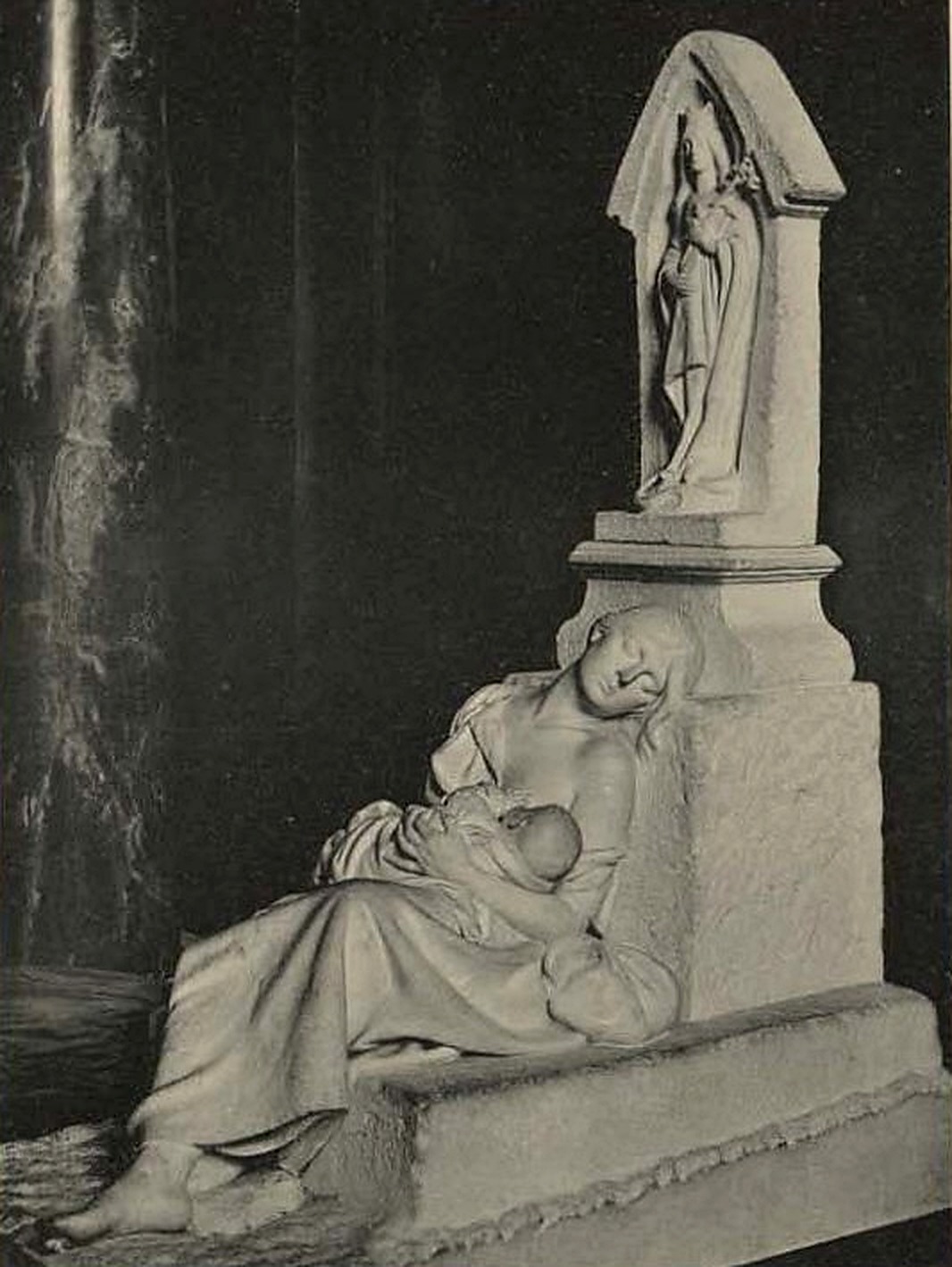
Life-size group of an exhausted young mother and child collapsed before a wayside tabernacle. The plaster was shown at the Great Berlin Art Exhibition in 1894; the Berlin National Gallery acquired it and commissioned the marble version, completed in 1896.
Rheinhold’s later, tragically brief career—which ended with his early death in 1900—demonstrates that this intellectual engagement was not a singular, fortuitous accident. His subsequent major projects continued to use the physical discipline of academic realism to articulate complex ethical dilemmas. His life-sized marble group Am Wege (1894–96), which was acquired by the Berlin National Gallery, depicted a collapsed, impoverished mother and child before a roadside shrine, confronting the contemporary urban reality of industrial poverty within a format traditionally reserved for religious or mythological idealization [3, 7].
Even more explicitly, his lost three-meter monument for the Hamburg Dynamite Company, Dynamit im Dienste der Menschheit (1896–97), personified destructive explosive force as a powerful, bound monster checked by a female figure representing the torch of science. Just as in Affe mit Schädel, Rheinhold’s final monuments resisted uncomplicated celebrations of progress. They functioned instead as urgent visual warnings that technological and scientific power, if detached from a rigorous framework of human ethics, would inevitably collapse into a force of absolute civilizational destabilization [19].
Academic Realism as an Instrument of Critique
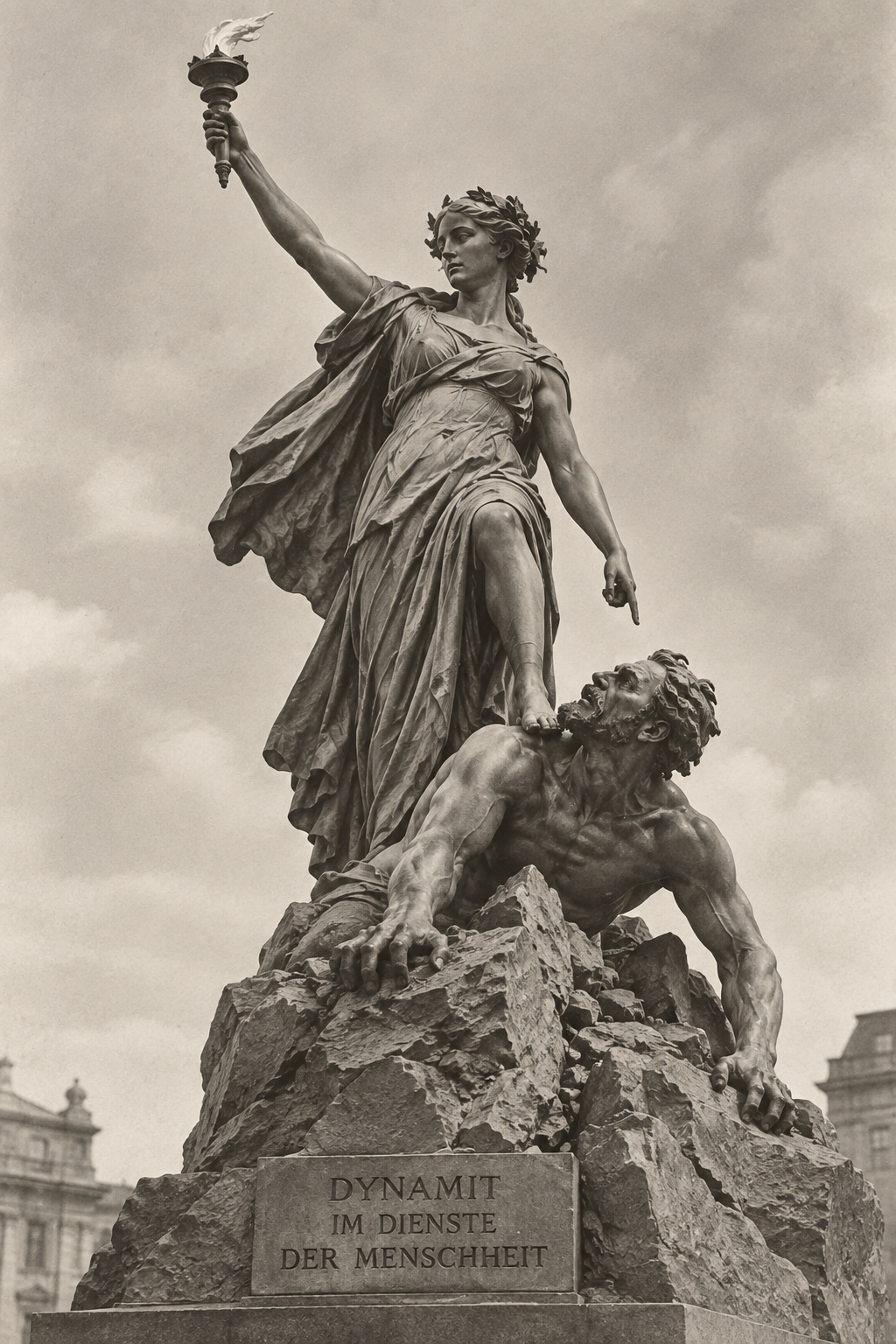
Artist's impression (AI-assisted)
Created for this website from surviving contemporary descriptions published in 1897 and later research by Richter & Schmetzke. No authenticated photograph of the original monument is presently known.
The relationship among the three works is more consequential than a shared taste for allegory. Affe mit Schädel sets the authority of knowledge against the problem of moral judgement; Am Wege makes deprivation visible within a culture of civic progress; and Dynamit im Dienste der Menschheit gives destructive industrial energy a body that must be restrained. Each depends on the intelligibility of academic realism. Rheinhold did not need to abandon the conventions of modelling to expose the limits of the civilisation that prized them. His method was to make those conventions carry a contradiction: scientific mastery without wisdom, wealth without protection, technological force without ethical restraint [3, 19].
This offers a different way to situate the sculpture in 1892. The Berlin Secession is often narrated as the triumph of a modern visual language over the Academy. Rheinhold’s achievement suggests a second trajectory of modernity, generated within academic naturalism. Its critical force does not depend on stylistic rupture. It depends on the precision with which a conventional medium can be made to ask an unconventional question [1, 2, 5].
Notes and bibliography
[1] Paret, P., 1980. The Berlin Secession: Modernism and its Enemies in Imperial Germany. Harvard University Press.
[2] Bloch, P. and Einholz, S., 1990. Ethos und Pathos: Die Berliner Bildhauerschule 1786–1914. Gebr. Mann Verlag.
[3] Richter, J. and Schmetzke, A., 2007. Hugo Rheinhold's Philosophizing Monkey—a Modern Owl of Minerva. NTM Zeitschrift für Geschichte der Wissenschaften, Technik und Medizin, 15(2), pp. 81–97.
[4] Deshmukh, M.D., 1975. Kaiser Wilhelm II and the Politics of Culture in Imperial Germany. Ph.D. Dissertation, University of Chicago.
[5] Werckmeister, O.K., 1986. The Secessionian Mystique. Critical Inquiry, 12(3), pp. 548–567.
[6] Werner, A. von, 1896. “Ansprache bei Gelegenheit der Preisvertheilungsfeier am 16. Juli 1892.” In Ansprachen und Reden des Direktors A. von Werner an die Studirenden, pp. 69–75. Berlin: Schuster. Digitised edition.
[7] Richter, J., 2001. Hugo Rheinhold: Bildhauer und Philosoph. Wissenschaftlicher Verlag.
[8] Ringer, F.K., 1969. The Decline of the German Mandarins: The German Academic Community, 1890–1933. Harvard University Press.
[9] Massin, B., 1996. From Virchow to Fischer: Physical Anthropology and Modern Race Theories in Germany. History of Anthropology, 8, pp. 79–154.
[10] Gould, S.J., 1981. The Mismeasure of Man. W.W. Norton & Company.
[11] Janson, H.W., 1952. Apes and Ape Lore in the Middle Ages and the Renaissance. The Warburg Institute.
[12] Bredekamp, H., 2005. Darwins Korallen: Frühe Evolutionsdiagramme und die Naturgeschichte. Klaus Wagenbach.
[13] Haeckel, E., 1892. Der Monismus als Band zwischen Religion und Wissenschaft. F. Starke.
[14] Pigler, A., 1974. Barockthemen: Eine Selection von Verzeichnissen zur Ikonographie. Akadémiai Kiadó.
[15] Gregory, F., 1977. Scientific Materialism in Nineteenth-Century Germany. D. Reidel Publishing Company.
[16] Foerster, W.J., 1893. Ethische Kultur und Wissenschaft. Deutsche Gesellschaft für ethische Kultur.
[17] Selz, P., 1957. German Expressionist Painting. University of California Press.
[18] Hermann Gladenbeck & Sohn, foundry catalogue, attributed to 1895 (bibliographic identification requires confirmation). Berlin-Friedrichshagen.
[19] Anon., 1897. Vermischtes: Denkmal für die Hamburger Dynamit-Actien-Gesellschaft. Deutsche Kunst, 2(12), p. 174.
[20] Singer, I. and Mannheimer, S., 1906. “Rheinhold, Hugo.” Jewish Encyclopedia. Biographical entry.
[21] “Rheinhold’s Philosophizing Monkey.” University of Edinburgh research repository. Research document.
[22] Wilhelm II. (18 December 1901). True art: Speech at the conclusion of the sculptural work on the Siegesallee. German History in Documents and Images (GHDI), germanhistorydocs.org.