For centuries, European artists have given monkeys a curious responsibility: to show human beings what they look like from the outside.
Sometimes the resemblance was intended to amuse. Sometimes it carried a moral warning. Monkeys appeared as fools, sinners, thieves, musicians, painters and scholars, imitating the activities of a species convinced of its own superiority. Their familiarity made them entertaining; their differences made them useful.
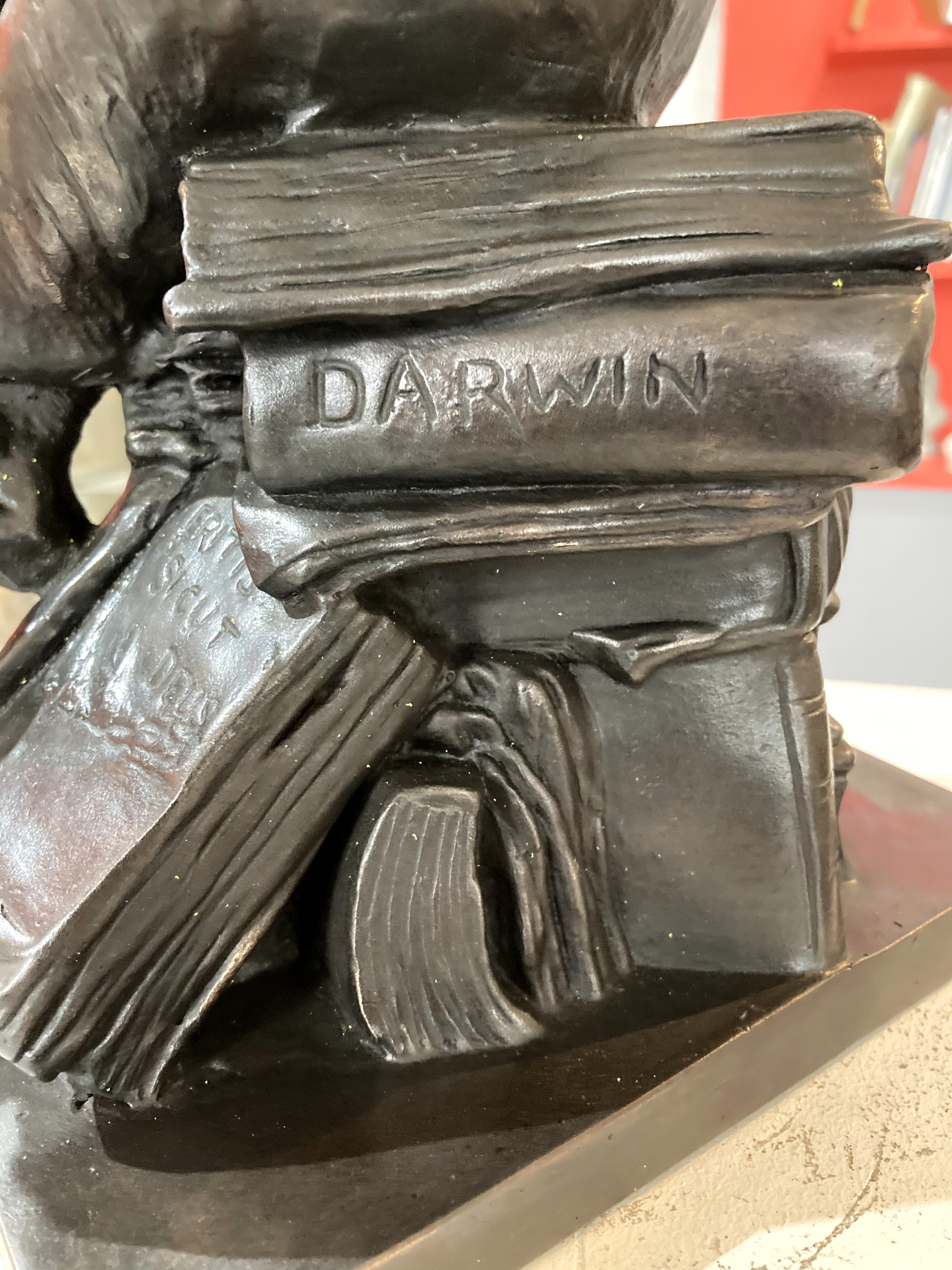
By the time Hugo Rheinhold created Affe mit Schädel (Ape with Skull) in 1892, this artistic tradition was already centuries old. Yet the intellectual setting had changed dramatically. Charles Darwin's evolutionary theory had challenged the assumption that human beings occupied a separate biological category, and the resemblance between humans and other primates had acquired a significance that earlier artists could scarcely have anticipated.
Rheinhold's sculpture belongs to both worlds. His ape inherits the long-established role of the animal imitating humanity, but the skull, books and scientific instrument introduce questions that reach beyond conventional satire.
To understand what makes the sculpture distinctive, it is worth following the monkey through some of its earlier appearances in European art.
The ape as an imperfect reflection
The association between monkeys and imitation is ancient. Their capacity to resemble human gestures while remaining unmistakably different made them natural subjects for stories about pretence, foolishness and deception.
In medieval European art and literature, the ape frequently carried negative moral associations. It might represent uncontrolled appetite, vanity or the human tendency to imitate appearances without understanding their significance. Within Christian imagery, it could also serve as a figure of sin or a parody of divine creation.
These meanings were not universal. Monkeys also appeared as exotic animals, amusing companions and objects of natural curiosity. Nevertheless, the association between the ape and imperfect imitation became a persistent element of European visual culture. [1]
One expression of this tradition was the phrase ars simia naturae: art is the ape of nature.
The comparison could be complimentary or critical. Just as an ape imitates human behaviour, an artist imitates the visible world. But does imitation demonstrate understanding, or merely reproduce appearances?
The analogy raised questions about artistic creativity itself. Was the painter a skilled copyist of nature, or could art reveal something beyond outward resemblance?
The monkey thus became a surprisingly useful participant in debates about representation, originality and the limits of imitation.
Dürer and the chained monkey
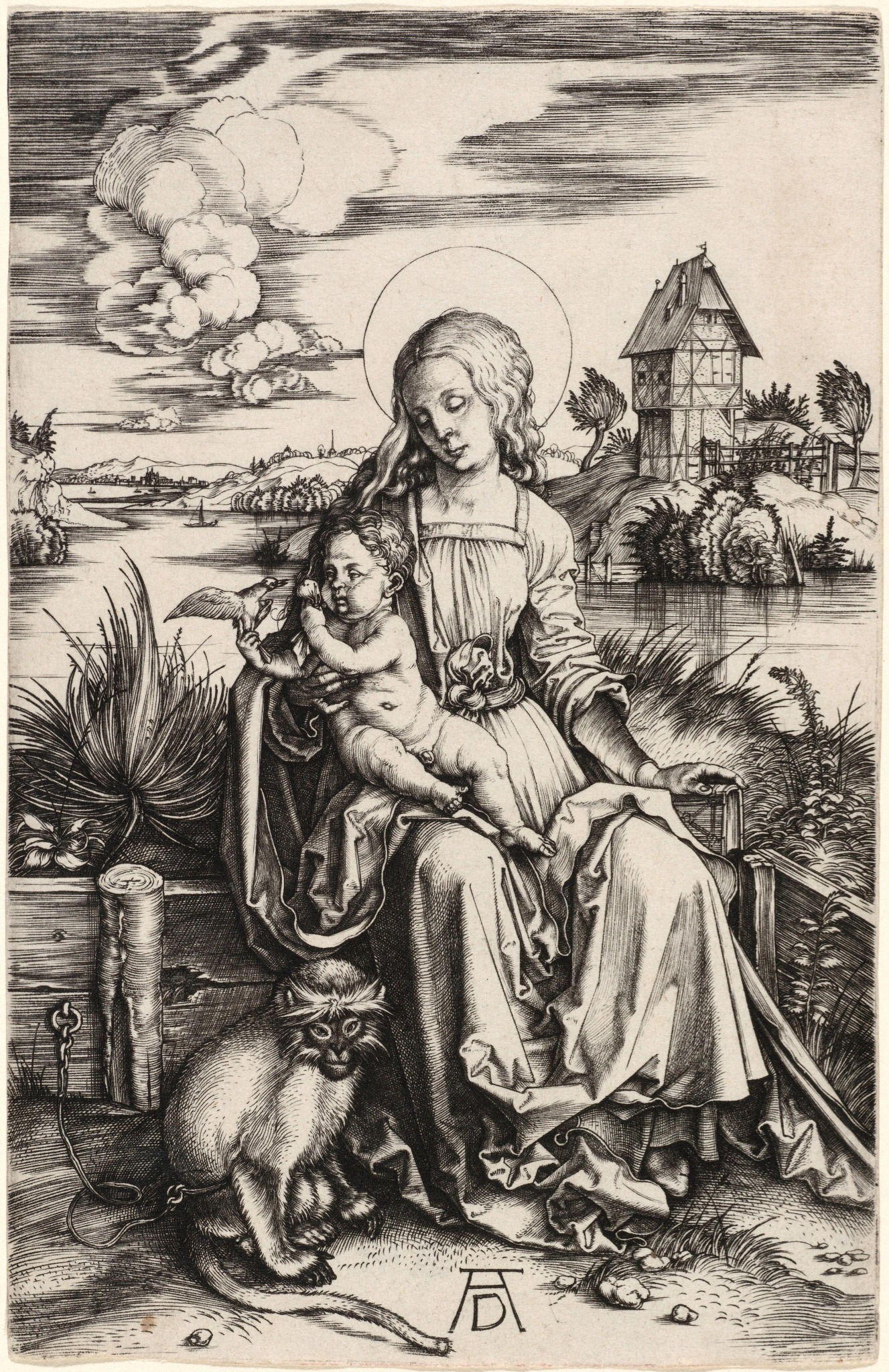
One of the most memorable Renaissance examples appears in Albrecht Dürer's engraving The Virgin and Child with a Monkey, produced around 1498.
The composition shows the Virgin Mary seated with the infant Christ in a peaceful landscape. Near her feet sits a small monkey, restrained by a chain.
Its presence seems incongruous. Why place an animal associated with mischief and bodily appetite beside an image of spiritual purity?
The contrast becomes more intelligible within the symbolism of the period. The chained monkey could represent sinful or unruly impulses brought under control. Set beside the Virgin, it emphasised the distinction between spiritual virtue and the appetites associated with fallen humanity. [2]
Yet Dürer's animal is not merely a conventional emblem.
It is carefully observed, with convincing bodily proportions and a recognisable posture. The artist's interest in the appearance of a real creature coexists with the religious symbolism assigned to it.
That combination is important. Even when the monkey serves a moral purpose, its physical resemblance to humanity remains part of the image's fascination.
The chain also establishes a relationship of authority. The animal occupies the lower part of the composition, restrained and subordinate. Its symbolic function depends upon the distance separating it from the sacred human figures above.
Four centuries later, Rheinhold would produce a strikingly different arrangement.
His ape is unchained. It occupies the centre of the composition, elevated upon books, and it is the human skull that lies within its grasp.
The monkey as social critic
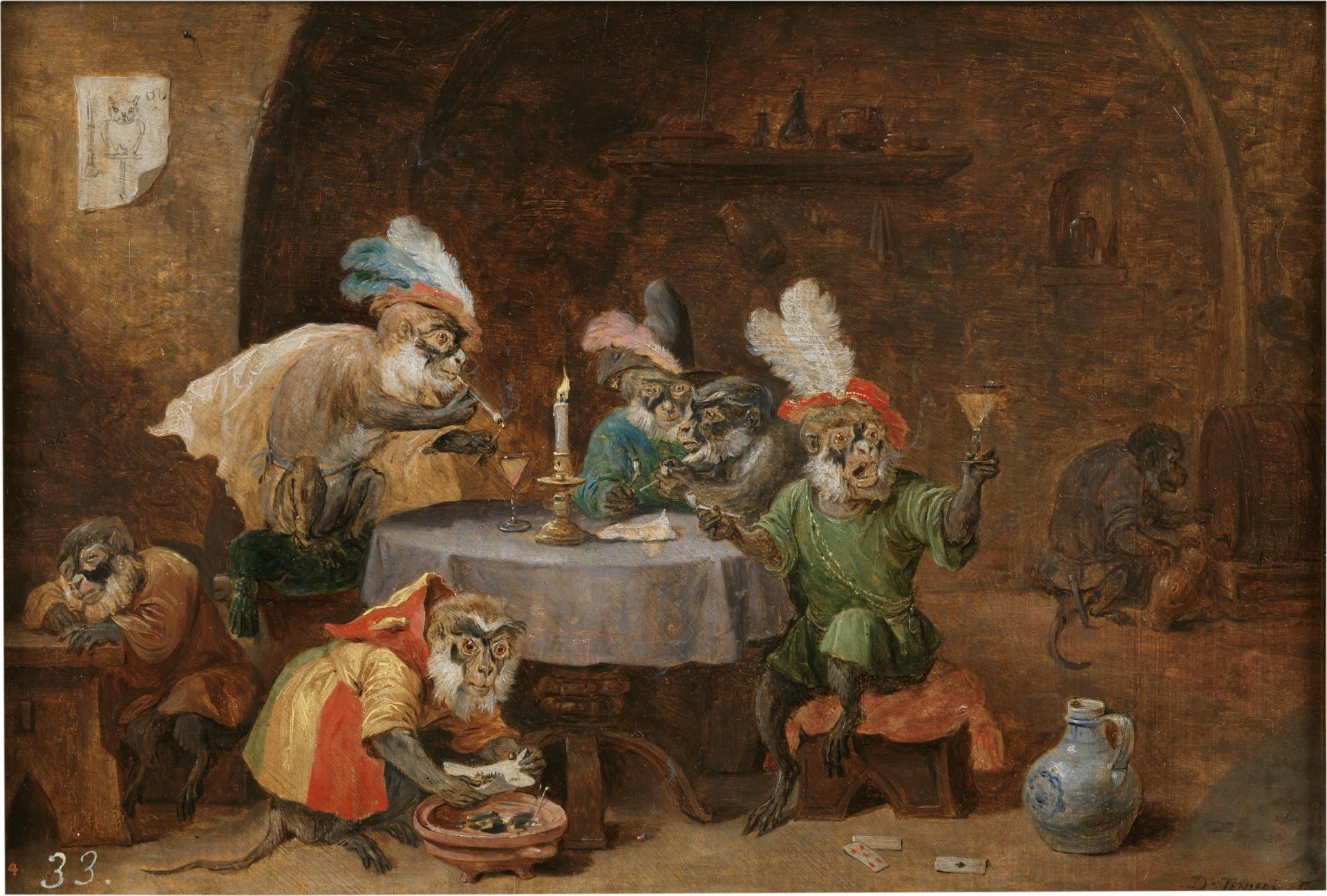
During the seventeenth century, monkeys increasingly appeared in secular scenes parodying human occupations and social behaviour.
The genre became known as singerie, from the French singe, meaning monkey.
In these pictures, monkeys might dress as soldiers, visit taverns, conduct business, practise medicine or behave like fashionable members of polite society. Their actions reproduced familiar human activities, but with enough exaggeration to expose the absurdities beneath respectable appearances.
The tradition developed particularly strongly in Flemish painting. Artists including Jan Brueghel the Elder and David Teniers the Younger helped establish the monkey as a recurring figure of social satire. [3]
Teniers's monkey scenes are especially revealing. His animals inhabit recognisably human environments, sometimes dressed in elaborate costumes and engaged in activities that appear perfectly ordinary until the identity of the participants becomes apparent.
The humour depends upon a reversal.
A monkey behaving like a soldier invites the viewer to reconsider the soldier's behaviour. A monkey behaving like a physician may make medical authority appear theatrical. A monkey acting as a connoisseur exposes the possibility that sophisticated judgement is sometimes little more than fashionable pretence.
The animals do not need to understand the activities they imitate. Their function is to expose the weaknesses of the humans whose roles they occupy.
This makes singerie more than a collection of amusing animal pictures. It belongs to a tradition in which the familiar world becomes strange when viewed through an unexpected substitute.
The monkey provides a mirror in which human conduct can appear ridiculous.
Goya: the monkey as artist

By the end of the eighteenth century, the satirical possibilities of the monkey had become especially sharp.
Francisco Goya's Ni más ni menos (Neither More nor Less), plate 41 of Los Caprichos, presents a monkey painting the portrait of a donkey.
The donkey poses with an air of importance. The monkey holds its brush and palette, apparently engaged in the serious business of portraiture.
The scene is absurd, but its target is recognisably human.
Goya's donkey represents vanity and social pretension. The monkey, meanwhile, suggests the artist willing to flatter a foolish patron. The painted likeness becomes an instrument of deception, presenting its subject not as it is but as it wishes to appear. [4]
The image also revisits the old problem of imitation.
A painter supposedly reproduces appearances, yet the act of representation may conceal as much as it reveals. If the monkey is merely copying, what happens when the original is itself ridiculous?
Goya's satire works because the animal roles are immediately intelligible. We understand the social relationship between painter and patron even though neither participant is human.
Here, as in the earlier singerie, the monkey acts as a substitute through which human behaviour can be criticised.
But the intellectual authority remains with the viewer. We are expected to recognise the folly that the animals themselves appear unable to see.
This distinction becomes increasingly difficult to maintain in the nineteenth century.
Darwin changes the resemblance
The publication of Darwin's On the Origin of Species in 1859, followed by The Descent of Man in 1871, transformed the scientific context in which images of primates could be understood.
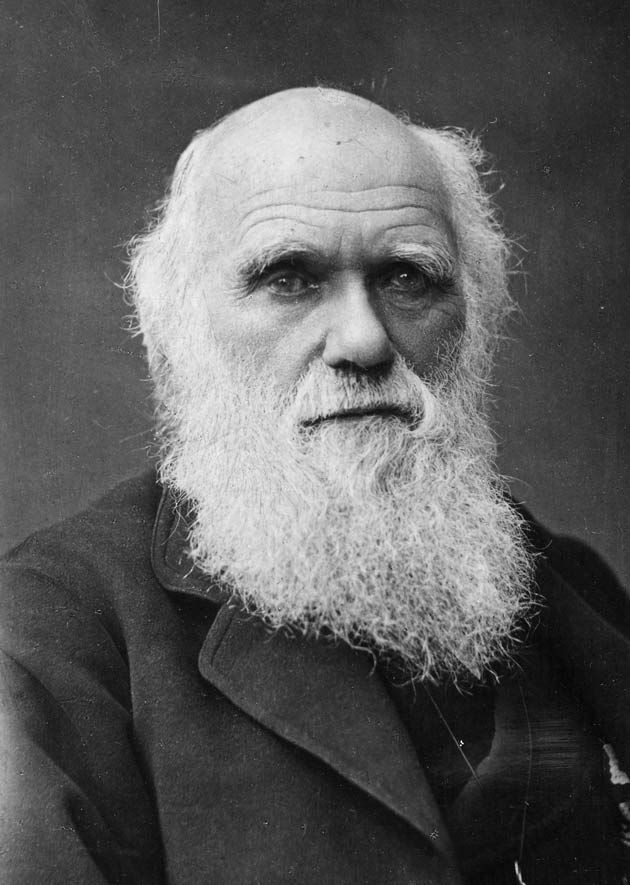
Human beings were no longer readily described as standing outside the animal kingdom. Darwin placed humanity within a shared evolutionary history and examined continuities between human and animal anatomy, behaviour and mental capacities. [5]
The implications for artistic representation were substantial.
Earlier monkey pictures had often depended upon the apparent impossibility of an animal possessing human intellectual abilities. Their humour arose from the contrast between superficial imitation and genuine human accomplishment.
Evolutionary theory did not eliminate that distinction, but it complicated the assumptions underlying it.
If human beings and other primates shared common ancestors, their similarities were not merely amusing coincidences. They were evidence of biological relationship.
The monkey could still function as a caricature. It could still parody human behaviour. But it could also become a subject through which artists explored the origins and nature of humanity itself.
The change was neither immediate nor universal. Traditional satire continued, while scientific illustration and popular caricature developed alongside it.
Nevertheless, the nineteenth-century primate acquired an intellectual significance that earlier representations had rarely possessed.
Gabriel von Max and the judging monkeys
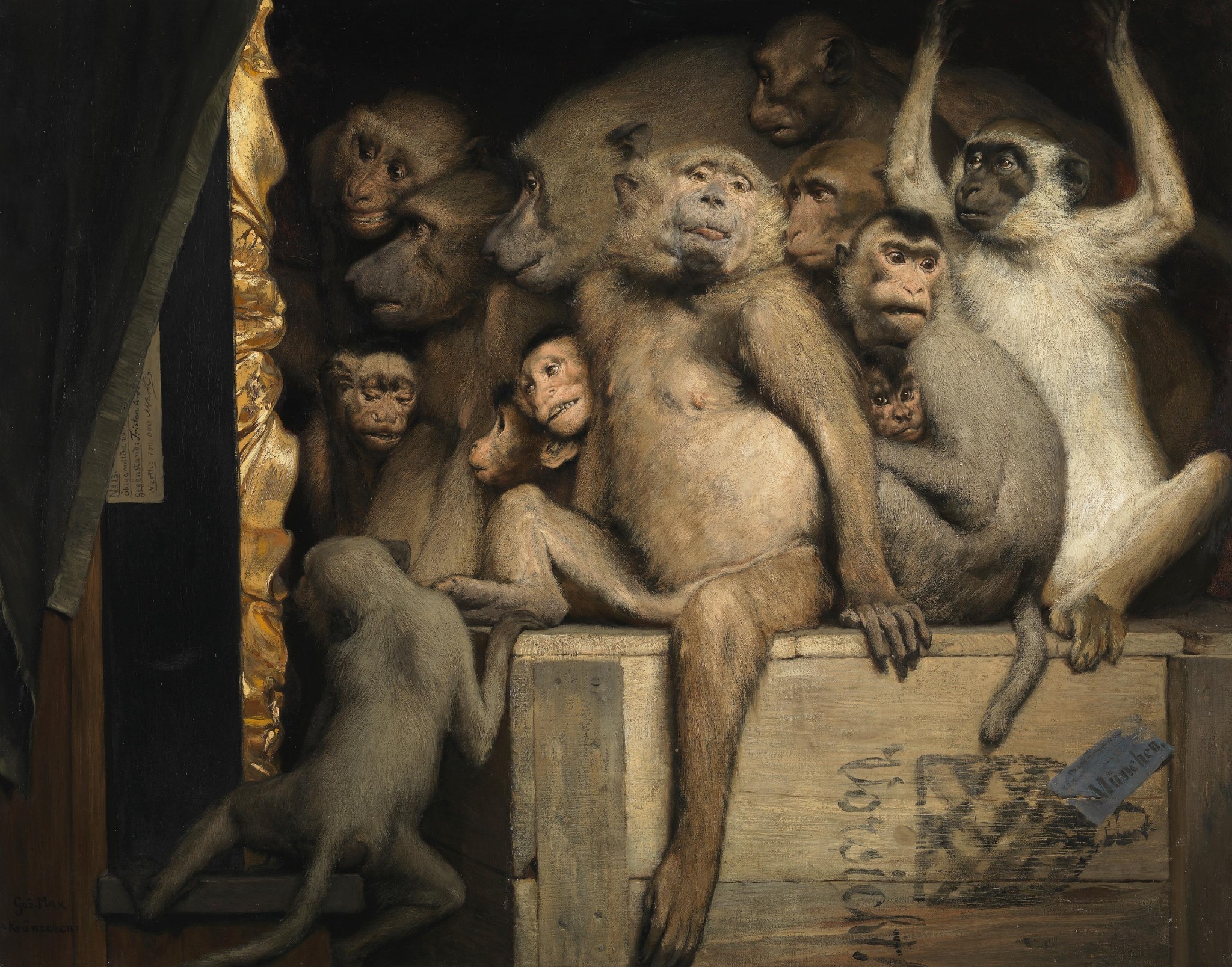
Few artists explored this new territory more enthusiastically than Gabriel von Max.
Born in 1840, von Max developed a remarkable interest in primates, combining artistic observation with studies of natural history, anthropology and evolutionary theory. His fascination with monkeys was not merely decorative: they became subjects through which he investigated questions about behaviour, intelligence and human origins. [6]
His painting Affen als Kunstrichter (Monkeys as Art Critics), completed in 1889, is particularly relevant to Rheinhold's sculpture.
A group of monkeys gathers before a framed painting. Some appear attentive, others distracted or puzzled. Their arrangement recalls the behaviour of human visitors inspecting a work of art.
At first glance, the picture belongs comfortably within the tradition of singerie. The monkeys have assumed a recognisably human activity, and the seriousness of their apparent judgement is amusing.
But von Max introduces a complication.
His monkeys are not dressed as people. They are depicted as animals, with careful attention to their bodily appearance and varied expressions. Their resemblance to human art critics arises principally from their behaviour rather than from costumes or theatrical accessories.
Moreover, the subject of their attention is not visible to us.
We observe the monkeys apparently judging a painting, but we cannot judge the painting ourselves. We are therefore unable to establish whether their responses are appropriate.
The arrangement subtly destabilises the viewer's position.
Are we laughing at the monkeys because they cannot understand art? Or are we recognising the familiar expressions of human critics whose judgements may be equally uncertain?
The painting accommodates both possibilities.
Von Max's work is particularly important because it demonstrates that Rheinhold was not the first artist to place an apparently thoughtful primate within a sophisticated intellectual setting.
The transition from comic imitation to more ambiguous forms of animal observation was already under way.
Rheinhold's philosophical ape
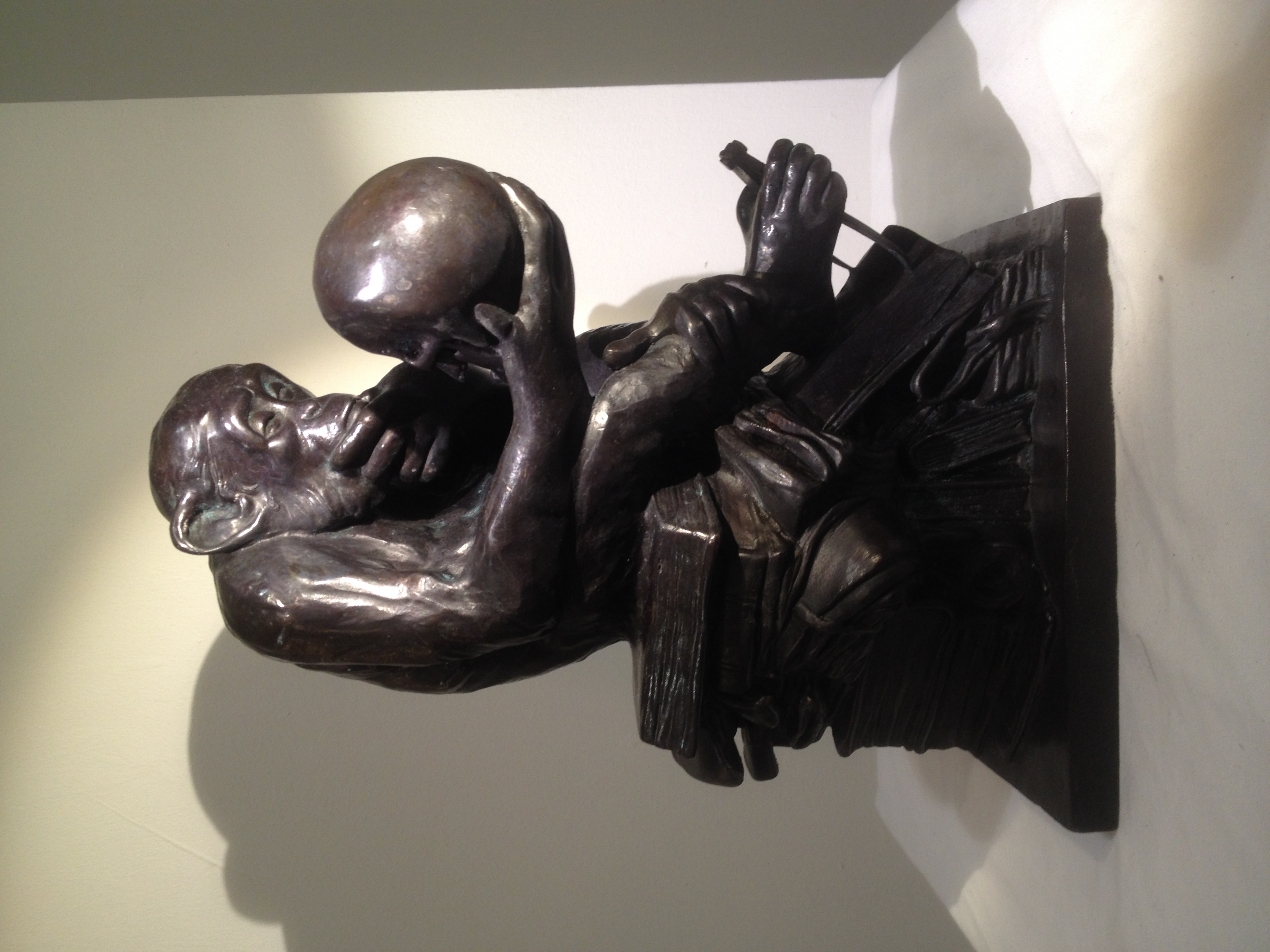
Against this background, Affe mit Schädel appears less as an isolated invention than as a particularly concentrated development of established artistic ideas.
Rheinhold retains the familiar device of assigning a human activity to an animal. His ape adopts the posture of a philosopher, holds a human skull and possesses an instrument of scientific measurement.
Yet the arrangement differs from traditional singerie in several important respects.
The monkey wears no costume. There is no elaborate domestic interior, no gathering of animals engaged in human occupations and no obvious social target comparable to Goya's vain donkey.
Instead, Rheinhold isolates a single figure.
The animal's apparent activity is not drinking, painting, trading or performing some other recognisable occupation. It is contemplating.
The skull introduces the tradition of memento mori, in which human beings confront the inevitability of death. The books and calipers place the animal within the intellectual world of science and scholarship.
These objects are significant, but their detailed philosophical implications belong to a separate investigation. What matters here is the change in the monkey's artistic role.
In Dürer's engraving, the monkey is subordinate to the human and divine figures. In the singerie, monkeys imitate human behaviour to expose its foolishness. In Goya's print, the monkey helps ridicule the pretensions of a human social world.
Rheinhold's ape, by contrast, appears to be conducting an inquiry of its own.
The distinction is not absolute. The sculpture remains humorous, and the possibility that the animal is merely imitating a philosopher cannot be dismissed.
Indeed, that uncertainty may be essential to the work.
The viewer cannot know whether the monkey is genuinely contemplating the skull or simply adopting a posture that humans associate with contemplation.
But the question itself has changed.
Earlier monkey pictures frequently asked what human foolishness looks like when animals imitate it.
Rheinhold's sculpture invites us to ask what human intelligence looks like when an animal appears to possess it.
The reversal of the observer
There is another distinction between Rheinhold's sculpture and much of the earlier tradition.
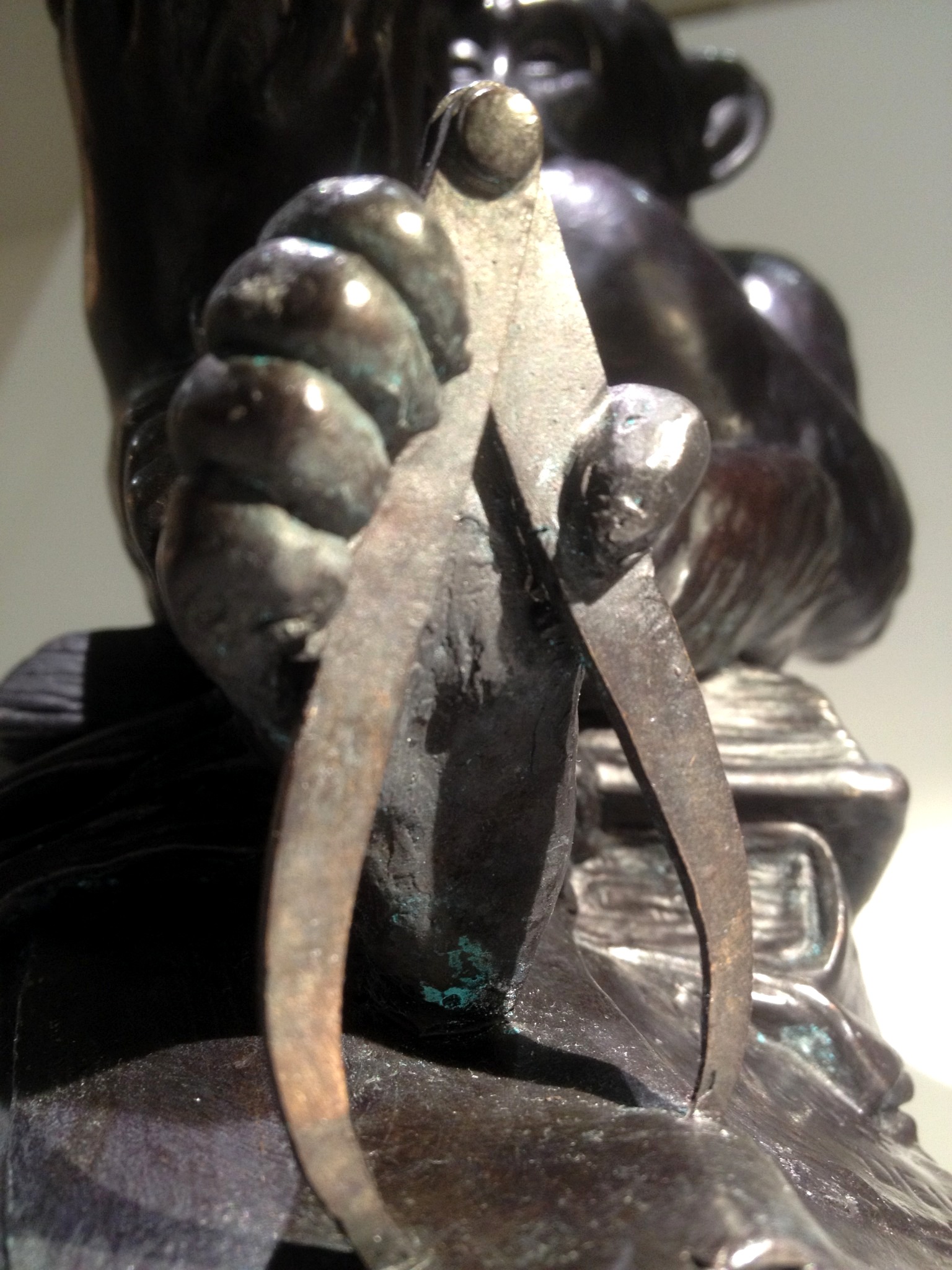
The monkey is no longer simply an object to be observed.
It has become an observer.
The change is especially striking when considered alongside the development of natural history and comparative anatomy.
European scientists had long examined animals as specimens, measuring their bodies, describing their habits and placing them within systems of classification.
Rheinhold reverses this relationship. The ape holds the human skull, while the calipers suggest the methods by which humans have studied the natural world.
The creature that science investigates has apparently become an investigator itself.
This reversal would have been intelligible without Darwin. Satirical art had long employed animals to expose human pretensions.
But evolutionary theory gives it an additional dimension.
The ape is not merely a comic substitute for a human scholar. It belongs to a lineage related to our own, and its apparent intellectual activity raises questions about the differences and continuities between species.
The sculpture therefore occupies an intriguing position between two traditions: the older use of monkeys as mirrors of human folly, and the newer scientific understanding of primates as evolutionary relatives.
Neither interpretation entirely displaces the other.
Rheinhold's ape can be funny and unsettling at the same time.
A mirror that looks back
It would be an exaggeration to claim that Affe mit Schädel brought the history of monkeys in art to a definitive conclusion.
Animal satire continued throughout the twentieth century, while artists developed many new ways of representing primates. Nor can we demonstrate that Rheinhold consciously intended to overturn the entire iconographic tradition that preceded him.
His sculpture is better understood as a particularly effective meeting point of several historical developments.
It inherits the medieval and Renaissance association between monkeys and imitation. It draws upon the satirical tradition of animals performing human activities. It belongs to the nineteenth-century fascination with primate behaviour and evolutionary relationships.
Yet it combines these elements with an unusually economical and suggestive composition.
A single ape, a skull, an instrument and a few books are sufficient to disturb the familiar relationship between humanity and the animal world.
For centuries, artists had used monkeys to make human beings look foolish.
Rheinhold's achievement was to make the monkey appear thoughtful—and leave us wondering whether the difference between those two possibilities is quite as great as we supposed.
The mirror has not disappeared.
It has begun to look back.
Notes
[1] H. W. Janson, Apes and Ape Lore in the Middle Ages and the Renaissance (London: Warburg Institute, 1952). Janson's study provides the principal historical framework for the symbolic roles of apes in medieval and Renaissance art.
[2] Albrecht Dürer, The Virgin and Child with a Monkey, c. 1498, engraving. See Cleveland Museum of Art, collection no. 1964.29, for the identification and symbolic interpretation of the chained monkey.
[3] Joanna Strzemecka, “Idea twórczości i figura artysty w singeries Davida Teniersa Młodszego, Antoine'a Watteau i Jeana Chardina,” Artifex Novus, no. 4 (2020), published 2021.
[4] Francisco Goya, Ni más ni menos, plate 41 of Los Caprichos, published 1799. See National Gallery of Art, Washington, Rosenwald Collection, accession no. 1943.3.4711.oo; and Philadelphia Museum of Art, collection no. 214940.
[5] Charles Darwin, On the Origin of Species (London: John Murray, 1859); Darwin, The Descent of Man, and Selection in Relation to Sex, 2 vols. (London: John Murray, 1871).
[6] Gabriel von Max, Affen als Kunstrichter, 1889, oil on canvas, Bayerische Staatsgemäldesammlungen, Neue Pinakothek, Munich, inventory no. 7781. See also Städtische Galerie im Lenbachhaus, Gabriel von Max: Malerstar, Darwinist, Spiritist, exhibition, 2010–11.
[7] Jochen Richter and Axel Schmetzke, “Hugo Rheinhold's Philosophizing Monkey—a Modern Owl of Minerva,” NTM 15, no. 2 (2007): 81–97.
Bibliography
Cleveland Museum of Art. “The Virgin and Child with a Monkey.” Albrecht Dürer, c. 1498. Collection no. 1964.29.
Darwin, Charles. On the Origin of Species. London: John Murray, 1859.
———. The Descent of Man, and Selection in Relation to Sex. 2 vols. London: John Murray, 1871.
Goya, Francisco. Ni más ni menos. Plate 41 of Los Caprichos. Published 1799.
Janson, H. W. Apes and Ape Lore in the Middle Ages and the Renaissance. London: Warburg Institute, 1952.
Max, Gabriel von. Affen als Kunstrichter. 1889. Oil on canvas. Bayerische Staatsgemäldesammlungen, Neue Pinakothek, Munich.
Richter, Jochen, and Axel Schmetzke. “Hugo Rheinhold's Philosophizing Monkey—a Modern Owl of Minerva.” NTM 15, no. 2 (2007): 81–97. https://doi.org/10.1007/s00048-006-0247-5.
Strzemecka, Joanna. “Idea twórczości i figura artysty w singeries Davida Teniersa Młodszego, Antoine'a Watteau i Jeana Chardina.” Artifex Novus, no. 4 (2020). Published March 9, 2021. https://doi.org/10.21697/an.7931.