A monkey sits on a pile of books, holding a human skull. One hand supports its chin in a gesture of contemplation; a foot holds a pair of calipers. Beneath it lie the accumulated achievements of human learning, including the name of Darwin and a fragment of the biblical account of humanity's first temptation.
It is an extraordinary arrangement. The animal appears to have acquired the habits of the scientist, the philosopher and the anatomist. The human being, meanwhile, has been reduced to a specimen.
Hugo Rheinhold's Affe mit Schädel (Ape with Skull), created in 1892 and exhibited in Berlin in 1893, is often described as a commentary on Darwin's theory of evolution. It certainly belongs to a period when the relationship between humanity and other animals had become a subject of intense scientific and public debate. But the sculpture's fascination lies in its refusal to remain within that debate. [1]
Why is the monkey contemplating a human skull? Why does it possess an instrument of measurement? Why does it sit upon books? And what are we to make of the biblical words lying beneath it?
These details invite interpretations that are sometimes complementary and sometimes contradictory. Together, they make Rheinhold's sculpture an unusually compact intellectual puzzle.
An animal in the philosopher's place
The most immediately recognisable feature of the composition is its resemblance to the familiar image of Hamlet contemplating Yorick's skull.
In Shakespeare's play, the skull recalls a particular human life and becomes an occasion for reflection on mortality. The prince remembers the jester's laughter, affection and vitality, now reduced to bone. The scene belongs to a much older tradition in which the skull reminds the living of the brevity of existence. [2]
Rheinhold's sculpture invites a similar response, but introduces a remarkable substitution. The figure contemplating the skull is not a prince, scholar or philosopher. It is an ape.
That substitution changes the question.
In Hamlet, a human being considers the fate awaiting all human beings. In Affe mit Schädel, an animal apparently considers the fate of humanity itself. The human subject has become the object of another creature's attention.
The reversal is amusing, but also disconcerting. We are accustomed to imagining ourselves as the observers of nature, the beings who classify, measure and explain other organisms. Here, the observer belongs to another species. The skull is ours.
The ape's expression is sufficiently ambiguous to accommodate several readings. It might be mourning, wondering, examining or simply puzzling over what it holds. We cannot know precisely what Rheinhold intended it to think, and that uncertainty is part of the sculpture's appeal.
The pose also challenges our confidence in recognising thought. We interpret the animal's posture as philosophical because it resembles a familiar human gesture. Yet does the appearance of contemplation necessarily imply contemplation itself?
In asking what the monkey might be thinking, we find ourselves confronting the more fundamental question of how we recognise thought in another creature.
Darwin and the problem of human exceptionalism
The sculpture appeared little more than two decades after Charles Darwin's The Descent of Man (1871), which argued that human beings belong within the evolutionary history of the animal kingdom.
Darwin did not simply propose that humans resembled other animals. He examined the continuity between human and animal capacities, including their mental and emotional characteristics. The implications extended beyond anatomy into questions about intelligence, morality and the supposed uniqueness of humanity. [3]
The ape in Rheinhold's sculpture enters this discussion with an unexpected advantage. Rather than being examined by a human naturalist, it has taken possession of the naturalist's intellectual position.
The inversion is especially effective because the sculpture does not require the ape to become anatomically human. Its feet, hands and bodily proportions remain recognisably those of another primate. What changes is its activity.
It studies. It measures. It appears to reflect.
The animal has assumed roles that nineteenth-century European culture often regarded as distinctively human.
There is an obvious comic reading: if humans are related to apes, perhaps apes might eventually acquire human intellectual habits (although this would perpetuate the common misreading of human evolution as a progression in which living apes are destined to become human). Humans and other living apes instead share common ancestors and have followed their own evolutionary histories.
But there is also a more unsettling possibility. Perhaps the sculpture is asking whether those intellectual habits make us quite as exceptional as we imagine.
Darwinian evolution does not erase the differences between humans and other animals. It does, however, challenge the assumption that those differences place humanity outside nature.
Rheinhold's monkey seems perfectly placed to exploit that uncertainty.
The calipers: measuring humanity, charting progress
The calipers are among the sculpture's most intriguing details.
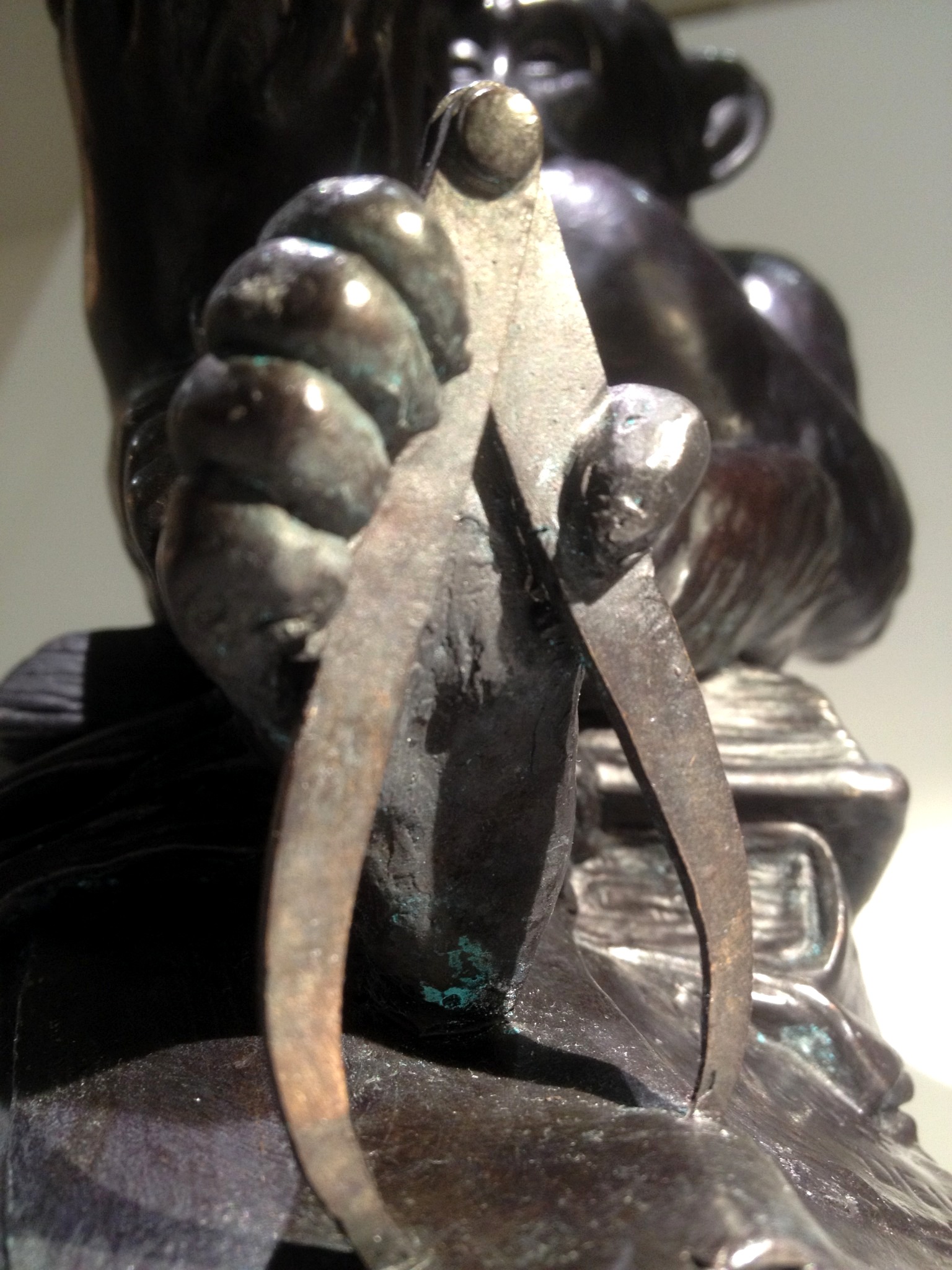
In the nineteenth century, instruments of measurement were central to physical anthropology and comparative anatomy. Researchers measured skulls and other anatomical structures in attempts to describe human variation, reconstruct evolutionary relationships and classify populations.
Some of these investigations produced valuable anatomical knowledge. Others were entangled with racial hierarchies and unjustified claims about intelligence or human worth.
The spreading calipers held by Rheinhold's ape have a particularly direct association with anatomical measurement. Yet calipers and related instruments also belong to the wider history of technical drawing, cartography, navigation and the measurement of distances. They represent not only the examination of bodies but humanity's efforts to measure and map the world.
This broader association opens another possible interpretation.
Perhaps the instrument represents humanity's intellectual journey: its growing ability to understand its surroundings, chart unfamiliar territory, manipulate materials and develop technologies that transform its relationship with nature.
But the journey has not always been prudent.
The same intellectual capacities that make scientific discovery and technological progress possible also enable the development of increasingly destructive technologies. Humanity's ability to measure, predict and control aspects of the physical world has advanced enormously, while the ethical questions surrounding those powers remain difficult.
The ape's calipers might therefore be read as an emblem of progress whose direction is uncertain. We have become extraordinarily accomplished at discovering how things work, without necessarily becoming equally accomplished at deciding what we ought to do with that knowledge.
This is a modern extension of the sculpture's symbolism rather than an established account of Rheinhold's intentions. The instrument's immediate anatomical significance remains important.
Yet Rheinhold has arranged matters strangely. The creature traditionally measured by human scientists now possesses the instrument. The human skull has become the specimen.
A skull can be weighed, measured and compared. Its dimensions may reveal something about its biological history. But they cannot, by themselves, tell us what its owner believed, loved, feared or understood.
This distinction suggests a question that extends beyond nineteenth-century anthropology: what can measurement tell us about being human, and what might remain beyond its reach?
The ape can examine the skull. Whether it can understand the person to whom the skull belonged is another matter.
Books, Darwin and the temptation of knowledge
The books beneath the monkey make the composition more complicated still.
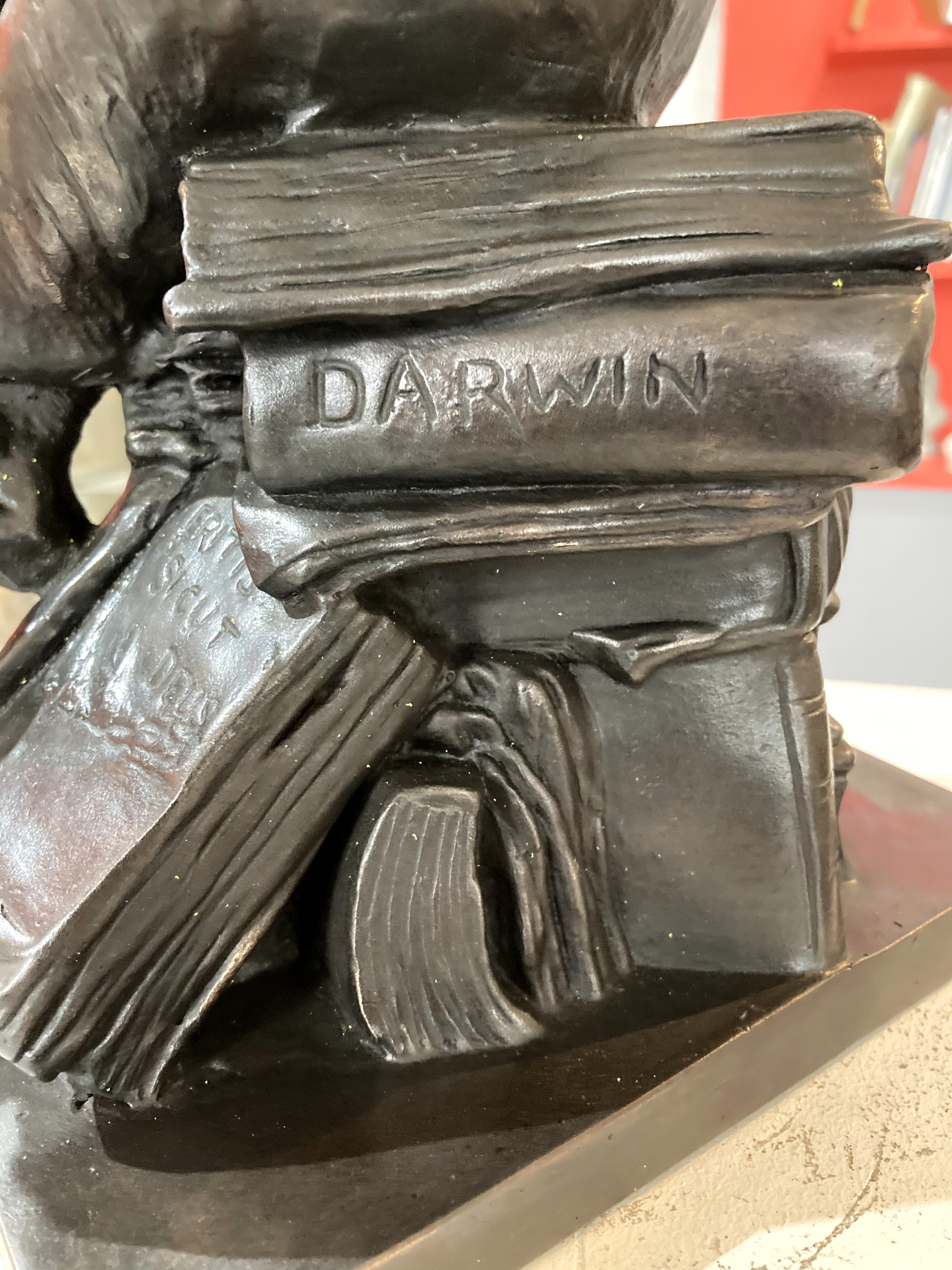
One bears Darwin's name, placing the sculpture unmistakably within the intellectual world transformed by evolutionary theory. The ape is literally elevated by human learning, even as its presence calls into question some of that learning's implications.
The biblical inscription introduces another tradition.
The words Eritis sicut deus—“You shall be like God”—come from the serpent's temptation in Genesis 3:5. In the Latin Vulgate, the promise continues with scientes bonum et malum: “knowing good and evil.”
On Rheinhold's sculpture, however, the biblical page is torn. The promise of becoming like God remains visible, while the words concerning knowledge of good and evil are absent.
This is an extraordinary detail.
The juxtaposition of Darwin and Genesis already introduces a tension between scientific explanations of human origins and the religious traditions through which humanity has understood its place in creation. But the incomplete biblical quotation introduces a more subtle possibility.
What if humanity has acquired something resembling divine power without acquiring the wisdom traditionally associated with it?
Scientific knowledge has given human beings extraordinary capacities. We can transform landscapes, alter ecosystems, investigate the workings of life and develop technologies whose consequences extend far beyond their inventors' intentions.
Yet our ability to do these things does not establish whether we ought to do them.
The missing words of Genesis can therefore be read as a warning about the separation of technical knowledge from moral judgement. Humanity may learn to act with powers once imagined as belonging to gods while remaining uncertain about the distinction between good and evil.
This interpretation is not merely a contemporary invention. Jochen Richter and Axel Schmetzke develop an ethical reading of Rheinhold's sculpture in their historical investigations, arguing that its symbolism invites scientists to consider the moral consequences of their research. Vernon Reynolds subsequently explored the same interpretation, drawing attention to the missing biblical words and to Rheinhold's involvement in ethical thought. [4] [5]
There is also an important connection with Goethe's Faust. The desire for knowledge, the temptation of extraordinary power and the consequences of its misuse are central concerns of Goethe's drama. Richter and Schmetzke's interpretation places Rheinhold's sculpture within this wider German intellectual tradition. [4]
The monkey, then, may be contemplating something more troubling than the mortality of an individual human being.
It may be considering the fate of a species whose ingenuity has outpaced its wisdom.
Rheinhold's Jewish intellectual background
The Genesis inscription acquires additional interest when considered alongside Rheinhold's biography.
Rheinhold was a German-Jewish artist whose intellectual interests extended beyond sculpture into philosophy, science and ethical questions. His involvement in the German Society for Ethical Culture provides a particularly relevant connection between his artistic work and contemporary debates about moral responsibility. [4] [5]
Nineteenth-century German Jewish intellectual life included substantial traditions of engagement with secular scholarship, rational inquiry and the reinterpretation of religious texts. The relationship between revelation, reason and scientific knowledge had been debated within Jewish philosophy for centuries, notably in the work of Maimonides.
Such traditions offer a possible context for reading the sculpture's juxtaposition of Darwin and Genesis.
But biographical caution is essential.
Rheinhold's Jewish identity does not, by itself, establish his personal theology. Nor does his interest in science prove that he rejected a literal interpretation of Genesis or regarded scripture principally as ethical allegory.
We should not assume that he embraced a particular philosophical position merely because it was available within the intellectual culture of his time.
What can reasonably be said is that the sculpture places biblical language and modern scientific thought in deliberate proximity. It invites the viewer to consider their relationship without explicitly resolving it.
One possible reading sees Genesis not as a competing scientific explanation but as a source of ethical reflection. Darwin addresses humanity's biological history; the biblical fragment raises questions about the uses and consequences of knowledge.
Understood in this way, the two texts need not be enemies. They may be addressing different aspects of the human predicament.
Whether Rheinhold himself understood the relationship in precisely these terms remains uncertain.
Is the monkey laughing at us?
There is a temptation to treat Affe mit Schädel as an elaborate warning against scientific arrogance.
Such a reading is possible, and it has a substantial place in the scholarship. But perhaps it is still too restrictive.
The sculpture is also funny.
Its humour depends on the incongruity of an animal behaving like a solemn academic. The monkey's pose resembles a philosopher's; its calipers suggest the anatomist; the books provide the trappings of scholarship. Yet the entire arrangement remains faintly absurd.
The humour need not be hostile to science. It may instead arise from the spectacle of humanity encountering its own habits in an unexpected mirror.
We take ourselves seriously. We construct elaborate systems of knowledge, develop instruments of increasing precision and devote enormous intellectual effort to understanding the world. Rheinhold places those activities in the hands and feet of an ape.
Perhaps the joke is that the ape has become human.
Or perhaps it is that the human philosopher has never been quite so far removed from the ape as he supposed.
The two possibilities are not mutually exclusive.
Indeed, the sculpture's enduring appeal may depend upon its capacity to accommodate both affectionate amusement and genuine philosophical unease.
A sculpture that resists a single answer
Rheinhold's Affe mit Schädel has survived well beyond the immediate debates of the 1890s. Historical castings, later reproductions and the sculpture's appearances in different collections and intellectual settings have given it a cultural life extending far beyond its original exhibition.
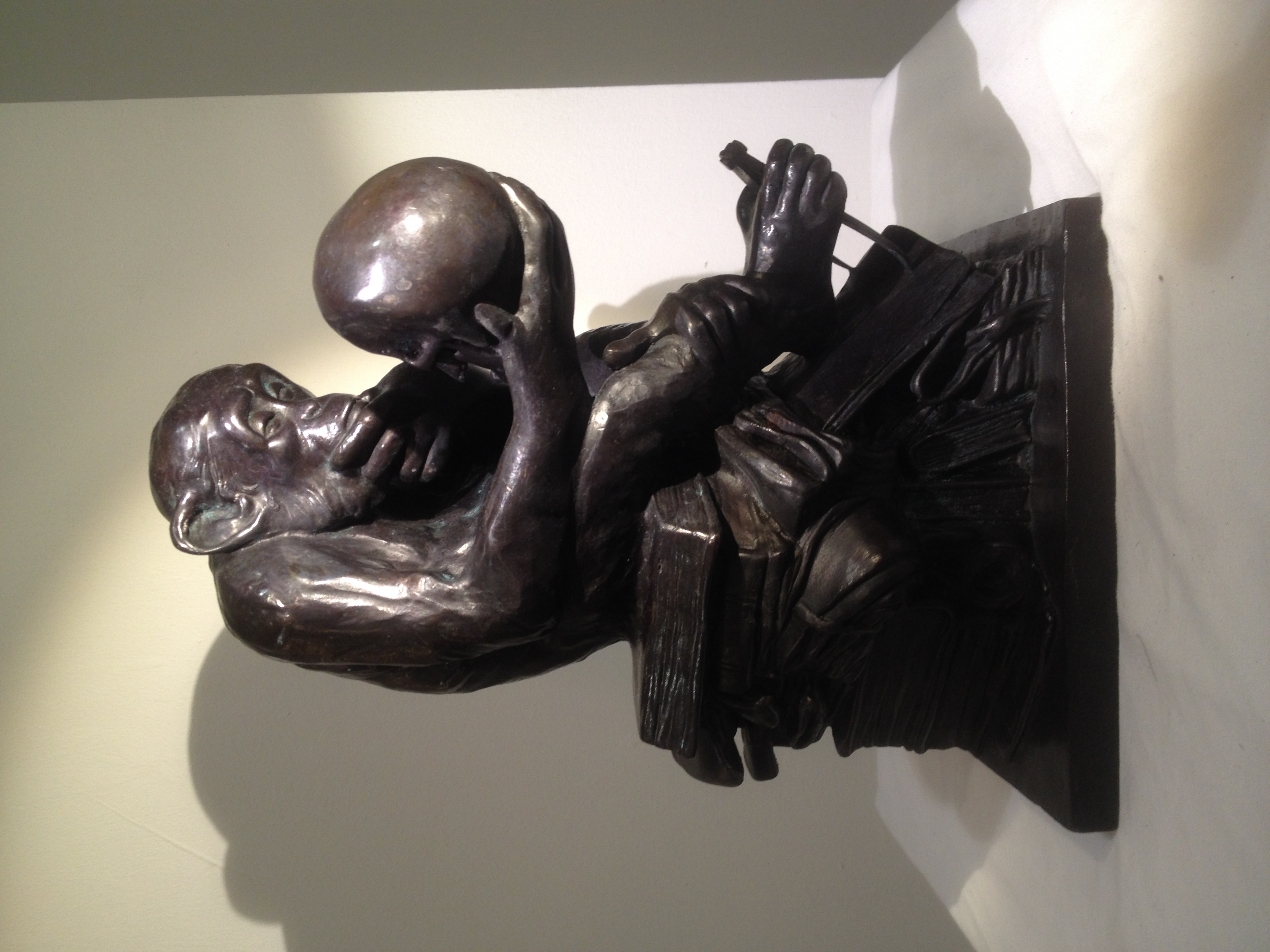
Its subsequent history deserves investigation in its own right. But the sculpture's central intellectual appeal remains remarkably accessible.
A monkey holds a human skull.
We recognise the gesture of contemplation and instinctively ask what the animal is thinking. We recognise the calipers and wonder what it intends to measure. We recognise Darwin and the biblical inscription and begin assembling explanations from science, philosophy and religion.
In doing so, we become participants in the very activity the sculpture depicts.
We observe an observer. We interpret a creature apparently engaged in interpretation. We attempt to discover the meaning of an object that seems to be asking what meaning itself might involve.
And eventually we confront an uncomfortable possibility: the monkey's intellectual equipment is not so different from our own.
We too have instruments, books, inherited beliefs and questions about our origins. We too can measure a skull more easily than we can explain the experience of being alive.
Rheinhold does not need to provide a definitive philosophical answer. The extraordinary achievement of his little sculpture is that it makes us ask the questions.
The monkey remains silent. We supply the arguments.
Notes
[1] Jochen Richter and Axel Schmetzke, “Hugo Rheinhold's Philosophizing Monkey—a Modern Owl of Minerva,” NTM: Zeitschrift für Geschichte der Wissenschaften, Technik und Medizin 15, no. 2 (2007): 81–97.
[2] William Shakespeare, Hamlet, act 5, scene 1.
[3] Charles Darwin, The Descent of Man, and Selection in Relation to Sex, 2 vols. (London: John Murray, 1871).
[4] Richter and Schmetzke, “Hugo Rheinhold's Philosophizing Monkey”; see also their earlier German study, “Der philosophische Affe und die Eule der Minerva” (2005), 11–31.
[5] Vernon Reynolds, “Hugo's Chimpanzee: Philosophy, Science, and Sculpture,” IPPL News 35, no. 2 (September 2008): 16–18.
Bibliography
Darwin, Charles. The Descent of Man, and Selection in Relation to Sex. 2 vols. London: John Murray, 1871.
Derry, J. F. Rheinhold's Philosophizing Monkey. Edinburgh, 2005.
Reynolds, Vernon. “Hugo's Chimpanzee: Philosophy, Science, and Sculpture.” IPPL News 35, no. 2 (September 2008): 16–18.
Richter, Jochen, and Axel Schmetzke. “Der philosophische Affe und die Eule der Minerva.” In Aus Wissenschaftsgeschichte und -theorie: Hubert Laitko zum 70. Geburtstag, edited by Horst Kant and Annette Vogt, 11–31. Berlin: Berliner Verlag für Wissenschafts- und Regionalgeschichte, 2005.
Richter, Jochen, and Axel Schmetzke. “Hugo Rheinhold's Philosophizing Monkey—a Modern Owl of Minerva.” NTM: Zeitschrift für Geschichte der Wissenschaften, Technik und Medizin 15, no. 2 (2007): 81–97. https://doi.org/10.1007/s00048-006-0247-5.
Shakespeare, William. Hamlet. Act 5, scene 1.
Biblia Sacra Vulgata. Genesis 3:5.