If you were to walk into Room 29 of the Moscow Kremlin during the tumultuous dawn of the Soviet Union, you would find yourself in a space defined by a fierce, almost monastic utility. This was the command centre of Vladimir Ilyich Lenin, a man who lived to dismantle the gilded excesses of the Romanov dynasty and the bourgeois world. His workspace was notably functional: tables, stacks of state decrees, maps, books and writing implements. [4, 5]
Yet, positioned within this revolutionary engine—in the later preserved display—sat a striking material contradiction: a bronze statuette of a chimpanzee sitting atop a pile of books, absorbed in examining a human skull while holding measuring callipers. The piece, Affe mit Schädel (“Ape with Skull”), was retained in the Kremlin office museum. A 1993 account of the museum describes it as a gift from the American businessman Armand Hammer; the Soviet guide Ot vsego serdtsa: Podarki V. I. Leninu (1980), discussed by Nikolai Ssorin-Chaikov in Two Lenins, likewise records the gift. [4, 5]
How did a piece of late-nineteenth-century German philosophical sculpture become a witness to the early Soviet state? Its story connects evolutionary anxieties, business diplomacy and political mythology—and requires us to distinguish what can be documented from what later interpreters have imagined.
The Anatomy of the Artifact: Rheinhold’s Pensive Primate
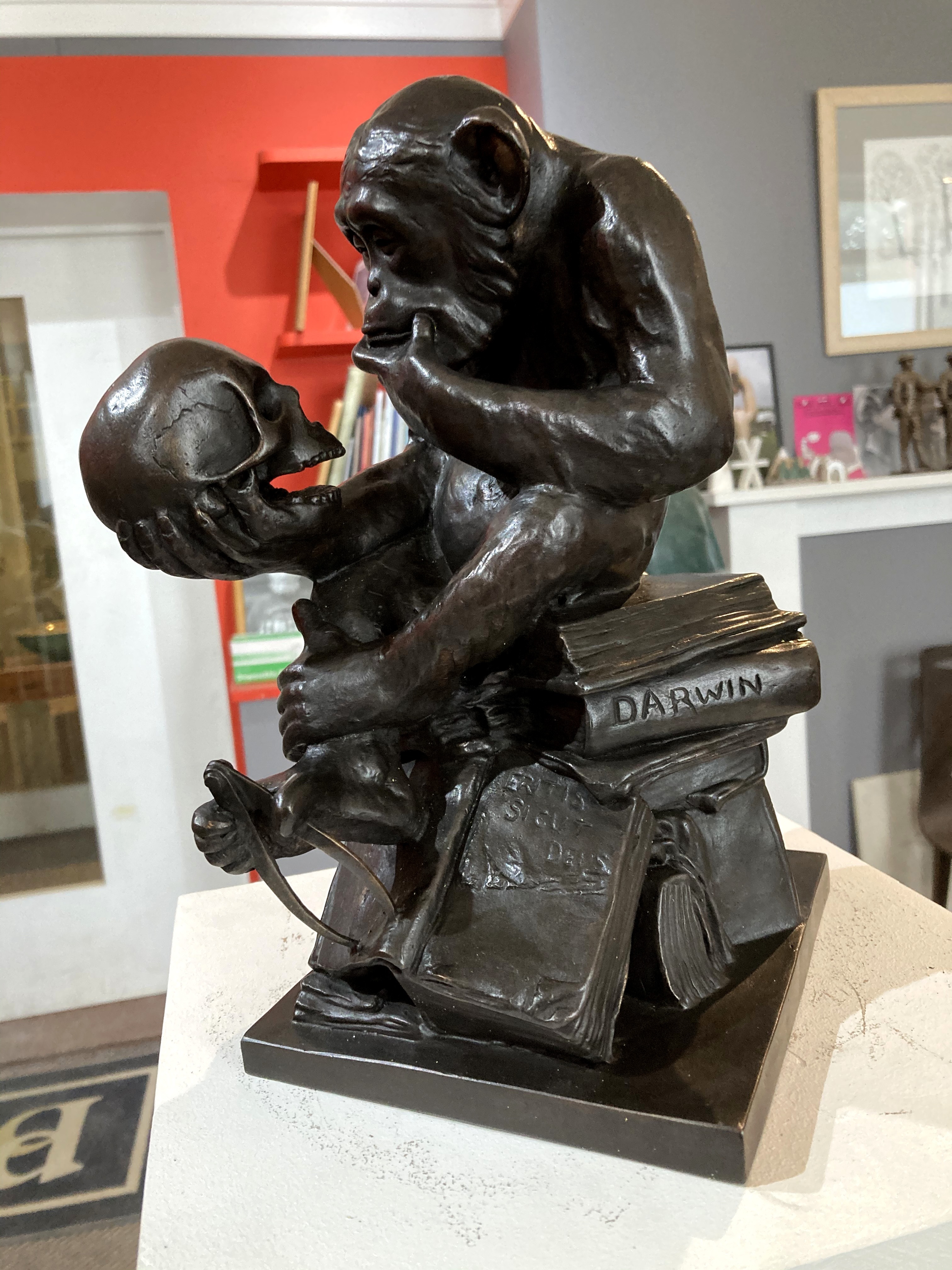
The German sculptor Wolfgang Hugo Rheinhold turned to the arts after a varied early career. His Affe mit Schädel, first exhibited in Berlin in 1893, became his best-known work. [1] The sculpture compresses several overlapping philosophical provocations into a small bronze.
The Hamlet allusion. The chimpanzee’s thoughtful posture and the skull evoke Hamlet contemplating Yorick, reversing the conventional image of a human reflecting upon mortality. [1]
The evolutionary challenge. The ape sits on books, including one marked “Darwin”. The reference places the sculpture in the debate about humanity’s relation to other animals following Charles Darwin’s The Descent of Man. [1, 7]
The biblical provocation. Beneath the ape’s foot lies a page bearing the words Eritis sicut Deus—“Ye shall be as gods”—from Genesis 3:5. The gesture invites competing interpretations: scientific confidence, moral transgression or human conceit. [1, 8]
Where traditional memento mori imagery places a skull in human hands, Rheinhold places measuring callipers in the grasp of an ape examining a human skull. One persuasive reading is that the work questions the limits of knowledge when detached from moral judgement; that is only one interpretation, however. [1]
Russia in 1921: Revolution, Civil War and the Opening to the West
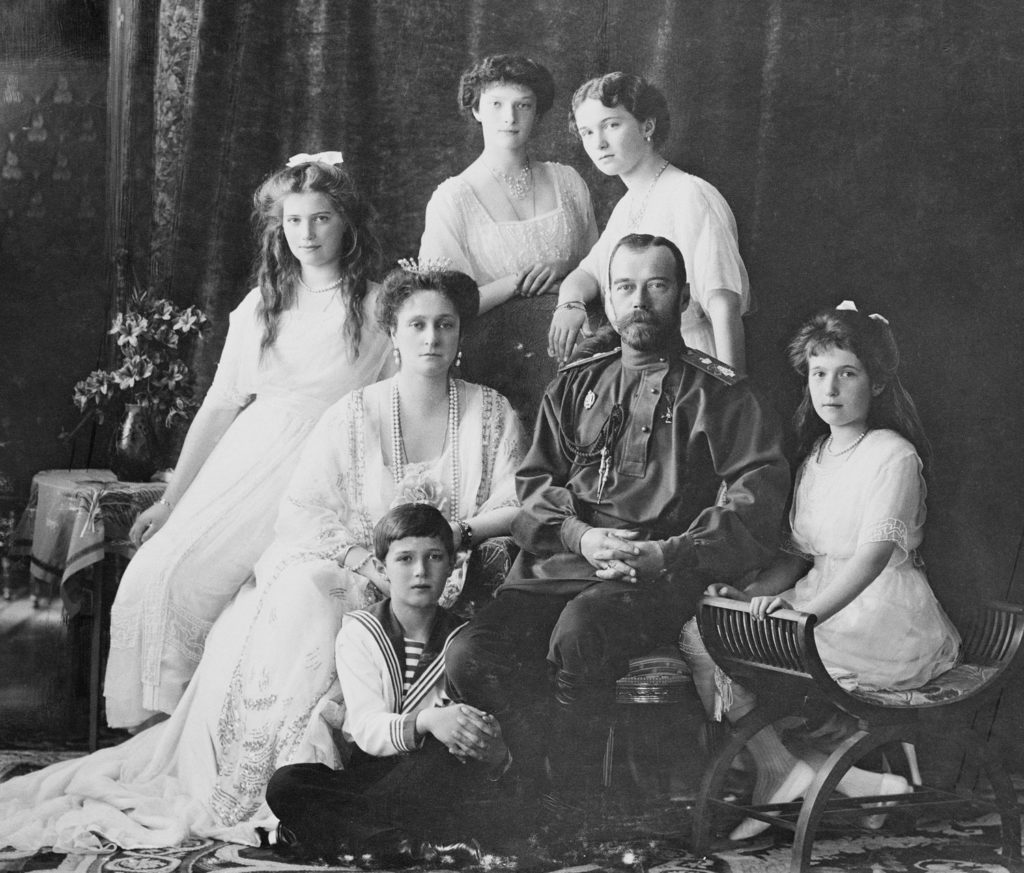
American businessman Armand Hammer arrived in a country still struggling to survive its revolution. In February 1917, wartime shortages, military exhaustion and mass protest had brought down Tsar Nicholas II. A provisional government succeeded the monarchy but continued Russia’s participation in the First World War. In October, Lenin’s Bolsheviks seized power, promising peace, land and a radically different social order. Russia withdrew from the war under the Treaty of Brest-Litovsk in March 1918, but the new regime then fought a devastating civil war against disparate anti-Bolshevik forces. Foreign powers, including Britain, France, Japan and the United States, intervened in varying ways; the revolutionary struggle was simultaneously a domestic contest and an international crisis. [12, 13]
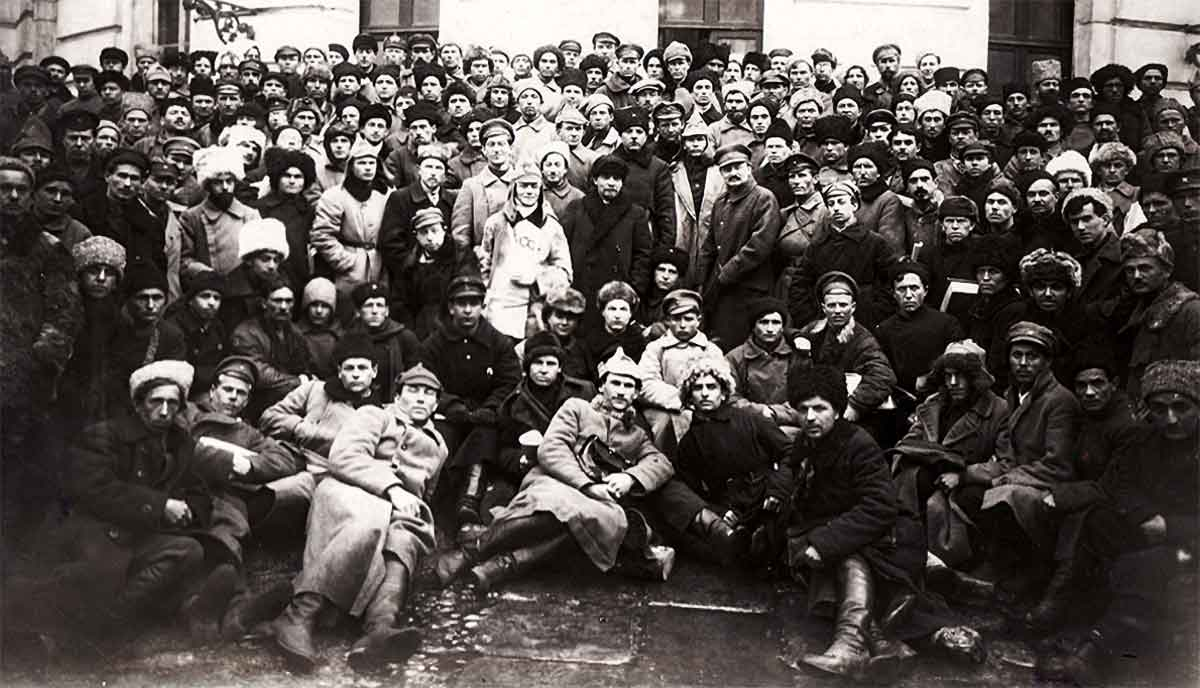
By 1921 the Red Army had prevailed over its principal White opponents, but the Bolsheviks faced widespread peasant resistance, industrial collapse, shortages and disaffection among workers. The March 1921 Kronstadt rebellion—by sailors at a base with revolutionary credentials—exposed how far opposition could reach. Political control tightened around the ruling party even as economic policies changed: at the Tenth Party Congress Lenin replaced much of the grain-requisitioning system of “War Communism” with the New Economic Policy (NEP), allowing limited private trade and small-scale enterprise while the state retained commanding sectors of the economy. [12, 13]
Drought compounded the damage of war and requisitioning in the Volga and Ural regions. Famine and epidemic disease demanded urgent relief. Herbert Hoover’s American Relief Administration became a major international aid presence, even while diplomatic relations between Washington and Moscow remained strained. Western governments feared revolutionary contagion and questioned Bolshevik legitimacy; Soviet leaders, in turn, sought food, machinery, technical expertise and—crucially—visible foreign commercial engagement. The contradiction was stark: a government committed to ending capitalism was inviting selected capitalists to help restart production. [12–14]
This is the setting in which an American doctor carrying medical supplies could become useful to Lenin’s government. Hammer’s visit belonged neither solely to philanthropy nor solely to opportunistic commerce. The relief emergency created an opening; Soviet economic necessity made an offer of grain and trade unusually consequential; and both parties stood to gain from the publicity of an American concession. [3, 12–15]
Documented History: The Capitalist and the Revolutionary
The sculpture’s journey to Lenin was not the result of a Bolshevik commission. The Kremlin apartment museum's own gift catalogue, E. N. Kharitonova's Ot vsego serdtsa: Podarki V. I. Leninu (1980, pp. 97–98), is cited by Nikolai Ssorin-Chaikov; the Moscow Times' 1993 report also identifies Armand Hammer as the donor. Ssorin-Chaikov traces both the museum's 1921 gift date and Hammer's later account of a presentation in 1922. [4, 5]
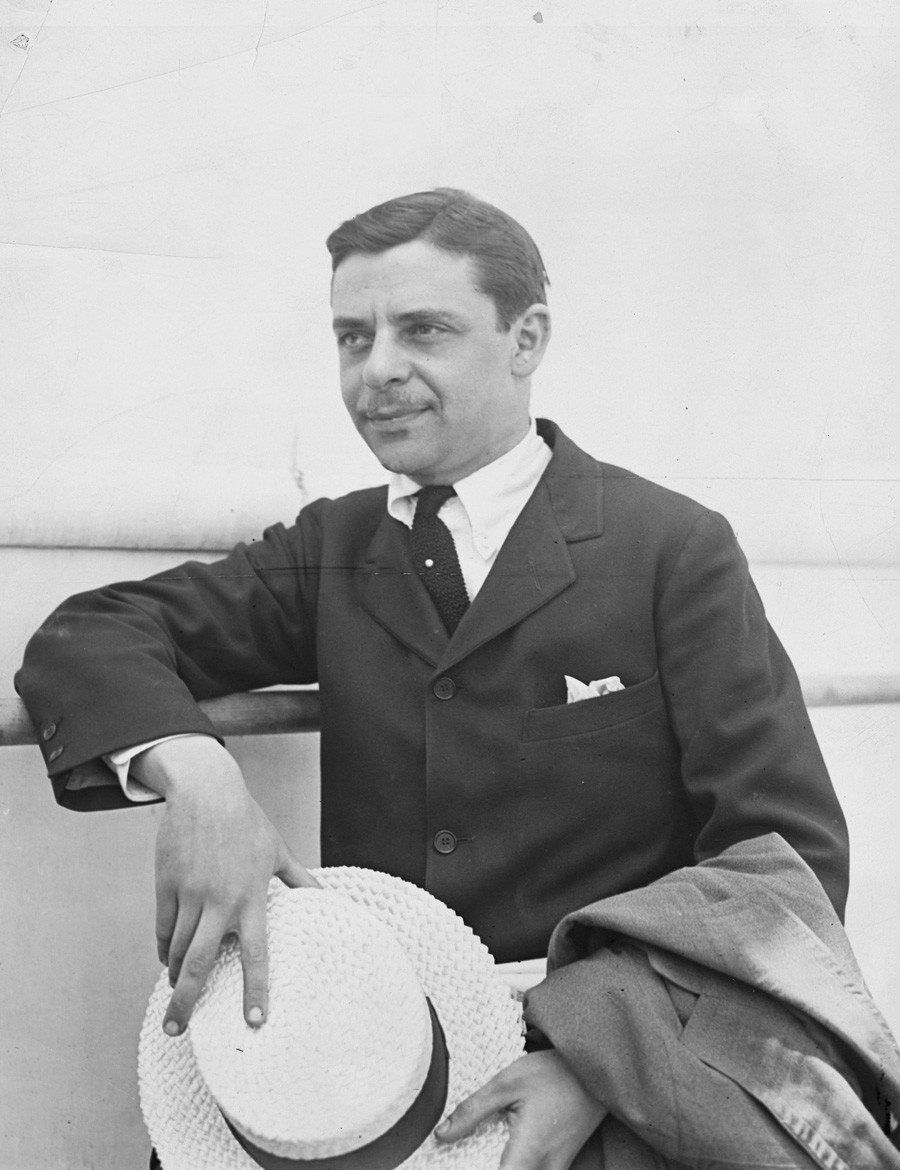
Hammer, born in 1898, had completed medical training at Columbia University and was due to begin work as a hospital resident physician in New York. He travelled with surgical equipment and pharmaceutical supplies intended for relief work during the Russian famine and typhus outbreaks. Yet a journey initially framed as humanitarian assistance developed rapidly into negotiation: the family's American business offered grain in exchange for Russian commodities, and Hammer became interested in an asbestos concession in the Urals. Hammer described these beginnings in later interviews and memoirs, while historian Philip S. Gillette has reconstructed the negotiations from Soviet documentation. [3, 5, 14, 15]
How did he gain access to Lenin? Not simply by arriving at the Kremlin. Lenin's letters, analysed by Gillette, identify the intermediaries: Boris Reinstein, who relayed the proposal, and Ludwig Martens, who negotiated on the Soviet side. In a letter to party leaders dated 14 October 1921, Lenin discussed a grain offer attributed to Julius Hammer, Armand's father, then imprisoned in the United States; Lenin described Julius's son, the young physician Armand, as bringing surgical equipment worth $60,000 for Soviet healthcare and visiting the Urals. In his letter to Martens of 19 October, Lenin urged formalisation of the grain arrangement—even if the nominal concession concerned asbestos or other Urals commodities. He made his reason explicit: it was politically important to show that Americans were willing to enter Soviet concessions. A public example of American commercial cooperation could encourage other investors, reduce the isolation of the new government and demonstrate that foreign business could negotiate with Soviet power despite the absence of normal diplomatic relations. [3, 16, 17]
When did they meet? Gillette reports 22 October 1921 as the date given by two Soviet sources for Hammer's interview with Lenin. The Kremlin apartment museum also recorded 22 October as the date of the bronze gift; Hammer's later memoir instead places the presentation at a second meeting in 1922. These are different chronologies of the gift, not a dispute over whether Hammer and Lenin met in 1921. On 27 October 1921, Lenin wrote to Martens about the contracts, referring to further terms shown by Reinstein and Hammer and emphasising their significance. On 3 November, Lenin addressed Armand Hammer in English, referring to the flour agreement and concession and apologising that party business prevented another meeting. The 3 November letter was published in English facsimile in the Soviet newspaper Krasnaya Gazeta in January 1926; for 14 and 19 October, this essay cites published transcriptions in Lenin's Collected Works, not manuscript facsimiles. [3, 5, 16–19]
How did Hammer use the connection? A direct association with Lenin became both commercial access and a powerful personal credential. Hammer and his associates pursued mineral concessions, grain-and-commodity exchange, machinery imports and later pencil manufacture. He could present himself to American and European businesses as someone who had dealt personally with the head of the Soviet government. For Soviet leaders, the publicity had an equally concrete purpose: a prominent American company's participation signalled that the Bolshevik regime could secure grain, equipment and investment without abandoning state political control. Lenin stated this objective directly in his letter of 19 October. The meeting was unusual but intelligible as part of an organised negotiation that both parties could use to their advantage. [3, 14, 15, 17]
From Imperial Treasure to International Trade
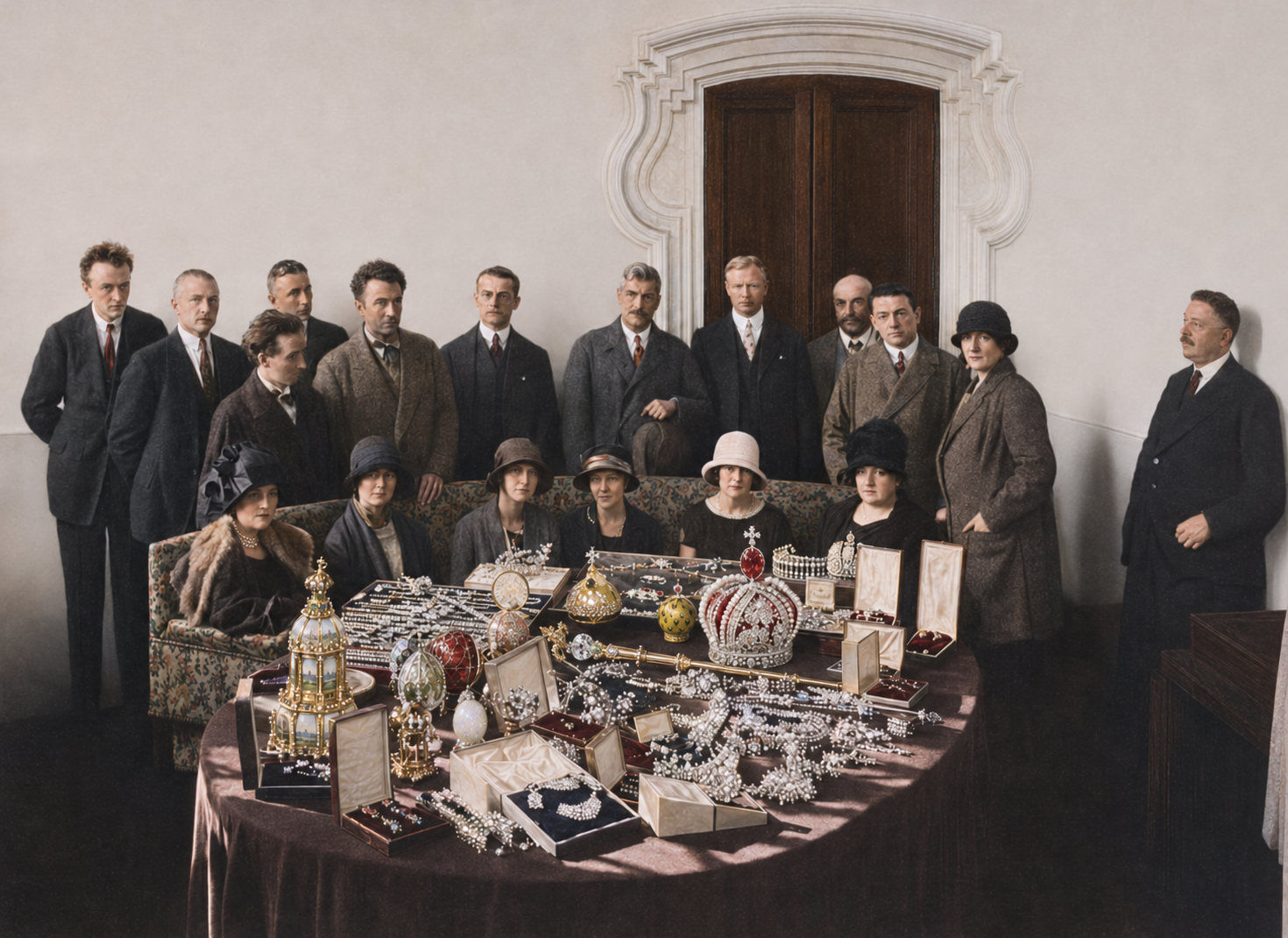
Hammer’s Soviet career soon extended beyond industrial concessions into an international trade in art and valuables. The revolution had nationalised or confiscated royal, aristocratic and private property, while the government faced an acute need for foreign currency. Imperial possessions that had once embodied dynastic prestige could now be catalogued, valued and sold to buyers abroad. The transformation was politically charged: the state repudiated the monarchy but could convert its material legacy into hard currency. [20–22]
A striking 1923 photograph captures foreign diplomatic personnel and their spouses examining former Romanov treasures in Moscow’s Gokhran state depository. The jewels and regalia were displayed for inspection in a country that had only recently abolished the dynasty they represented. The image records the wider world of state-controlled valuation and potential sales; it does not show Hammer conducting a transaction or establish that he handled the objects pictured. [20]
Hammer later became associated with the export and sale of Russian artworks, furnishings and decorative objects. A 1944 TIME account connected his rise as a dealer with the disposal of former Imperial treasures; a 1937 account described the Hammer Galleries marketing Russian icons and luxury objects in New York. Both are useful contemporary journalistic evidence of his public business profile, although their colourful accounts simplify a longer and more complex commercial history. [21, 22]
The irony runs alongside that of Rheinhold’s bronze. A revolutionary regime could repurpose symbols of its defeated monarchy for external trade, just as it could receive an intellectual artwork from a foreign capitalist. The Soviet state was neither economically sealed off nor ideologically untroubled; its early international relations were marked by pragmatic exchange amid profound political antagonism. [12, 13, 21]
The Bronze and Lenin’s Last Months at the Kremlin
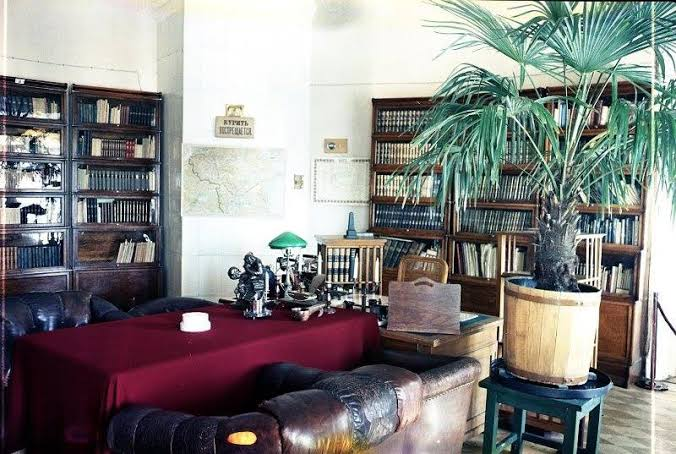
A further irony emerges from the dates. The Kremlin museum catalogue associates Hammer’s gift with October 1921; Hammer recalled presenting the bronze on a subsequent visit in 1922. Either way, the sculpture entered Lenin’s circle at a moment when illness was increasingly interrupting his working life. [3, 5]
Lenin suffered a serious stroke in May 1922 and convalesced at Gorki before returning intermittently to government business that autumn. His last working visit to the Kremlin office was on 12 December 1922; further strokes followed, and he died on 21 January 1924. Hammer’s recollection of a later gift makes for an intriguing possibility: a bronze now so strongly associated with Lenin’s desk may have been there for only a short part of his working life. The museum’s earlier dating leaves open a longer acquaintance. [3, 5, 23, 24]
Semyon Fridlyand’s 1956 photograph of the preserved study places the bronze among the books, lamp and familiar working furniture. By then the little ape had acquired a second life: no longer simply a gift in a statesman’s office, it was an exhibit in the Soviet presentation of Lenin’s memory.
What Did the Monkey Mean to Lenin?
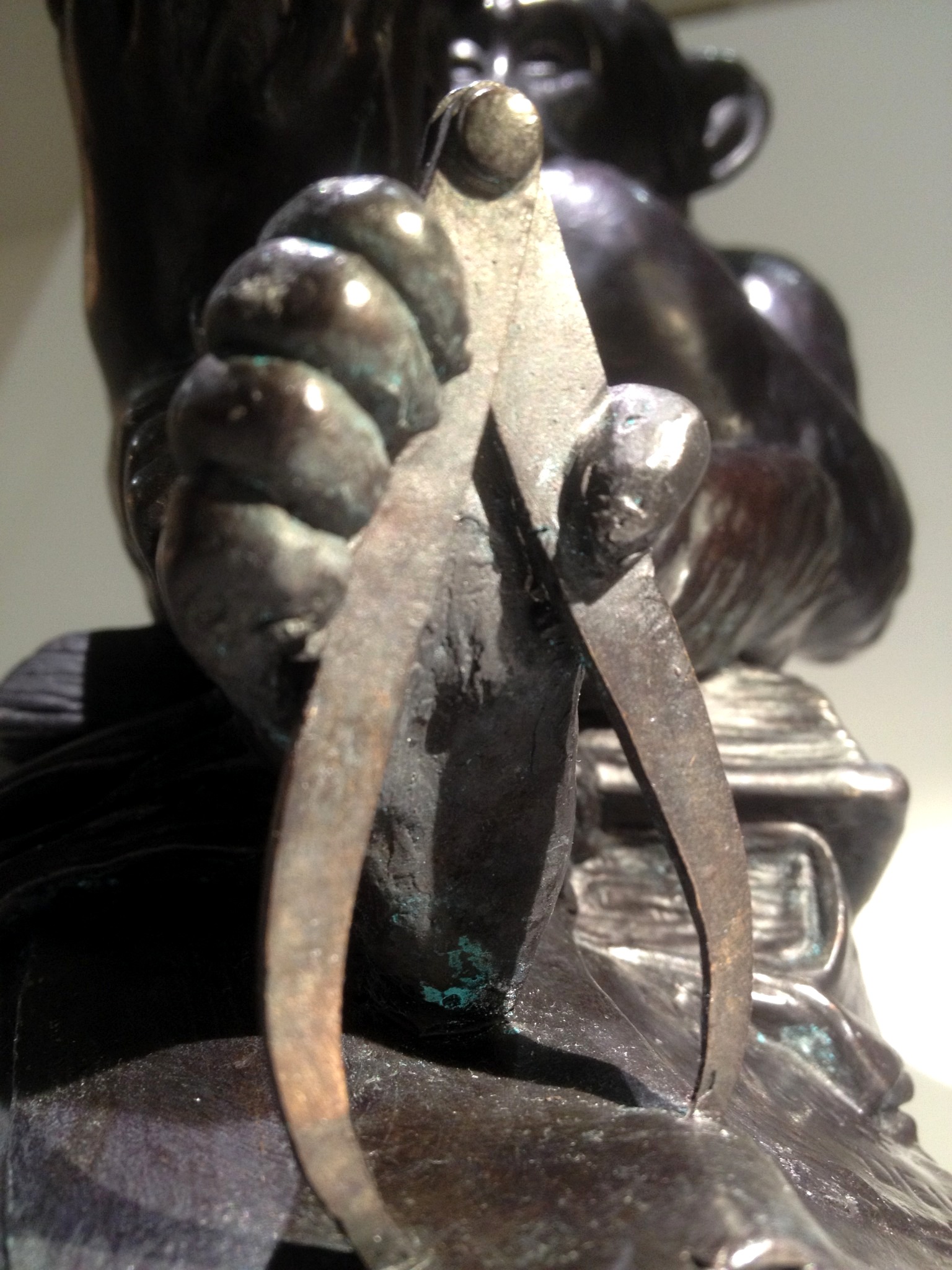
The bronze became a conspicuous feature of Lenin’s preserved Kremlin study, appearing in museum descriptions, press accounts and archival film records. Writers have since seen in the little ape several sharply different reflections of Lenin’s intellectual and political world. [4–6]
Did Lenin ever speak about the statuette? His surviving correspondence with Hammer is concerned instead with the practical business of aid, concessions and trade. In May 1922, Lenin wished Hammer success in his first concession and instructed Soviet officials to help him. Payne later imagined the bronze as a treasured fixture of the room, while a story about Lenin joking at the expense of bureaucrats offers a more mischievous interpretation of the same object. [19, 25, 26, 9]
Scientific materialism. The Darwin book, callipers and biblical page lend themselves to a reading in which scientific enquiry challenges inherited religious authority. For a revolutionary committed to historical materialism, such a sculpture could have appeared an apt, even playful, companion. [1, 7]
The bureaucratic warning. In one often-repeated story, Lenin used the monkey to tease bureaucrats about the danger of humanity evolving backwards. Whether or not he ever made the joke, it captures a familiar Bolshevik impatience with administrative self-importance.
The Western-imperialist parable. Viewed against the catastrophe of the First World War, the skull could also embody the human cost of European claims to scientific, industrial and civilisational superiority. In that interpretation, the ape’s examination becomes a pointed question directed at the supposedly advanced societies that had devastated a continent.
Robert Payne’s “The Ape and the Skull”
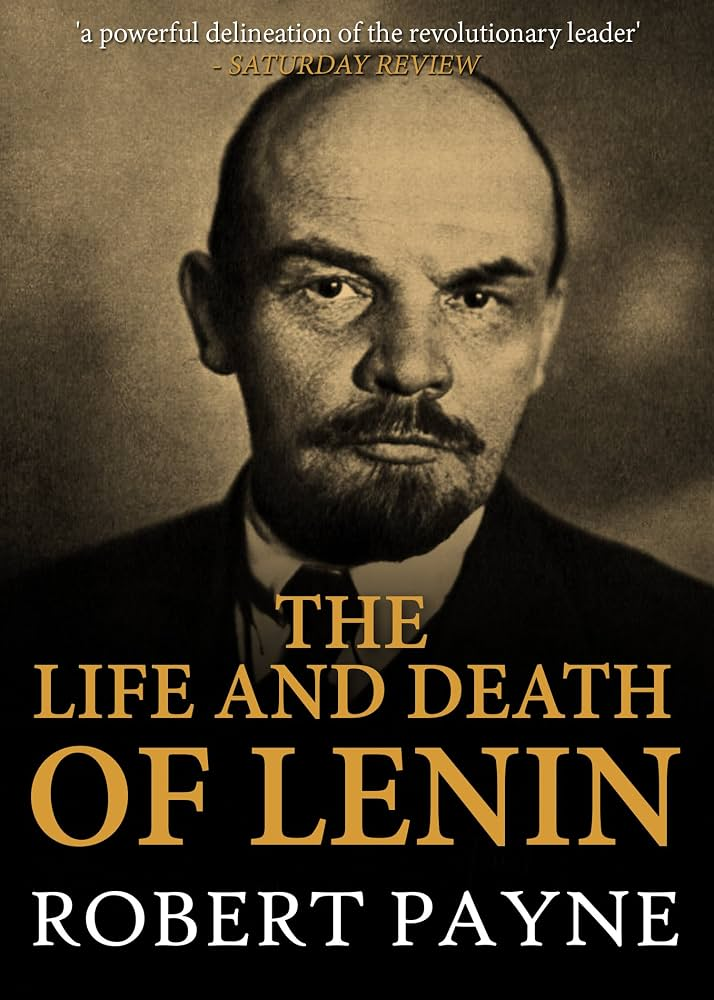
In The Life and Death of Lenin, Robert Payne uses the image of the ape and skull as a closing allegory for Lenin’s revolutionary career. [9] Payne’s approach is explicitly interpretive: the bronze becomes a way to ask whether abstract calculation and the pursuit of historical transformation can eclipse the moral consequences for actual people.
Payne was unimpressed by the object’s appearance, dismissing it as an “ugly and vulgar statue”. Yet his description also finds a compelling confrontation at its centre: “The ape gazes ponderously at the skull, and the skull gazes back at the ape.” His disdain for the bronze becomes the prelude to a sustained attack on the political certainties he associates with Lenin. Rheinhold’s densely allusive sculpture is rather more sophisticated than Payne’s caricature suggests: the callipers, biblical text and Darwin volumes complicate any simple equation of the ape with ignorance or brutality. [9, 27]
Payne links Lenin’s uncompromising revolutionary temperament with the darker tradition of radical politics, including Sergey Nechayev’s severe conception of revolutionary commitment. The parallel with Shigalov’s paradox in Dostoevsky’s Demons—beginning with unlimited freedom and ending in unlimited despotism—sharpens his argument about revolutions that reproduce the coercion they set out to overthrow. [9–11]
As Lenin’s health deteriorated and his influence over the state became increasingly constrained, the sculpture acquired a retrospective poignancy for later writers. It could stand for the tension between rational schemes for a new society and the violence or coercion that their implementation might entail. [9]
History and Legend at a Glance
| Question | Documented or supported | Unverified or interpretive |
|---|---|---|
| Origin | Rheinhold’s bronze emerged in the 1890s. [1] | That it was commissioned by Bolsheviks. |
| Arrival | Hammer gave Lenin a bronze monkey; a museum catalogue records their 1921 meeting. [3, 5] | Detailed stories of a London purchase and reciprocal gifts. |
| Desk | The bronze appears in later photographs of the preserved office, including the rear table behind the writing desk. [4–6] | That it always stood in precisely the same place or faced Lenin directly. |
| Meaning | The sculpture evokes Darwin, Hamlet and Genesis. [1] | Lenin’s supposed remarks about bureaucrats or a definitive personal interpretation. |
Conclusion: The Political Irony
The bronze monkey on Lenin’s desk offers a remarkable visual irony. Rheinhold’s work can be understood as a question about the relationship between knowledge, human exceptionalism and ethical responsibility. Hammer’s gift placed that question within the workplace of a leader attempting to reorder society on an unprecedented scale.
A gift from an American businessman, a curious ape in the Kremlin, and a succession of writers determined to explain its significance: the sculpture has accumulated meanings far beyond the occasion of its presentation. The most compelling account brings together the object itself, Lenin’s turbulent final years and the changing political interpretations imposed upon it.
Bibliography
[1] Derry, J. F. (2005). Rheinhold’s Philosophizing Monkey. Institute of Evolutionary Biology, University of Edinburgh.
[2] Hammer, Armand (1987). Witness to History. Simon & Schuster. [Bibliographic details supplied with the essay; edition/title require checking.]
[3] Gillette, Philip S. (1981). “Armand Hammer, Lenin, and the First American Concession in Soviet Russia.” Slavic Review 40(3). Publisher record.
[4] “Last Look at Lenin’s Apartment.” The Moscow Times. Article.
[5] Kharitonova, E. N. (1980). Ot vsego serdtsa: Podarki V. I. Leninu [From the Heart: Gifts to V. I. Lenin]. Moscow: Izobrazitel’noe Iskusstvo, pp. 97–98, cited and analysed in Nikolai Ssorin-Chaikov, Two Lenins: A Brief Anthropology of Time (2017), chapter “An American in Moscow”, esp. pp. 49–57. Full text.
[6] Net-Film. “V. I. Lenin’s office in the Kremlin” (1970s), archival film description. Archive record.
[7] Darwin, Charles (1871). The Descent of Man, and Selection in Relation to Sex. John Murray.
[8] The Bible, Genesis 3:5 (Latin Vulgate: “Eritis sicut dii”).
[9] Payne, Robert (1964). The Life and Death of Lenin. Simon & Schuster.
[10] Nechayev, Sergey (1869). Catechism of a Revolutionary.
[11] Dostoevsky, Fyodor (1872). Demons (also published as The Possessed).
[12] Library of Congress. “The Soviet Union and the United States,” Revelations from the Russian Archives, section “Early Cooperation: Economic Cooperation.” Exhibition and documents.
[13] “Building a New State and Society: NEP, 1921–1928.” In The Cambridge History of Russia, vol. 3, pp. 168–191. Publisher record.
[14] Hammer, Armand, with Neil Lyndon (1987). Hammer (memoir), reviewed in “Hammer: Odyssey of an Entrepreneur,” Federal Reserve Bank of Minneapolis. Review and historical synopsis.
[15] “Business: Concessionaire in Barrels.” TIME, 21 August 1933. Article.
[16] Lenin, V. I. “Letter to the Members of the RCP(b) Central Committee,” 14 October 1921. Collected Works, vol. 45. Text.
[17] Lenin, V. I. “Letter to Ludwig Martens,” 19 October 1921. Collected Works, vol. 45. Text.
[18] Lenin, V. I. “Letter to Ludwig Martens,” 27 October 1921. Collected Works, vol. 45. Text.
[19] Lenin, V. I. “To Armand Hammer,” 3 November 1921. Collected Works, vol. 45. Text.
[20] Russian State Documentary Film and Photo Archive (Krasnogorsk), via History of Russia in Photographs. “Inspection of the Russian Imperial Family’s jewels by foreign embassy employees and their wives at Gokhran, Nastasyinsky Lane, Moscow,” 1923. Archive record.
[21] “Art: Under the Hammer.” TIME, 20 March 1944. Article.
[22] “Art: Hammer Icons.” TIME, 16 August 1937. Article.
[23] Lenin — Life and Works, chronology for 1922, using Collected Works, vol. 42, pp. 474–478 (including the last office visit on 12 December). Chronology (PDF).
[24] Lenin Internet Archive. “Timeline: 1922–1924” (strokes, final working period, death). Chronology.
[25] Lenin, V. I. “To Armand Hammer,” 11 May 1922. Collected Works, vol. 45, pp. 542c–543a. Original correspondence.
[26] Lenin, V. I. “To G. Y. Zinoviev,” 11 May 1922, accompanying telephone message concerning Hammer’s concession and shipment. Correspondence.
[27] Payne, Robert. “The Ape and the Skull”, passage reproduced in Lenin’s Body, 31 March 2016. Secondary transcription of the passage from [9]. Reproduced passage.
[28] Boasson and Eggler (1913). Photograph of the Romanov Imperial family. Public-domain image record.
[29] Leonidov, Lev (1921), attributed. Lenin, Trotsky and other delegates to the Tenth Congress, March 1921. Image record.