Introduction
The late nineteenth century in Wilhelmine Germany was defined by profound intellectual and social fracturing. The rapid ascent of industrialisation, the paradigm shift of Darwinian evolutionary theory, the intensifying polarization between the imperial bourgeois establishment and the rising socialist working class, and the disturbing undercurrent of political anti-Semitism created a volatile cultural landscape [1, 2]. Intellectuals were forced to grapple with a fundamental crisis of authority: as traditional religious frameworks weakened under the weight of scientific materialism, where could society find a stable, universal foundation for human morality?
Few individuals embodied this multi-faceted crisis—and sought to resolve it—as uniquely as the Berlin sculptor and essayist Hugo Rheinhold (1853–1900) [2, 4]. Historically celebrated for his iconic 1893 bronze sculpture Affe mit Schädel ("Ape with Skull"), Rheinhold was far more than an artist; he was an insightful public intellectual, an advocate for enlightened Judaism, and a foundational leader within the German Society for Ethical Culture (Deutsche Gesellschaft für ethische Kultur) [2, 3]. His intellectual background seamlessly bridged the worlds of international commerce, rigorous scientific philosophy, institutional Jewish community defense, and radical secular humanism [9].
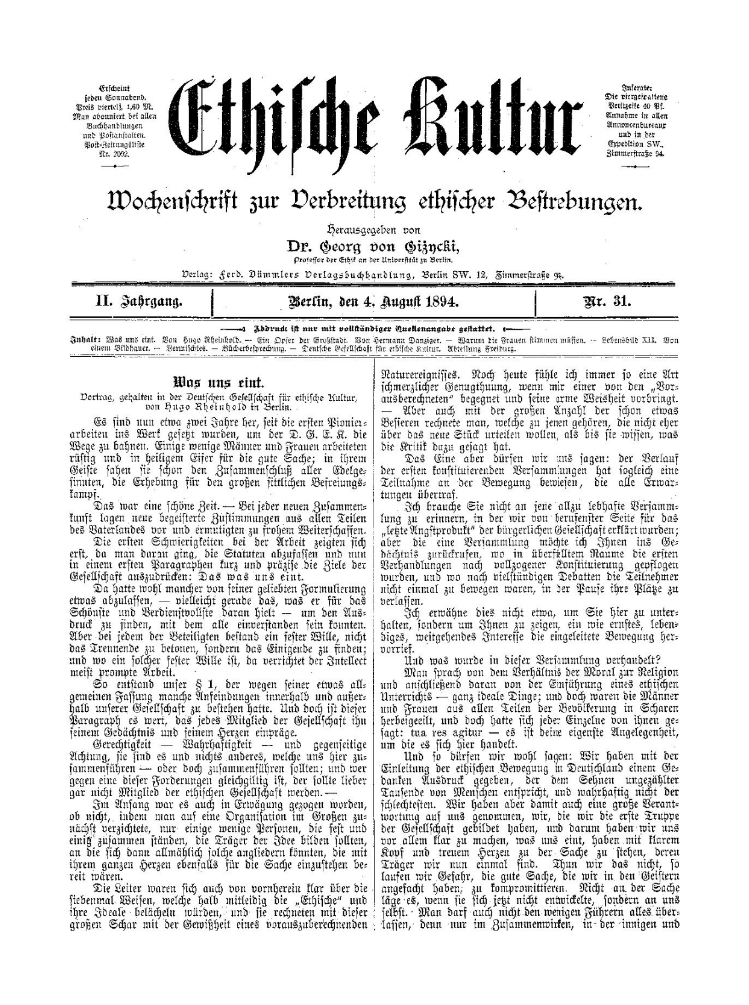
The definitive synthesis of Rheinhold’s worldview can be found in his seminal 1894 address, Was uns eint ("What Unites Us"), delivered before the Ethical Culture Society and published in three installments in the movement’s journal, Ethische Kultur [1]. Investigating Rheinhold’s intellectual evolution, his deepseated Jewish and humanistic beliefs, and the textual architecture of Was uns eint reveals a thinker who recognized that while science explains the mechanics of life and religion characterizes its historical origins, it is only a purified, independent framework of ethical practice that can ultimately unite a divided humanity.
Intellectual Background: The Merchant Turned Scientist-Philosopher
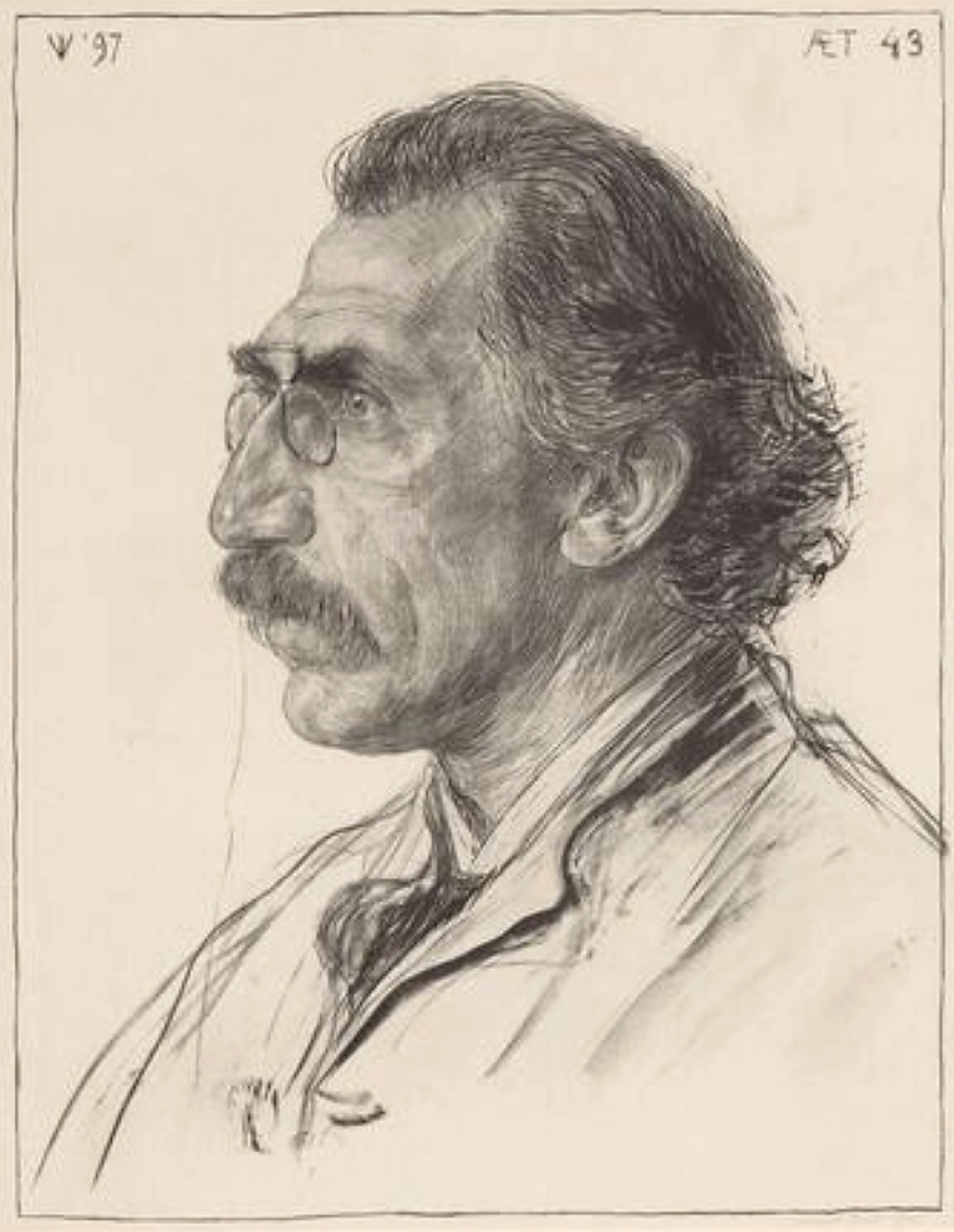
Rheinhold’s path to becoming a cultural philosopher and artist was highly unconventional, marked by geographical mobility and profound personal tragedy [2]. Born into a Jewish family in Oberlahnstein, Prussia, in 1853, his early adulthood was dedicated to international trade [9]. Rheinhold spent four years in San Francisco working in commerce, an experience that preceded his establishment of an import-export business in Hamburg [9].
Upon returning to Germany, he established an import-export business in Hamburg and married Emma Levy [9]. The trajectory of Rheinhold’s life fractured in 1882 when Emma died just eighteen months into their marriage [2, 4]. Overwhelmed by grief, Rheinhold took a step that defines his intellectual severity: he left his mercantile career and relocated to Berlin to dedicate himself to an intense, formal education in science and philosophy [9].
Enrolling at the Friedrich-Wilhelms University, Rheinhold spent the mid-1880s immersing himself in the dominant academic debates of his era—most notably the philosophical implications of Charles Darwin’s evolutionary theories [2]. This period of scientific training left an indelible mark on Rheinhold’s mind. Unlike many of his contemporaries who viewed science through a lens of uncritical materialism or reactive theological terror, Rheinhold absorbed scientific empiricism as a methodology of truthfulness [2].
He recognized that natural science had liberated human thought from dogmatic superstition, yet he remained deeply cautious of a purely reductive materialism that stripped human existence of its moral imperative [2, 4]. It was only after this exhaustive intellectual immersion that, in the later 1880s Rheinhold turned to the arts, studying first in a sculptor’s atelier and then at the Berlin Academy of Arts; the Getty authority record also identifies Ernst Herter as a teacher [9]. His subsequent artistic creations were never merely aesthetic exercises; they were the physical manifestations of a mind deeply trained in scientific epistemology and philosophical ethics [2].
Judaism, Identity, and the Fight Against Anti-Semitism
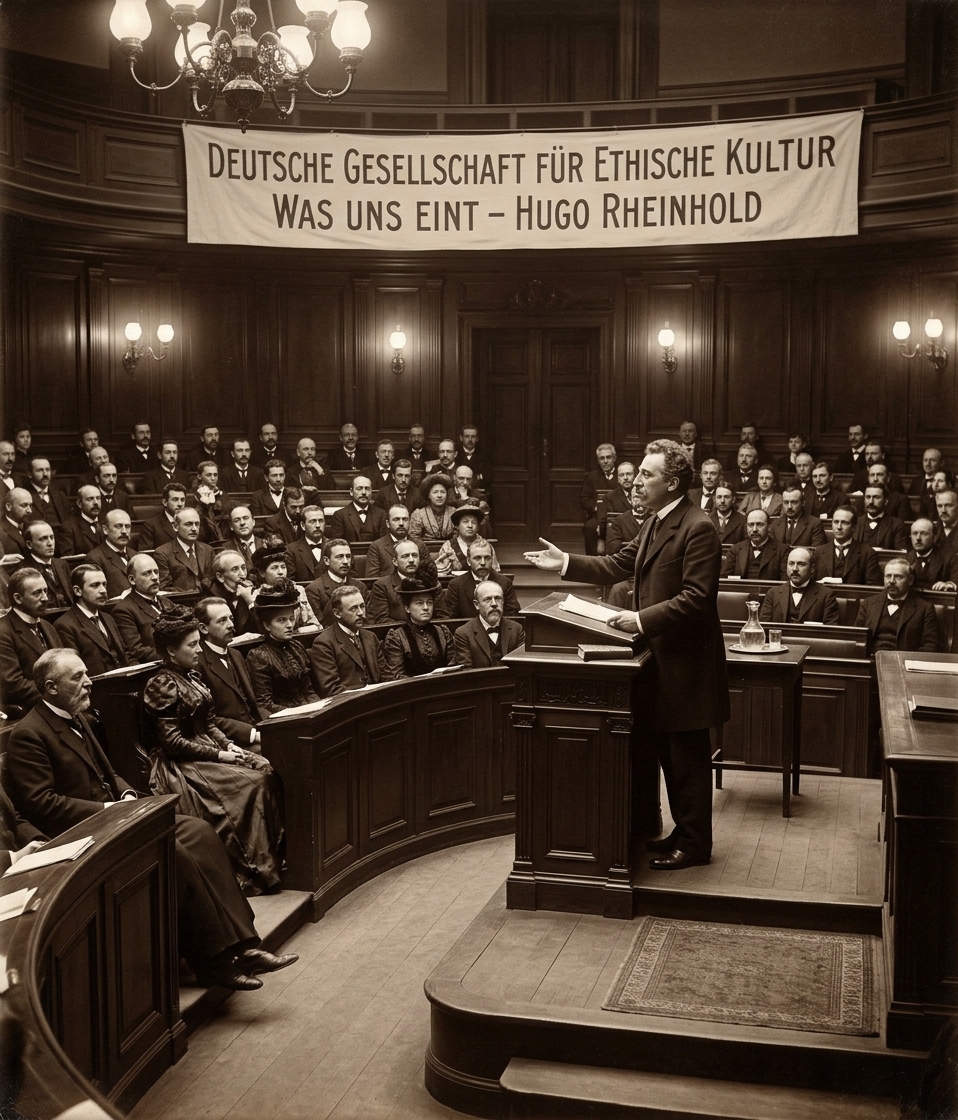
As Rheinhold established his artistic and philosophical footing in Berlin, he found himself operating within an environment of escalating cultural anxiety for German Jewry. The 1880s and 1890s witnessed the political weaponization of anti-Semitism in Germany, championed by figures like the court chaplain Adolf Stoecker. In response to this existential threat, Rheinhold did not retreat into assimilation, nor did he abandon his heritage in favor of an abstract, detached cosmopolitanism. Instead, he maintained a proud commitment to his Jewish identity, channeling his organizational talents into structural community defense [3].
Rheinhold became an active, driving force within the DeutschIsraelitischer Gemeindebund (the Association of GermanJewish Corporations), working to safeguard the legal and social status of Jews across the Empire [3]. His art directly reflected this struggle. His sculpture Die Kämpfer ("The Warriors") was associated by an early biographical source with his response to antisemitic attacks [9]. For Rheinhold, Judaism was not a collection of insular, dogmatic restrictions that isolated Jews from modern progress.
Rather, he viewed it as a profound ethical tradition capable of working in harmony with contemporary European science and universal human welfare [3]. His later involvement in secular ethics was an extension, rather than a rejection, of this enlightened Jewish perspective; he sought to translate the prophetic demand for justice into a universal vocabulary that could be embraced by all human beings, regardless of their theological convictions.
The Ethical Culture Movement in Germany
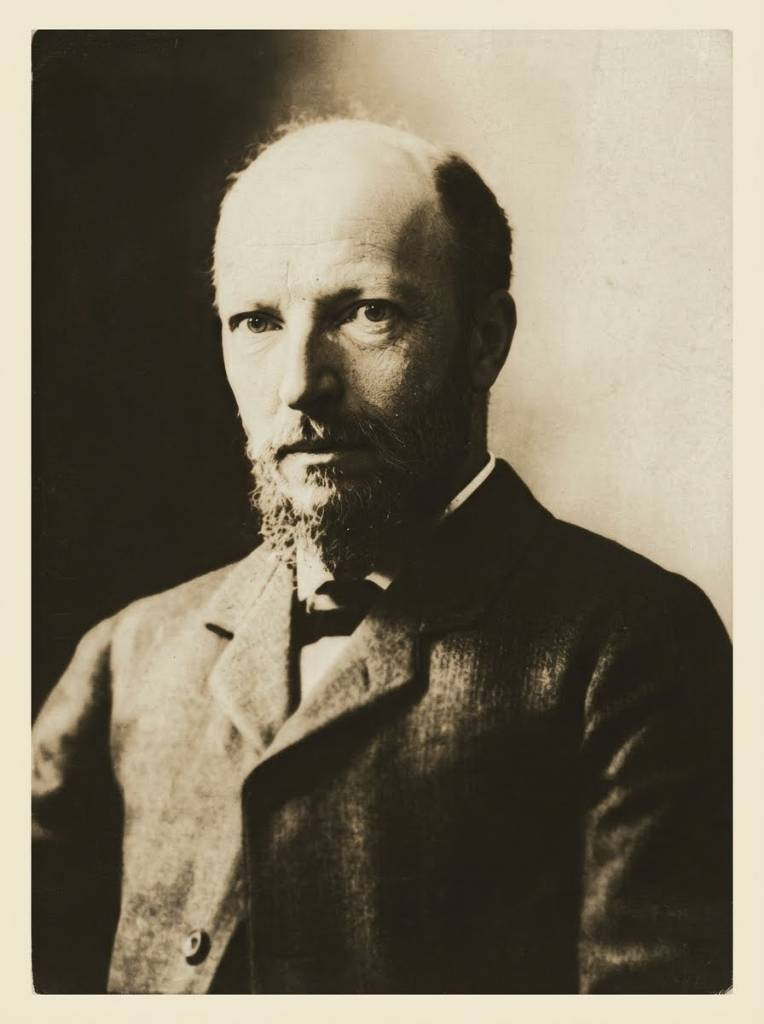
Rheinhold’s quest for a universal moral framework led him to co-found the German Society for Ethical Culture in 1892 [1]. The movement had originated in New York in 1876 under the leadership of Felix Adler, the son of a rabbi who had similarly transitioned from religious leadership to universalist ethical philosophy. Adler’s central premise—that deed matters more than creed, and that morality possesses an inherent validity completely independent of supernatural revelation—found a powerful resonance in Germany.
The establishment of the Deutsche Gesellschaft für ethische Kultur was met with immediate hostility from the state, theological authorities, and conservative political parties. In a state where the throne and the altar were tightly intertwined, an organization advocating for an ethics divorced from the Christian church was viewed as subversive. The Prussian authorities placed the society under surveillance, viewing it as a gateway to atheism, socialism, or social anarchy. Conversely, as Rheinhold notes in Was uns eint, some radical left-wing critics dismissed the society from an authoritative stance as the "last product of fear of bourgeois society," viewing it as a weak attempt by the bourgeoisie to patch over systemic economic injustices with moral platitudes [1].
Despite these dual pressures, the movement attracted crowds of eager citizens. Rheinhold observed that "men and women from every section of the population had hurried there in crowds," indicating a profound social longing for an ideal concern that directly impacted their personal lives [1].
Rheinhold’s Berlin society belonged to a wider movement that had begun with Felix Adler’s New York address in 1876. Adler’s programme made ethical conduct a common undertaking among people with different religious and philosophical commitments. The German society, established in 1892, brought that ambition into a setting shaped by debates over education, social reform and the place of religion in public life. Later scholarship identifies Georg von Gizycki, Wilhelm Foerster and Friedrich Jodl among its principal organisers. [5] [7] [8]
The diagram below offers a thematic guide to the argument, rather than a claim that Rheinhold himself divided the address into these three formal categories.
An important distinction emerges between a society without a common theology and a society without convictions. Ethical Culture did not demand indifference to religion; it asked whether adherents of different traditions could agree on obligations toward one another without first settling metaphysical disagreements. The movement’s institutional setting was therefore as significant as its abstract programme: lectures, associations and educational initiatives offered places in which shared duties might be discussed and practised [5, 6, 8].
The American origins of Ethical Culture mattered, but Rheinhold was adapting the movement to German circumstances rather than simply repeating Felix Adler’s New York programme. His 1894 address records the practical difficulty of sustaining a broad association amid objections from religious conservatives and the political left. Its central question—what actually unites participants who disagree about first principles?—was also a question about the boundaries of an organisation. Agreement on justice, truthfulness and mutual respect offered a narrower, more workable foundation than agreement on an entire philosophy of life [1].
What Unites Us: Ethical Independence and Moral Practice
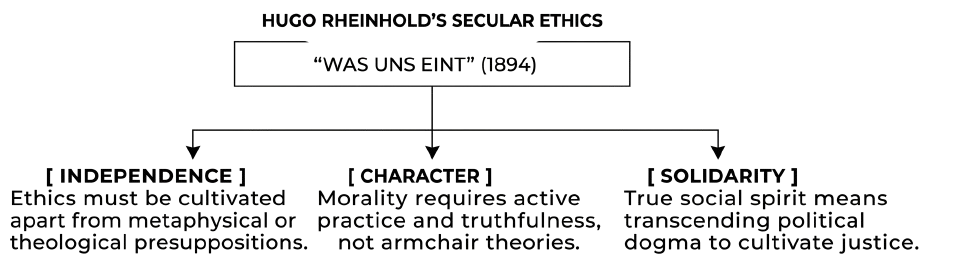
In Was uns eint, Rheinhold recounts the constitutional challenges of defining the movement's shared purpose, culminating in Section 1’s mandate of "Justice, truthfulness and mutual respect" as non-negotiable requirements for membership [1]. He argues that traditional religion fails as a unifying social force because its reliance on the supersensible fragments humanity into competing, exclusionary dogmas [1]. Instead, ethics must operate as an independent sphere dedicated to "the simple devotion of the heart to the good" [1].
Addressing critics like Bishop Haffner—who dismissed ethical culture as a blade-less knife—Rheinhold defends the movement by drawing a parallel to university departments: just as the "Society for Surgery" operates independently of theology, ethics must be free to develop without religious monopoly [1].
Rheinhold posits that the absence of a rigid philosophical theory is what unites the movement, preventing endless sectarian debates among scholars [1]. Dismissing Schopenhauer’s claim that moral foundations must precede action, Rheinhold notes that criminal judges impose justice and Homer wrote epics long before academic theories caught up [1]. Addressing the era's sharp political divisions, Rheinhold insists that the society must maintain strict political neutrality [1].
True social spirit (sozialer Geist) requires working unselfishly for the collective welfare rather than letting the organization become the servant of any single political party [1].
The address is especially interesting because its independence is methodological rather than an assertion that every religious belief must be discarded. Rheinhold’s analogy with a professional society separates the task at hand from the ultimate convictions of its members. A surgeon’s work does not require consensus about theology; likewise, cooperation in ethical action need not await agreement about the supernatural. The argument is not that moral disagreements vanish, but that a shared practice can begin before their philosophical resolution [1].
His emphasis on character also prevents the argument from collapsing into mere procedural tolerance. Truthfulness and mutual respect are demanding virtues: they constrain how members argue, represent evidence and treat opponents. Justice is not simply the absence of open hostility, but a positive standard by which social conduct can be judged. The three headings in the accompanying diagram—independence, character and solidarity—are an analytical reading of these recurring themes, not Rheinhold’s own formal chapter divisions [1].
The political neutrality Rheinhold advocated has an important limit. Refusing affiliation with a party is not the same as refusing to judge injustice. The distinction becomes clear when his Jewish communal work and his response to antisemitism are considered alongside the address. A commitment to mutual respect may be politically non-partisan in form while remaining morally consequential in a society that denies equal standing to some of its members [1, 9].
Art, Universalism and the Moral Meaning of Affe mit Schädel
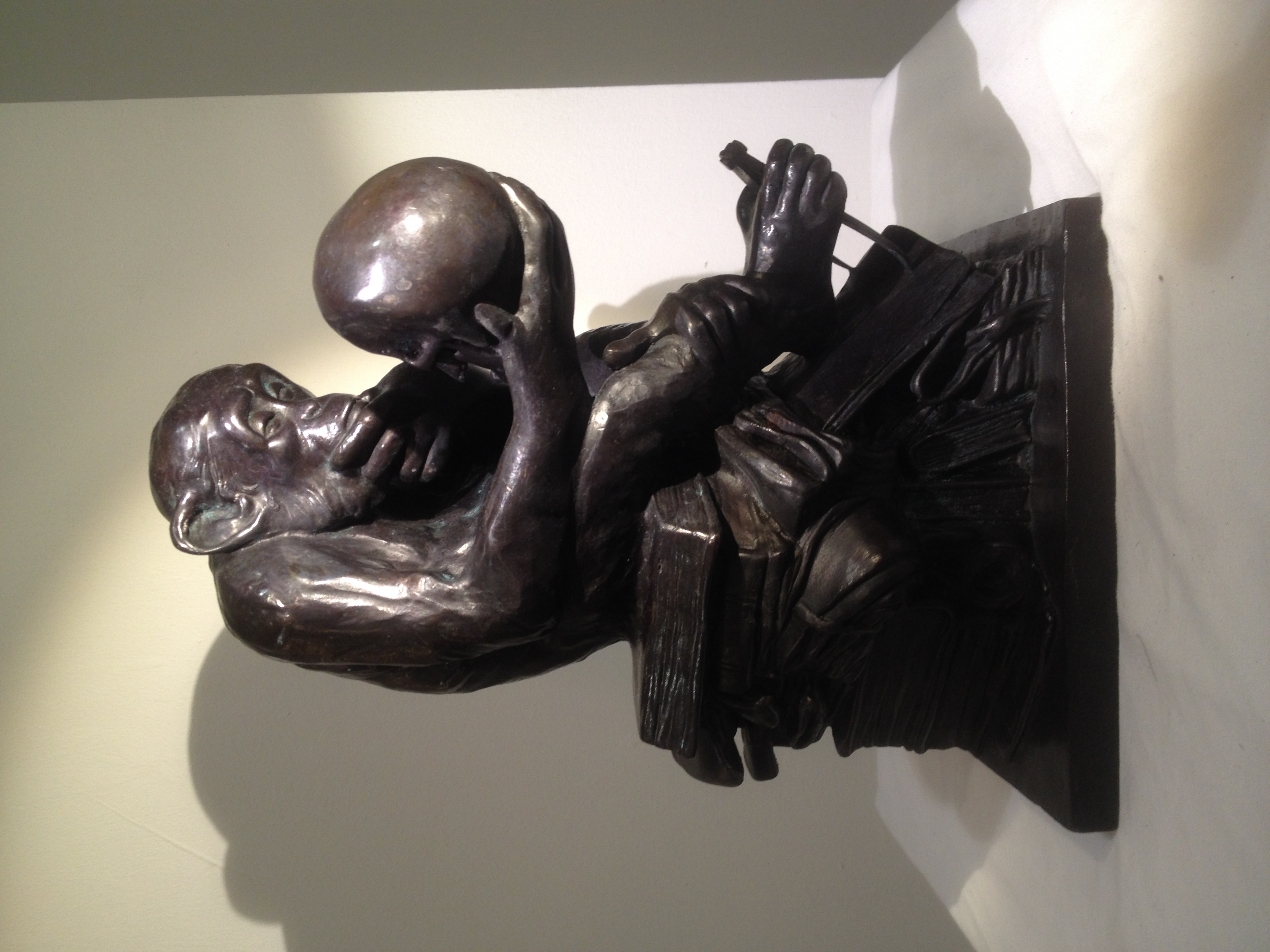
Rheinhold’s 1893 sculpture Affe mit Schädel brings together a seated ape, a human skull and books associated with Darwinian evolution and biblical tradition. The figure holds the skull in a gesture that recalls philosophical contemplation, while the books place the animal within the contested intellectual landscape of the late nineteenth century [2, 3].
At first sight the sculpture appears to be a joke about evolution: an ape takes up the familiar pose of a human philosopher. Yet the skull makes that joke disquieting. It brings mortality and the fragility of human self-importance into a scene otherwise dominated by intellectual confidence. The animal is not simply an object of scientific classification; it has been given the outward attitude of an inquiring subject. This inversion makes the viewer consider whether reason, dignity and ethical judgement can be assigned as neatly as inherited hierarchies suppose [2, 3].
The books are equally important. Darwinian natural history had made human origins a matter of empirical investigation, while biblical language still supplied a powerful vocabulary for human identity and aspiration. By setting these traditions beside one another, Rheinhold gives visible form to the cultural collision discussed throughout this essay. Neither a rejection of science nor a straightforward endorsement of religious authority is required to appreciate the question the sculpture poses: what should human beings do with the knowledge they acquire?
That question is close to the practical emphasis of Was uns eint. In the address, ethical action does not wait for agreement on ultimate causes; in the sculpture, the confrontation of natural history, human mortality and inherited religious imagery resists any easy intellectual triumph. The common thread is the insufficiency of knowledge alone as a guide to conduct. The bronze therefore offers a visual counterpart to Rheinhold’s insistence that truthfulness, justice and mutual respect must be enacted rather than merely defended in theory [1, 2].
The comparison also has a social dimension. In a society marked by confessional division and antisemitic exclusion, the question of who counts as fully human was hardly abstract. Rheinhold’s Jewish communal work demonstrates that his universalism coexisted with particular obligations to people facing discrimination. The sculpture’s unsettled boundaries between human and animal, thought and instinct, knowledge and wisdom acquire additional force when viewed against that historical background [3, 9].
The ethical independence Rheinhold defended was not simply a refusal of religion. It was a proposal for cooperation across disagreements about ultimate belief. Yet independence also raises a difficult question: can shared moral commitments remain effective without political institutions capable of protecting them? Myriam Bienenstock’s study of Hermann Cohen and Ethical Culture traces precisely this tension, observing that universal ethical ideals may need the support of laws if they are to avoid becoming another marginal association. This is a later scholarly comparison, not a position attributed to Rheinhold himself. [5]
Recent scholarship likewise treats the German Ethical Culture movement as an actor in educational and social reform, rather than merely an abstract philosophical school. Read against that background, Rheinhold’s insistence on truthfulness, mutual respect and practical conduct becomes a programme for public life, even while his own call for party-political neutrality remains open to debate. [6]
The sculpture and the 1894 address belong to the same concentrated period of Rheinhold’s intellectual life. Read together, they reveal a sustained concern with what scientific discovery means for moral responsibility, without reducing the artwork to a literal illustration of the later address [1, 2].
The relationship between Rheinhold’s Jewish commitments and his universal ethical language is particularly revealing. The contemporary biographical account identifies his work as treasurer of the Deutsch-Israelitischer Gemeindebund and associates Die Kämpfer with his response to antisemitic attacks. These are concrete commitments, not merely retrospective interpretations of a supposedly secular artist. His defence of a common ethical culture can consequently be read alongside, rather than in place of, his participation in Jewish communal life [9].
The historical tension did not disappear after Rheinhold’s death. Bienenstock’s discussion of Hermann Cohen shows how a sympathetic participant in Ethical Culture came to question whether voluntary associations alone could secure universal ideals. Without effective law and public institutions, moral principles risk remaining the property of a small, self-selecting group. That later debate sharpens the stakes of Rheinhold’s position without proving that he anticipated Cohen’s conclusions [5].
Richter and Schmetzke’s reading of its layered scientific and religious symbolism opens a particularly fruitful way of understanding the bronze alongside the 1894 address. The sculpture’s chimpanzee, skull and books support several complementary interpretations; its intellectual richness is precisely what makes the comparison illuminating [1, 2].
Conclusion: The Demands of a Shared Humanity
Hugo Rheinhold’s intellectual synthesis in Was uns eint demonstrates that human unity relies not on shared dogmas or partisan politics, but on practical moral action [1]. By detaching ethics from metaphysical and political conflicts, Rheinhold established a cooperative framework centered on justice, truthfulness, and mutual respect [1, 2].
What makes Rheinhold distinctive is not that he solved the philosophical disputes of his age, but that he proposed a way of acting together while they remained unresolved. Science could alter the account of human origins; religious communities could continue to disagree about revelation; political movements could struggle over the future of the German Empire. None of these conflicts, he argued, cancelled the immediate obligations of justice, truthfulness and respect [1].
His biography gives that proposal unusual weight. The merchant who crossed the Atlantic, the student of science and philosophy, the Jewish communal advocate and the sculptor were not separate personalities. Each inhabited institutions in which intellectual commitments had practical consequences. His participation in the German Ethical Culture movement brought these experiences into a public programme that sought cooperation without demanding uniformity [1, 9].
There was nevertheless a tension at the heart of the programme. Ethical independence protected the association from confessional and party-political capture, but voluntary agreement could not by itself guarantee that injustice would be corrected. Later debates around Hermann Cohen and the movement’s social and educational ambitions make this problem especially visible: the aspiration to universal respect continually encounters the need for institutions capable of putting it into effect [5, 6].
Affe mit Schädel and Was uns eint illuminate different sides of this problem. The bronze disturbs inherited certainties about human exceptionalism and the authority of knowledge; the address asks how people should behave once such certainties have been disturbed. Their continuing interest lies in this conjunction of intellectual humility and moral seriousness. Rheinhold’s answer to division was neither a new dogma nor withdrawal from public life, but the demanding work of making shared principles visible in conduct.
Bibliography
[1] Rheinhold, Hugo. “Was uns eint.” Ethische Kultur: Wochenschrift zur Verbreitung ethischer Bestrebungen, vol. II, no. 31 (4 August 1894), pp. 241–243; no. 32 (11 August 1894), pp. 251–253; no. 33 (18 August 1894), pp. 258–260.
[2] Richter, Jochen, and Axel Schmetzke. “Hugo Rheinhold’s Philosophizing Monkey—a Modern Owl of Minerva.” NTM: International Journal of History and Ethics of Natural Sciences, Technology and Medicine, vol. 15, no. 2 (2007), pp. 81–97. https://doi.org/10.1007/s00048-006-0247-5.
[3] Schmetzke, Axel. Hugo Rheinhold... and His Philosophizing Monkey. University of Wisconsin–Stevens Point, Online Research Repository, 1999/2008.
[4] Derry, J. F. Rheinhold’s Philosophizing Monkey. Edinburgh, 2005. Included as earlier interpretive commentary; not relied upon here for specific biographical assertions.
[5] Bienenstock, Myriam. “Assessing Ethical Culture in Germany: Friedrich Albert Lange, Felix Adler—and Hermann Cohen.” Journal of the History of Ideas 86, no. 2 (2025): 237–261. https://doi.org/10.1353/jhi.2025.a959033.
[6] Engelmann, Sebastian. “Die Verantwortung des Menschen für die Kultur—Arenen der Kulturarbeit in der Ethischen Bewegung in Deutschland um 1900.” Vierteljahrsschrift für wissenschaftliche Pädagogik 101, no. 2 (2025): 245–262. https://doi.org/10.30965/25890581-10102007.
[7] Lanser, Edith. “Die ‘Ethische Gesellschaft’ als Gelehrten-Netzwerk in der Zeit vor dem Ersten Weltkrieg.” In Die Soziologie und ihre Nachbardisziplinen im Habsburgerreich, edited by Karl Acham. Böhlau, 2020.
[8] Adler, Felix. Founding Address to the New York Society for Ethical Culture, 15 May 1876. American Ethical Union, archival text. https://aeu.org/wp-content/uploads/Founding-Address.pdf.
[9] Singer, Isidore, and S. Mannheimer. “Rheinhold, Hugo.” The Jewish Encyclopedia (1901–1906), vol. 10, pp. 399–400. https://jewishencyclopedia.com/articles/12724-rheinhold-hugo.