Hugo Rheinhold · Original German and English
Was uns eint — What Unites Us
Hugo Rheinhold · 1894
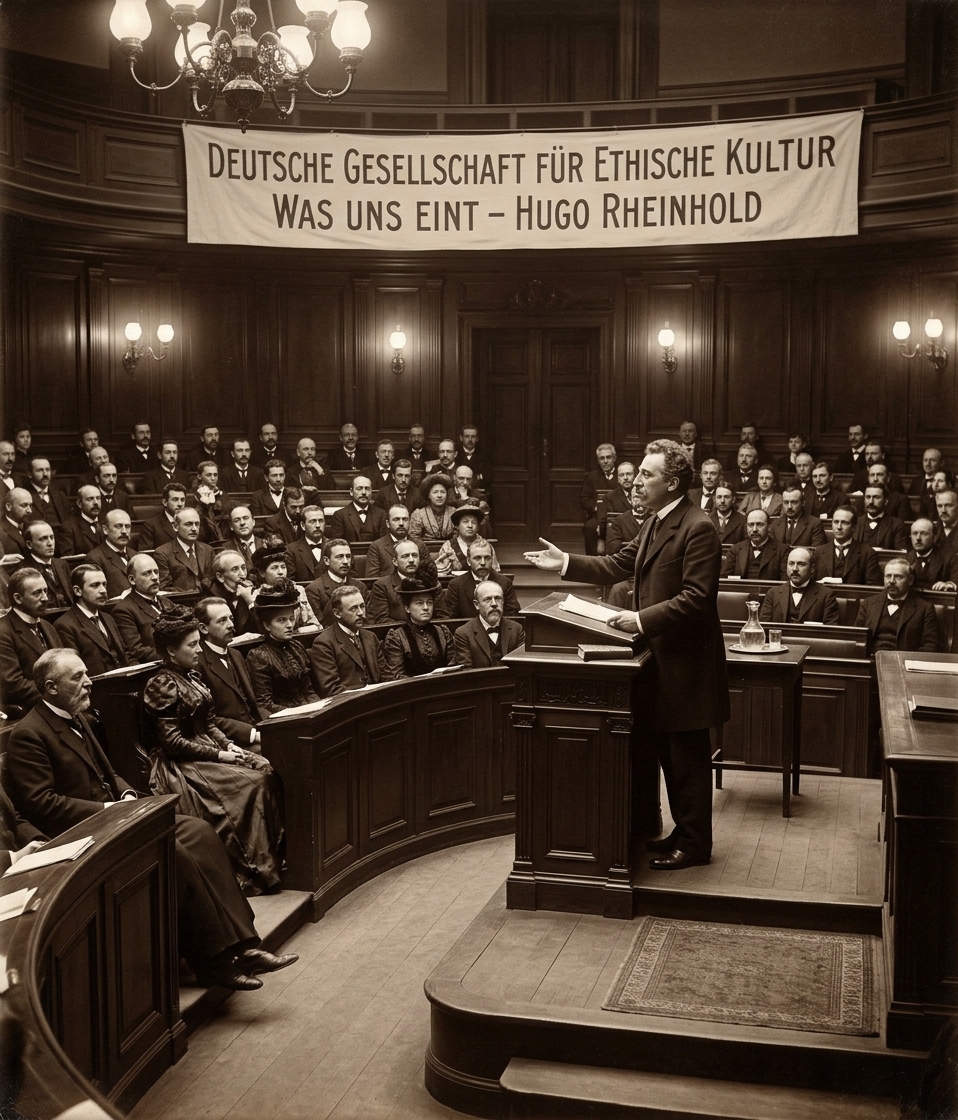
Published in three instalments of Ethische Kultur in August 1894, Hugo Rheinhold’s Was uns eint was delivered as an address to the German Society for Ethical Culture. It asks how people divided by religious, philosophical and political convictions can find common ethical ground. Its arguments about truthfulness, justice and moral responsibility offer direct evidence of Rheinhold’s philosophical interests, alongside the questions of belief and knowledge raised by Affe mit Schädel.
Instalment I · 4 August 1894
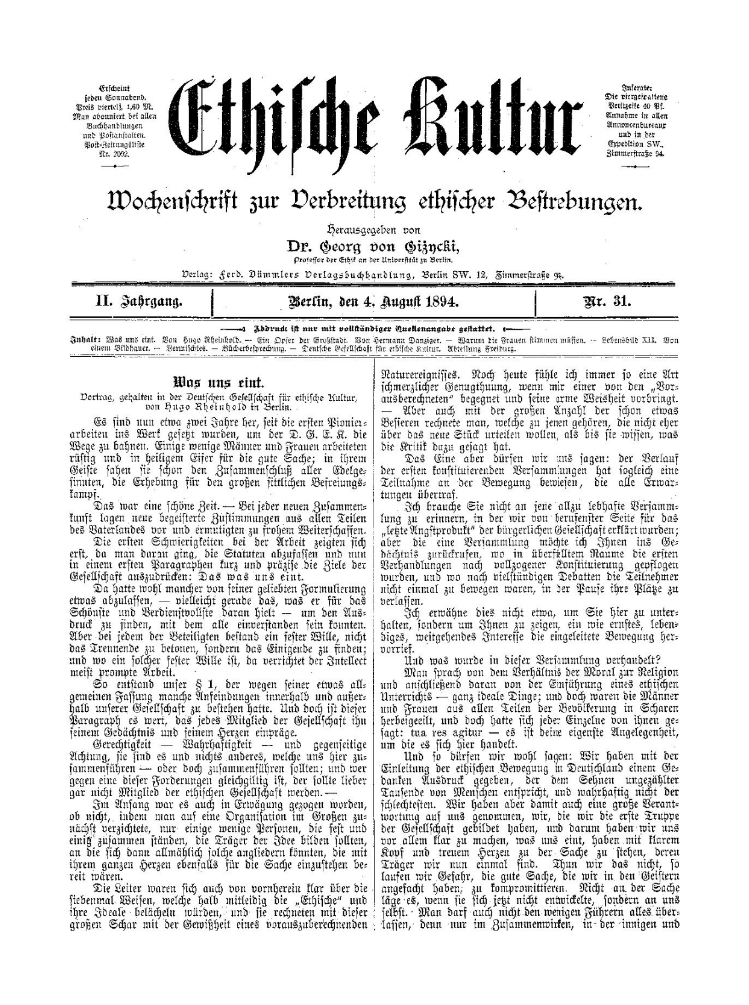
English translation · Page 241
What Unites Us.
An address delivered in the German Society for Ethical Culture, by Hugo Rheinhold in Berlin.
It is now about two years since the first pioneering work was undertaken to prepare the way for the German Society for Ethical Culture. A few men and women worked vigorously and with sacred zeal for the good cause; in their minds they already saw all people of noble disposition coming together, rising up for the great struggle for moral liberation.
That was a fine time. At every new gathering, fresh, enthusiastic expressions of support arrived from all parts of the fatherland and encouraged us to continue our work with good cheer.
The first difficulties in the work arose only when we came to draft the statutes and express the Society’s aims briefly and precisely in a first paragraph: that which unites us.
Many a person must then have relinquished something of his cherished formulation—perhaps precisely what he considered its most beautiful and meritorious feature—to find an expression with which everyone could agree. But every participant firmly wished not to emphasise what divided us, but to find what united us; and where such a firm will exists, the intellect generally does its work promptly.
Thus our Section 1 came into being. Because of its somewhat general wording it had to withstand many attacks both within and outside our Society. Yet this paragraph deserves to be impressed upon the memory and heart of every member of the Society.
Justice, truthfulness and mutual respect: these, and nothing else, bring us together here—or at least should bring us together; and anyone indifferent to any one of these requirements would do better not to become a member of the ethical society at all.
At first it was also considered whether, initially foregoing organisation on a large scale, only a few people standing firmly and united together should bear the idea, gradually joined by others equally ready to stand wholeheartedly for the cause.
From the outset the leaders were also clear about those supremely wise people who would smile half-pityingly at the ‘Ethical Society’ and its ideals, and they reckoned with this great host with the certainty of a predictable natural event. Even today I always feel a kind of painful satisfaction when I meet one of those ‘predicted’ people and he produces his paltry wisdom. But they also reckoned with the great number of somewhat better people who belong to those unwilling to judge a new play until they know what the critics have said about it.
One thing, however, we may say: the course of the first constituent meetings immediately demonstrated an interest in the movement exceeding all expectations.
I need not remind you of that excessively lively meeting at which we were pronounced, by an authoritative voice, the ‘last product of fear’ of bourgeois society. But I would recall to your memory that meeting in an overcrowded room where the first proceedings after the formal constitution took place, and where, after many hours of debate, the participants could not even be persuaded to leave their seats during the interval.
I mention this not to entertain you here, but to show you what serious, lively and far-reaching interest the movement we had launched aroused.
And what was discussed at that meeting?
People spoke about the relationship of morality to religion and, following that, the introduction of ethical instruction—entirely ideal concerns; yet men and women from every section of the population had hurried there in crowds, and each had said to himself: tua res agitur—it is your own most personal concern that is at issue here.
And so we may surely say: by initiating the ethical movement in Germany we have expressed an idea answering to the longing of countless thousands of people, and certainly not the worst of them. But in doing so we have also assumed a great responsibility, we who formed the Society’s first contingent. That is why, above all, we must make clear to ourselves what unites us and stand with clear heads and faithful hearts for the cause whose bearers we now are. If we fail to do so, we risk compromising the good cause we have helped into the saddle. Should it now fail to develop, the fault would lie not with the cause but with ourselves. Nor may everything be left to the few leaders; for only in working together, in the close and
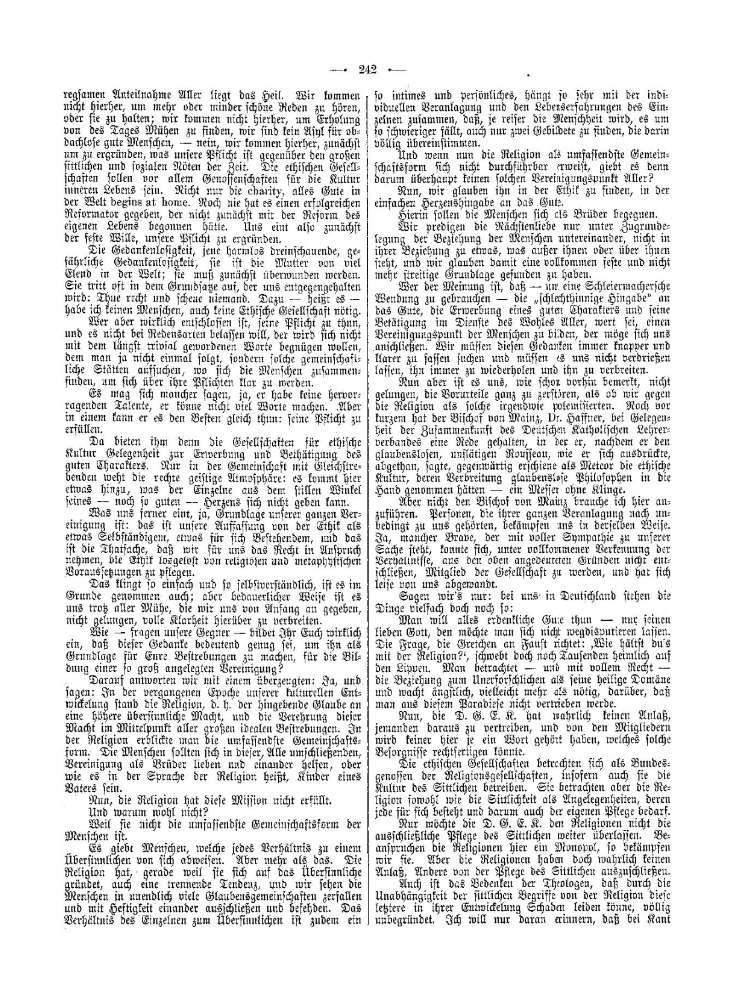
English translation · Page 242
active participation of everyone lies our salvation. We do not come here to hear more or less fine speeches, or to deliver them; we do not come here to find recreation from the day’s exertions, nor are we a refuge for homeless good people. No, we come here first to discover our duty towards the great moral and social distress of the age. Above all, ethical societies should be associations for the cultivation of our lives. Not only charity: everything good in the world begins at home. There has never been a successful reformer who did not begin by reforming his own life. What we therefore need first is the firm will to discover our duty.
Thoughtlessness, that harmless-looking, dangerous thoughtlessness, is the mother of much misery in the world; it must first be overcome. It appears in the maxim held up against us: do right and fear no one. For that, people say, no one needs other people, nor an Ethical Society.
But anyone truly resolved to do his duty, unwilling to leave it at mere phrases, will not be content with that long since trivialised saying, which people do not even follow. He will seek out places of fellowship where people gather to become clear about their duties.
Many a person may say to himself that he has no outstanding talents and cannot make many speeches. But in one thing he can equal the best: fulfilling his duty.
The societies for ethical culture offer him the opportunity to acquire and exercise good character. The right intellectual atmosphere lives only in fellowship with others striving for the same ends: something is added here which the individual cannot give himself from the quiet corner of his heart, however good it may be.
What further unites us, indeed forms the foundation of our entire association, is our conception of ethics as something independent, something existing in its own right, and the fact that we claim the right to cultivate ethics apart from religious and metaphysical presuppositions.
That sounds so simple and self-evident, and fundamentally it is; yet regrettably, despite all the trouble we have taken from the beginning, we have not succeeded in making it entirely clear.
What, our opponents ask, do you really imagine this idea important enough to make it the foundation of your endeavours, of the formation of so extensively conceived an association?
We answer with a convinced yes, and say: in the past epoch of our cultural development, religion—that is, devoted faith in a higher, supersensible power and reverence for that power—stood at the centre of all great ideal endeavours. Religion was seen as the most comprehensive form of community. In this all-embracing association, people were to love one another as brothers and help one another, or, in the language of religion, to be children of one father.
Now, religion has not fulfilled this mission.
And why not?
Because it is not humanity’s most comprehensive form of community.
There are people who reject any relationship with something supersensible. But more than that: precisely because religion rests upon the supersensible, it also has a divisive tendency, and we see people split into infinitely many communities of belief, vehemently excluding and fighting one another. Moreover, the individual’s relationship with the supersensible is so intimate and personal, so closely bound up with individual disposition and experience of life, that the more mature humanity becomes, the harder it is to find even two educated people who agree about it completely.
And if religion proves unworkable as the most comprehensive form of community, does that mean there is no point at which everyone can unite?
We believe we find it in ethics, in the simple devotion of the heart to the good.
In this, people should meet as brothers.
We preach love of one’s neighbour solely on the basis of people’s relationships with one another, not in their relationship to something outside or above them, and believe we have thereby found a completely firm foundation no longer open to dispute.
Anyone who thinks that—to use a turn of phrase associated with Schleiermacher—‘unconditional devotion’ to the good, the acquisition of good character and its exercise in the service of everyone’s welfare deserve to form a point of human union should join us. We must seek to express this idea ever more concisely and clearly, and must not weary of repeating and spreading it.
Yet, as already remarked, we have not succeeded in entirely destroying the prejudice that we are somehow polemicising against religion as such. Only recently the Bishop of Mainz, Dr Haffner, gave an address at a gathering of the German Catholic Teachers’ Association. After dismissing the unbelieving, immoral Rousseau, as he put it, he said that ethical culture now appeared as a meteor, its propagation having been taken in hand by unbelieving philosophers—a knife without a blade.
But I need not cite the Bishop of Mainz here. People who, by their whole disposition, certainly belong with us oppose us in the same way. Indeed, many a worthy person wholeheartedly sympathetic to our cause, completely misunderstanding the circumstances, could not resolve to join the Society for the reasons indicated above, and quietly turned away from us.
Let us say it plainly: in Germany, things still often stand thus:
People want to do every conceivable good—but they do not want their dear God argued away. The question Gretchen asks Faust, ‘How do you stand with religion?’, still secretly hovers on thousands of lips. People regard their relationship with the inexhaustible—and quite rightly—as their most sacred domain, and anxiously watch over it, perhaps more than necessary, lest they be expelled from this paradise.
The German Society for Ethical Culture certainly has no reason to expel anyone from it, and no member will ever have heard a word here that could justify such fears.
Ethical societies regard themselves as allies of religious societies insofar as these too cultivate morality. But they regard religion and morality alike as concerns each existing in its own right and therefore each requiring its own cultivation.
Only, the German Society for Ethical Culture no longer wishes to leave the cultivation of morality exclusively to religions. If religions claim a monopoly here, we oppose them. But religions surely have no reason to exclude others from cultivating morality.
The theologians’ concern that making moral concepts independent of religion might endanger the latter’s development is also entirely unfounded. I need only recall that in Kant

English translation · Page 243
it is precisely morality’s absolute unconditionality that provides the ground for belief in God.
As to the attitude of the German Society for Ethical Culture’s members towards religion, there may be almost as many answers as there are members. Perhaps, however, they agree even in this. The question has no legitimate place in our circle, any more than in a medical or historical society, where no one would think of asking which religion someone belonged to.
It is not enough, when confronted with such attacks, simply to refer to our Section 1, which says ‘independently of all religious and other differences’. That is not the issue, but rather the suspicion that, even if we are not hostile towards religious convictions, we at least consider them superfluous or a matter of indifference.
To be able to enlighten others here, every individual member must first become clear in his own mind.
Must one be indifferent to religion if one does not bring it to the fore on every occasion? Must one be godless if one does not parade the entire realm of one’s ideals at every opportunity? Perhaps precisely the opposite is the case.
‘A society without religion!’—that condemns us. How is it that no such reproach is made against the Society for Surgery, which is housed here under the same roof as ourselves? There was, after all, a time not even so remote in our cultural development when natural science too could not escape the suspicion of being without religion; people would not allow it to develop independently of existing religious traditions.
Ethics now finds itself at this truly sad stage. For those with insight it is no edifying spectacle to see how stubbornly people cling to inherited religious traditions from an alien cultural age, how they would envelop ethics for all eternity in an impenetrable veil.
It will be left to later centuries to come to terms with the scarcely comprehensible fact that such circumstances were possible in so highly developed a culture.
We finally want the right to develop ethics independently of religion—to develop it, not to establish its foundations, for that is the individual’s concern. We want to become acquainted with existing moral ideas in every respect, to examine them and reform them where necessary, leaving religious societies in turn to examine and reform religious ideas.
(To be continued.)
Instalment II · 11 August 1894
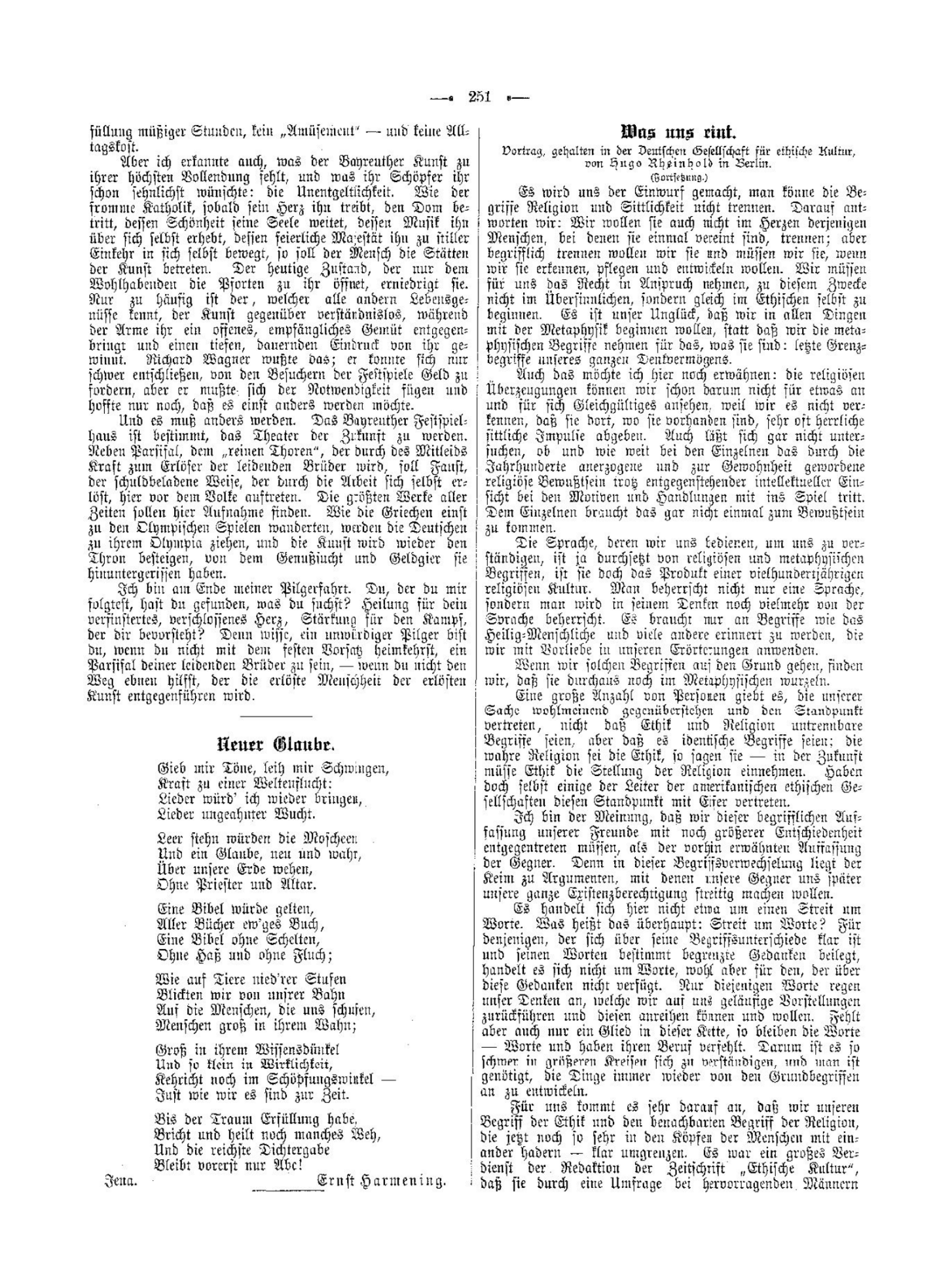
English translation · Page 251
What Unites Us.
An address delivered in the German Society for Ethical Culture, by Hugo Rheinhold in Berlin.
(Continued.)
The objection is made that the concepts of religion and morality cannot be separated. We reply: we do not wish to separate them in the hearts of those in whom they are already united; but we wish and must distinguish them conceptually if we are to understand, cultivate and develop them. We must claim the right, for this purpose, to begin not in the supersensible but directly in the ethical itself. It is our misfortune that in everything we wish to begin with metaphysics, instead of taking metaphysical concepts for what they are: the ultimate limiting concepts of our entire faculty of thought.
I would also mention this: we cannot regard religious convictions as intrinsically indifferent, if only because we recognise that, where they exist, they very often provide splendid moral impulses. Nor can one investigate whether, or how far, in an individual’s motives and actions, the religious consciousness inculcated through the centuries and become habitual comes into play despite contrary intellectual insight. The individual need not even become aware of it.
The language we use to understand one another is permeated with religious and metaphysical concepts, being the product of many centuries of religious culture. One does not merely command a language: in one’s thinking one is still more commanded by language. We need only recall concepts such as the sacredly human, and many others we favour in our discussions.
If we examine such concepts to their foundations, we find that they are still thoroughly rooted in the metaphysical.
There are many people well disposed towards our cause who maintain not that ethics and religion are inseparable concepts, but that they are identical: true religion, they say, is ethics; indeed, in the future ethics must take religion’s place. Even some leaders of the American ethical societies have fervently defended this position.
I believe we must oppose this conceptual understanding among our friends still more decisively than the opponents’ view mentioned earlier. For this confusion of concepts contains the seed of arguments with which our opponents will later seek to challenge our entire right to exist.
This is not merely a dispute about words. What does that mean, after all: a dispute about words? For someone clear about his conceptual distinctions, who attaches definite, delimited thoughts to his words, it is not a matter of words; but it is for someone who does not possess these thoughts. Only those words stimulate our thinking which we can and wish to refer back to familiar ideas and connect with them. If even one link is missing from this chain, the words remain words, without reference for us. That is why mutual understanding is so difficult in larger circles, and why one is compelled repeatedly to develop matters from their fundamental concepts.
For us it is very important clearly to delimit our concept of ethics and the neighbouring concept of religion, which still contend so strongly with one another in people’s minds. It was a great service on the part of the editors of the journal Ethische Kultur that, through a survey among distinguished men

English translation · Page 252
and women of our time, they sought to establish what these understood by the concepts of religion and morality and their relationship to one another.
Admittedly, this does not bring us to a uniform definition acknowledged by everyone. Yet one thing has been confirmed—though there was no reason to doubt it before, since the philosophers named, from Plato to Schopenhauer, agree on it—that the essential characteristic of the concept of religion is the metaphysical: the relationship to a higher power, to the infinite.
Like almost all metaphysical concepts, the word is also used figuratively, then meaning devotion to the ideal. But the word should never be used in this latter sense without making clear to oneself and to the other person that one is employing it figuratively. Members of the ethical society, however, should use the word only in its proper sense. If we use it now in its proper sense, now in its other sense, mutual understanding becomes very difficult. Many people simply do not notice that they are quietly exchanging concepts or having them exchanged for them—and this is by no means always easy to demonstrate. Often the word is used in the conclusion in a different sense from that in the premises. Hence the frequent, unedifying spectacle of people no longer speaking to one another, but against one another.
If ethics were religion, religious societies would be the real ethical societies—and indeed they claim this for themselves. We would then have had no reason at all to found an Ethical Society, and would merely have added one more to the existing reform congregations. What distinguishes us, then, from religious societies, for example the Free Religious and Egidy’s movement?
First, we make a clean distinction between the concept of the ethical and that of the religious. Further, we concern ourselves exclusively with cultivating morality, while leaving the cultivation of the religious to religious societies. Their task is precisely to examine the concept of God, to purify and develop it. Ethics, however, is in no position to furnish a proof for or against belief in God.
The Free Religious societies and Egidy’s movement admittedly also have the good intention of freeing themselves from divisive transcendent presuppositions. Yet what unites them is once again a religious or philosophical principle, even if it were only opposition to another religious or metaphysical principle. They seek to substitute a different religious or philosophical foundation for the traditional one. But that is precisely what we believe must be avoided if ethics is finally to develop freely and healthily.
We neither assert a metaphysical principle nor oppose any such principle. Both, we think, are theories that may well suit communities of belief, but not us.
Of all religious reform societies, Egidy’s is closest to ours, and in its development so far has drawn ever closer. Mr von Egidy began by fighting individual religious dogmas, and was then led by the logic of his thought to protest against every dogma, until finally, in the latest phase of his development, he came to declare belief and profession of faith the individual’s concern, and to describe disposition and action alone as valuable. In this he has approached our position considerably. Yet for us his movement remains an anomaly, since it still wishes to be a religious association whose task is to reform religious feeling. This does not prevent us from having every reason to welcome such cooperation. It is precisely Mr von Egidy’s merit that he does not approach matters as a learned theologian or philosopher with a preconceived principle, but with earnest, honest intentions, and can thus advance unhindered in the development of his movement.
On the question of how we should conduct ourselves towards religions in these unavoidable discussions, one further point deserves mention:
We should not relegate religion to the domain of poetry either, to provide it with a refuge, however beautiful, in the realm of imagination. Given the extraordinary, painfully acute sensitivity prevailing here, this could easily encourage the mistaken notion that such a view arose from a feeling of contempt.
People are inclined to equate poetry with mere play, and one is still more exposed to misunderstandings with the word fantasy or imagination.
It is an ambiguous word.
On the one hand, it means the logically creative, sovereign imagination, which comes fully into its own even where the all too narrowly drawn limits of knowledge begin; on the other, mere imagining without any foundation, creating only phantoms and illusions. Our opponent will not be inclined to assume we were using the word in the former sense.
It can therefore readily offend a religious person when we relegate his highest ideal to the domain of imagination.
We must not disregard any of these difficulties.
What, then, is the Ethical Society’s relationship to ethics?
The opinion is widespread that, if anything unites us as an Ethical Society, it must surely be an ethic, a supreme standard for our moral conduct to which we subscribe. Not everyone readily understands that it is precisely the absence of such an ethic which unites us.
If we subscribed to an ethical theory, we would make a mistake scarcely smaller than if we subscribed to a religious or political system. To begin with, the professional ethicists among us would confront one another in conflict and set the others a bad example.
Our opponents and friends, however, reproach us:
You wish to take the cultivation of ethics under your special care and develop it—yet will not even subscribe to certain ethical principles?
Certain ethical principles undoubtedly exist in each one of us, since only that makes the individual a member of the Society. But even if we could establish complete unanimity here, the Ethical Society as such subscribes to no principle. It subscribes not to particular principles of morality, but to morality itself, and that distinction must be recognised.
What unites us is each individual’s endeavour to let justice and truthfulness prevail in every matter of life. That is the common bond uniting not only those professing different religious and political convictions, but also the representatives of different ethical views.
Only recently a distinguished member of our Society emphasised here that, without a proper understanding of morality, the inner impulse lacks a full understanding of the Society’s aims and tasks.

English translation · Page 253
That must be conceded without reservation. Nor do we intend to content ourselves with the poet’s words: ‘A good man, in his dark striving, is well aware of the right path.’ On the contrary, we demand that the good person strive to emerge from that dark impulse in order to become conscious of the right path. That is precisely what the Ethical Society is for.
The questions ‘What is the content of the moral demand?’ and ‘What foundations are considered necessary for a moral life?’ are very important and must be discussed here for every individual member’s moral advancement, without the Society as such favouring any system.
Our theoretical attitude towards ethics is certainly of great importance, but it interests the theorist still more than the moral person. ‘Only do not let religion and philosophy intervene too early,’ says Felix Adler, and that should be taken very much to heart. Once a theory has taken hold within us, it readily moulds our thinking and conduct, pressing us in a particular direction.
For members of the ethical society, their theory should arise from their moral conduct. I also believe that only those theories retain lasting value for the individual which have arisen from his moral practice. How far an individual is entitled to assume sufficient practice of morality in his own case must, of course, be left for him to decide.
In this sense, adapting Lessing’s well-known saying about the pursuit of truth, one could say: striving for an ethical theory is preferable to possessing an ethical theory. But simply accepting a ready-made theory of morality with the intellect, without first having troubled oneself overmuch with the inconvenience of moral action—that, of course, must be rejected.
The fact that all theories of morality agree on certain fundamental concepts has something binding for the moral practitioner, since it suggests to him that, when the different theories contradict one another, this is attributable to their shortcomings, not to the moral demands in which they consistently agree and which they should serve. To these the moral person can initially hold fast.
(Conclusion to follow.)
Instalment III · 18 August 1894
English translation · Page 258
What Unites Us.
An address delivered in the German Society for Ethical Culture, by Hugo Rheinhold in Berlin.*
(Conclusion.)
We must not let ourselves be disconcerted by Schopenhauer’s maxim, so often quoted among us too:
‘To preach morality is easy; to establish its foundations is difficult.’
While fully agreeing with this statement, one may surely say: certainly, establishing morality’s foundations is so difficult that even Schopenhauer did not succeed to any very great extent. His community of believers is small too, and every attempt at establishing foundations always comes down to a community of believers.
We, however, will not cease to emphasise our moral demands, to increase our knowledge of what is held right and good, to kindle love of morality and justice, and to act from our moral impulse. If we wish to wait with all this until scholars have agreed about the foundations of morality, we would be mistaken.
We have analogous cases in every field, for example in jurisprudence: from time immemorial, criminal-law scholars have disputed the reasons why people punish. Some say: for retribution, quia peccatum est—because an offence has been committed; others: to deter, ne peccetur—so that no offence is committed; and many other theories find their advocates. The gentlemen have not yet agreed. Meanwhile, however, judges calmly go on imposing punishments.
The theory of music did not come first and music afterwards; nor, certainly, did Homer first depend upon an existing poetics in order to write his verses.
It is no different in ethics.
* A separate printing of this address is available from the office of the German Society for Ethical Culture, Berlin N., Ziegelstrasse 10, at a price of 30 pfennigs.
English translation · Page 259
But if the science of ethics is still relatively little developed, this is due not least to the insufficient development of moral practice. The experiment has not yet been made of how far one can get in the world with a morally purified humanity.
What we certainly have to do amid the conflict of principles is examine whether those principles tend to serve everyone’s welfare. Everyone’s welfare is surely the harmony sounding from all moral systems, even where a system emphatically rejects the welfare of the whole as a theoretical principle. We therefore stand on firm ground when we ask: does an ethical theory avoid conflict with our endeavour, springing from a sense of justice, to serve everyone’s welfare?
Here too, ultimately, we are often referred—who would deny it?—to feeling, to subjectively sufficient grounds. The understanding will not always reach an objectively valid judgement as to whether an action ultimately serves everyone’s welfare; but that is not necessary either. One need only draw upon the moral fund each of us has received on life’s journey as his inheritance from the cultural work of many thousands of years, whether one calls that fund conscience or not.
Anyone who has ever devoted himself in life with all zeal and earnestness to everyone’s welfare, indeed anyone who has even earnestly striven with his whole being to live for the happiness of one person—a child or a friend, let us say—will have discovered how difficult it is, given the unpredictability of every factor involved.
There is only one entirely certain means of serving everyone’s welfare: the same means wise educators recommend to parents as an unconditionally effective instrument of education. Let everyone work unceasingly at his own moral improvement in disposition and action.
I now turn to the social question.
What unites us—the members of the German Society for Ethical Culture—in the political controversies unfolding before us with all too much vehemence?
Our opponents attacked here from the beginning, asserting with the full force of expert superiority that it was a wholly idle, irrational undertaking to suppose that people of different political convictions, such as Social Democrats and Liberals, could work side by side. Here, they said, two moral worldviews confronted one another, each excluding the other. Only superficiality could overlook this gulf; sooner or later the Society would have to learn this to its cost.
I remember that shortly after the draft statutes were drawn up, a letter arrived from a university professor elsewhere. He enthusiastically welcomed the Society’s idea, but said the clause ‘independently of all differences in political outlook’ must surely rest on a mistake: it could not possibly mean that Conservatives, Social Democrats and Liberals should cooperate and discuss economic questions peacefully together.
Yet that is precisely what the Society seeks, and it regards as a principal achievement having created a place where adherents of the most diverse political parties can associate peacefully and learn to understand one another.
This is not entirely easy, we must admit, as we have seen in our many discussions of the great questions of socialism and individualism. At first it seemed as if the Society’s opponents might, for once, prove right; but it only seemed so. In this short time we have already made considerable progress in the art of wishing to listen to and understand one another.
Unfortunately, an excessive composure towards moral questions contrasts with excessive animation and irritability about the great economic and political questions of the day, making it very difficult to discuss them with immediately visible success. Yet we have a duty to conduct these discussions, as Section 2 of our statutes expressly recognises.
It says: ‘Discussion of the facts and forms of economic and social life. Support for reforms which prove ethically necessary.’
That naturally has its dangers. Harm readily arises when, in the established fashion, minds divide and group themselves with those whose views they sympathise with and whose convictions they share, thus confronting one another as opponents. From our standpoint we must seek absolutely to avoid this, for by forming such camps we deny our own essential nature. Precisely in well-intentioned dealings with those who think differently in politics lies a seed of ethical education.
Otherwise, nothing is so simple as answering the question: what unites us in political and economic controversies? The answer is ethics.
We need only show the firm, clear will not continually to emphasise what divides us—people in parliaments and political meetings could do that far better than we can—but to bring forward what unites us, which is always the moral, the ethical aspect of all these questions. It is not true, as our opponents claim here, that a great moral worldview here divides one from another. Underlying this is a confusion of the moral worldview with the political worldview, which does the politician every credit, but remains a confusion nonetheless.
The logic out there in the world, as manifested in the gradual shaping of moral relations, does not follow the same simple path as the logic in the politician’s head.
In undertaking to form an association in which people are to work together independently of their religious and political views, we have indeed presupposed that a moral standard will predominate among members in their discussions. Only insofar as they are able to assert it and see what unites them will our Society be able to flourish.
For what unites us—Socialists, Individualists, Conservatives and Liberals—is the endeavour to cultivate a sense of justice. We all want a higher social justice than that now unfolding before our eyes in the world.
Devotion to justice constitutes the ethical person’s worth; devotion to the political theory by which one believes this justice can most readily and reliably be attained constitutes the politician’s worth.
Should it not then be possible, for a start, to set aside what divides political theories and pursue what lies along our common path? Certainly. It only has to be learned. We are already making good progress.
How much valuable shared work already lies in collecting the facts.
If we wish to devote ourselves to these matters seriously and successfully, we must above all seek to acquire knowledge of the facts: first, how they have developed, and then how matters actually stand in the world today. The discussions in the groups serve this purpose.
English translation · Page 260
Such a procedure is an indispensable precondition for a proper judgement of things and for practical activity, which we undertake with zeal and which remains our chief concern above all. Through knowledge of the facts we shall also learn to avoid the political catchwords bred in popular assemblies.
What divides us should by no means be disregarded; on the contrary, it should be discussed. It must simply not come to the fore within our circle.
For example, there is no reason why, as an ethical society, we should not discuss in every respect a question so eminently important ethically as the reform of property, a question connected with almost all the other questions of shaping an ethical life.
But everything need not happen at once.
If we have members who stand for their political theories with their whole souls and are entirely absorbed in them, that is certainly something very fine and valuable to us too. For a political association that may be a member’s ideal condition; for an ethical society it is not yet so. Much, at least in its present stage, we may still leave to political and economic associations. In many matters we still lack the necessary expert knowledge required for an ethical judgement.
If we wish to remain united, the Society must maintain political neutrality. It will have to seek out injustice in the capitalist class as in the working classes and address its ethical demands to everyone. Above all, it must guard against making itself the servant of any party.
That is a great reef on which we could founder if we did not know how to steer with clear insight and a firm hand.
Precisely the greater the kinship between certain problems of socialism and the purely ethical fundamental problems, the greater the danger that we lose sight of the boundaries.
If we had the doubtful good fortune that all of us here in the ethical society belonged to one political party, it might soon be all over with preserving the ethical cause’s purity, whatever that political conviction might be called.
What unites us is combating selfishness in its great domains and all its hiding places. In place of egoism, a consciousness of solidarity must be developed, as follows consistently from the idea of justice.
This consciousness of solidarity is the truly social spirit, which we still lack all too greatly in Germany.
Let us not deceive ourselves: belonging to the social party and advancing social demands by no means always guarantees the ideal quality of disposition which does, indeed, find expression in the great principles of socialism.
The social spirit does not consist in the individual relying upon the whole to secure a better, safer position in life for himself and his own, but solely in the individual working for the whole and devoting himself entirely to it. The cultivation of the social spirit and ethical culture are almost the same thing. Yet it is not social cooperation as such, but only the social cooperation of morally purified natures that can benefit humanity.
Like individualism, socialism too would necessarily perish without the cultivation of this social spirit.
Thus here too the ethical movement has its quite definite task to perform. Social problems dominate the world; no one today can say with certainty how things will develop. But this much can be said: the social movement, once brought into the world, can never be reversed.
Our task is to contribute our part so that, however it may develop, it may flourish towards a goal beneficial to humanity.
Hugo Rheinhold, “Was uns eint,” Ethische Kultur: Wochenschrift zur Verbreitung ethischer Bestrebungen, II (1894), no. 31 (4 August), pp. 241–243; no. 32 (11 August), pp. 251–253; no. 33 (18 August), pp. 258–260. Consult the digitised volume.