The likeness is easy to spot. Auguste Rodin’s Thinker and Hugo Rheinhold’s Affe mit Schädel both sit forward, one hand raised towards the face, apparently absorbed in thought. It is hardly surprising that writers have placed them side by side. Jochen Richter and Axel Schmetzke drew attention to the resemblance in their study of Rheinhold’s sculpture; their comparison provides a useful starting point. [1]
But what are we really looking at? Is the shared posture evidence that Rheinhold knew Rodin’s work, or does it belong to a much older habit of depicting thought? To answer that question we need to look at when the sculptures were made, at the behaviour of our own bodies, and at the long company of seated, pensive figures that came before them.
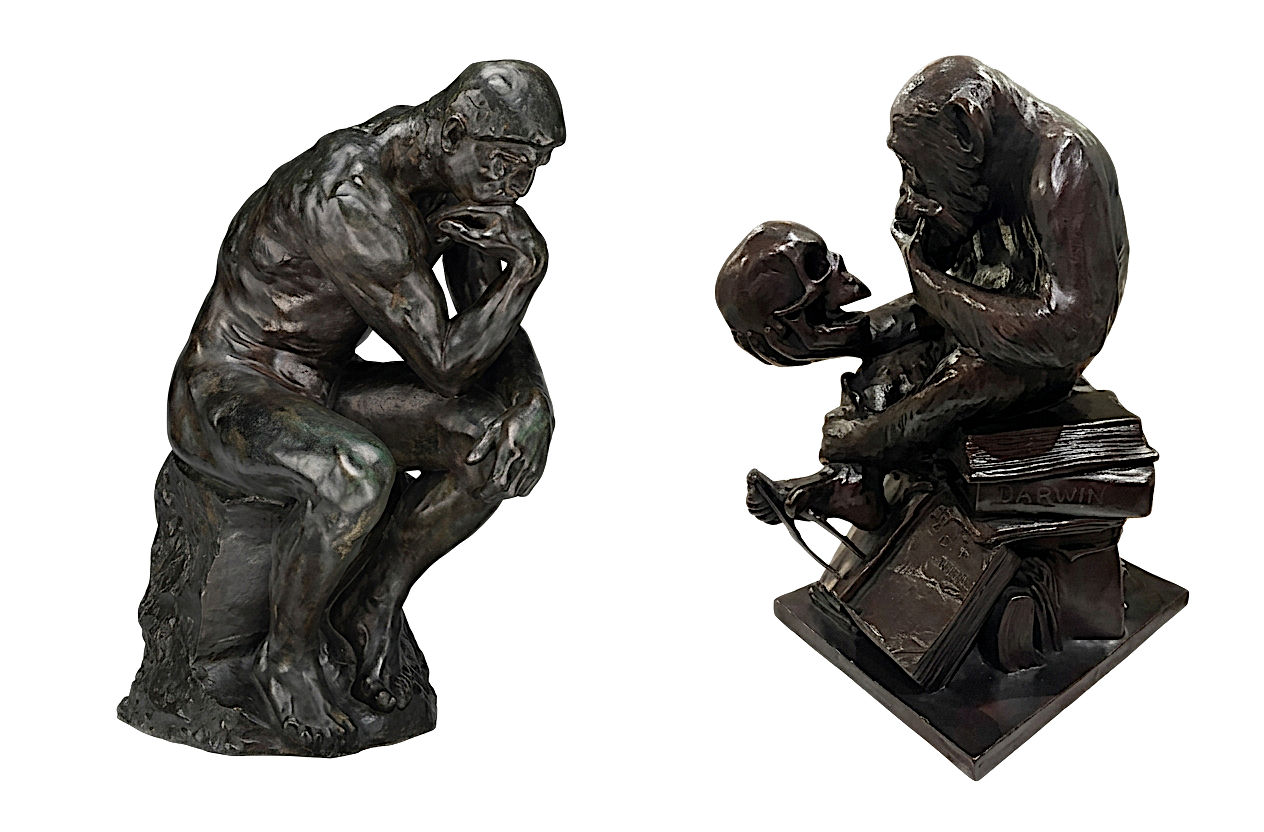
Look closely at the figures. Rodin’s man is naked, muscular and drawn tightly into himself; almost every part of him seems to strain with thought. Rheinhold’s ape handles a human skull. Books, callipers and a biblical inscription crowd around it. The pose invites comparison, but the two sculptures ask different questions. Rodin’s figure leaves the viewer to wonder what, exactly, is being thought. Rheinhold immediately provides objects of enquiry and a philosophical setting. That contrast will matter throughout this essay.
An Attractive but Superficial Comparison
Artists have always noticed gestures that communicate feelings without a word. A person sitting forward with the cheek resting on a hand may be bored, anxious, absorbed, grieving or simply tired. From a distance we cannot tell which. Once we know the setting and the subject, however, the pose can become wonderfully expressive. This everyday ambiguity is one reason the gesture has had such a long artistic life.
Rodin’s Thinker is famous enough that a later figure in a similar position almost automatically brings it to mind. That familiarity is part of the trap. A resemblance to a well-known masterpiece can make it seem that the masterpiece must have been the source. Yet Rodin was himself working with a posture that belonged both to the world around him and to centuries of earlier art.
Richter and Schmetzke’s Rodin comparison can therefore be appreciated as an illuminating parallel, while we follow the wider question it raises. Was there any reason Rheinhold would have chosen this pose because he had seen Rodin? The best answer begins not with a dramatic theory of influence but with patient description: what was available, what the body naturally does, and what older images had already made visible.
The more closely one compares the two sculptures, the more clearly the similarity reveals its limits. Rodin gives thought a heroic, almost volcanic physical intensity. Rheinhold provides the props, signs and intellectual tension of a philosophical problem. The posture links them; the conception separates them.
Could Rheinhold Have Seen Rodin’s Thinker?
Rodin began the figure around 1880, while working on the great doorway he called The Gates of Hell. It was originally conceived as The Poet, a seated Dante looking down over the damned. In that first conception the figure belonged to a much larger drama. It was not yet the free-standing emblem of thought that would become famous around the world. [2, 3]
“…since in thought I consumed action, that had been so ready to begin.”— Inferno, Canto II
The line is not a documentary source for Rodin’s sculpture, but it captures the atmosphere of the original conception: a figure poised above action, held in suspension by inward attention. That makes the early Thinker less like a generalised monument to philosophy and more like a specific dramatic presence within Rodin’s Dantean scheme.
The original model was relatively small, about seventy centimetres high, and it was first worked in clay; a plaster version of that original scale survives in the Musée Rodin collections. Small bronzes followed. The monumental bronze now most familiar to modern viewers came later. This matters because the imposing public Thinker by which we instinctively measure all comparisons did not yet exist in 1893. [2, 3]
Rheinhold’s sculpture was already ready for the 1893 Berlin exhibition. The catalogue records it as no. 2359, Affe, einen Schädel betrachtend—‘Ape Contemplating a Skull.’ There is no need to suppose that he could have known the monumental Rodin figure: that version belonged to a later period. The relevant object, if any contact occurred at all, would have been the smaller early model, a small bronze, or an illustration of it. [4]
Rheinhold was studying sculpture in Berlin. Rodin worked in Paris. Works by Rodin were becoming known in Germany, so the two artistic worlds were not sealed off from one another. But a photograph, a magazine reproduction, a sculpture exhibited abroad or a fellow artist’s recollection would each have had to find its way into Rheinhold’s actual experience. We have no evidence of that particular meeting between artist and image.
Of course, a young sculptor could admire a work without leaving a record of it. Even then, we would want more than two figures sitting forward before calling one a version of the other. We would need stronger visual correspondences, or documentary evidence, because the seated contemplative gesture was already commonplace long before Rodin’s birth.
The Natural History of a Familiar Gesture
Before tracing the pose through art, it helps to consider why it feels so natural. Put a group of people in a waiting room or a library and sooner or later someone will lean forward, elbow on knee, hand at the chin. It takes no acting lessons. It can happen during a difficult calculation, in the middle of private worry, or simply while waiting for time to pass. The same outward attitude can accompany very different inward states.
There is a simple physical advantage. Supporting the head with a hand allows the neck and upper body to settle into a comfortable position. The elbow can rest on a knee, a chair arm or a table. Yet comfort alone does not explain the gesture. We touch the mouth, the cheek and the brow even when no support is needed. Often we do it without realising.
Psychologists distinguish these spontaneous movements from deliberate actions such as washing the face or brushing away a fly. Self-touching may accompany a shift of attention, a moment of uncertainty, or an effort at emotional regulation. It is not a perfect sign of concentration or distress, but it is a familiar companion to both. [7, 22]
That ambiguity is precisely what makes the gesture artistically productive. A seated body folded inward can suggest that outward action has paused while inward activity continues. The hand touching the face may draw attention to expression, partly conceal it, or interrupt communication altogether. A small movement becomes the key to an entire story.
Once we notice how ordinary the pose is, a direct line from Rodin to Rheinhold begins to look less compelling. Both sculptors may simply have recognised the expressive power of a bodily habit their viewers already knew from life.
Why the Face Draws the Hand
The habit is common enough to be counted. In a 2015 observational study, Yen Lee Angela Kwok, Jan Gralton and Mary-Louise McLaws watched 26 students for a combined 240 minutes and recorded 2,346 touches to the face. Of these, 1,322 were on regions away from the eyes, nose and mouth. The chin accounted for 409 of those non-mucosal touches and the cheek for 383. Another 1,024 touches involved mucosal areas. These figures describe a particular group of students, not a universal rate for everyone, but they show how frequently the hand returns to the face without deliberate intent. [6]
A systematic review published in 2020 brought together studies of facial and T-zone touching. It emphasised both the frequency of the behaviour and the wide variation between studies. The same authors explicitly mention chin-resting—the pose made famous by Rodin—as one among the taxonomies of face touching. [7]
Why the face? Part of the answer may lie in its unusual sensory richness. We are constantly gathering information from our lips, cheeks, skin and facial muscles. A small touch can be registered very clearly. The major divisions of the trigeminal nerve supply different regions: the ophthalmic division (V1) covers much of the forehead and upper face; the maxillary division (V2) serves the mid-face; and the mandibular division (V3) supplies the lower face and jaw.
The accompanying diagram maps those territories. It is an anatomical map, not a chart of where people touch most often. The grey dots mark communicating branches between the trigeminal and facial nerves. Mueller, Martin and Grunwald included it in their 2019 study of spontaneous facial self-touching, in which they showed that both the duration and the location of touches changed with different cognitive and emotional tasks. [22]
The function remains a lively research question. Tactile stimulation may help regulate attention or feeling, and the face may be a particularly effective place to receive that stimulation. Studies have not reduced all self-touching to a single cause, however. That uncertainty is useful here. Artists do not need a final biological explanation in order to recognise an expressive human constant.
When Rodin shaped his seated figure, he was turning one of these commonplace movements into a powerful visual shorthand. The posture already belonged to his viewers’ own bodies. That familiarity helped make the sculpture immediately legible.
The Evolutionary Continuity of Self-Touching
Human beings are not alone in this behaviour. Self-directed touching is well documented among other primates. Chimpanzees and bonobos scratch, rub, touch and groom themselves in ways that vary with context, attention and arousal. [9–11] The individual meanings of those actions can differ, but the broader point is clear enough: the hand returning to the face is not an exclusively modern or exclusively human event.
This matters because Rheinhold’s sculpture places the familiar contemplative pose on an ape. The effect is unsettling precisely because the gesture remains recognisable. We do not see a completely alien body mimicking a human convention. We see a creature whose bodily repertoire overlaps with our own, then find that overlap redirected into a philosophical question.
The T-zone is especially helpful here. In human hygiene literature the term usually refers to the eyes, nose and mouth—the mucosal regions most relevant to infection control. In broader behavioural discussion, the phrase can also be used more loosely for the central face, including the brow, nose bridge, mouth and chin, where self-touch often clusters. That broader central zone is exactly where a thinking or worried gesture tends to gather.
Studies of chimpanzees under cognitive challenge suggest that self-directed behaviours can increase when attention and uncertainty are engaged. [10] One should be cautious: ape self-touching is not the same thing as human philosophical reflection. Yet the bodily continuity helps explain why Rheinhold’s ape does not feel absurd. It feels just plausible enough to make the satire bite.
In other words, Rodin’s man and Rheinhold’s ape are not linked only by art. They are linked by a deeper behavioural repertoire from which artists, across periods and cultures, have repeatedly drawn.
Before Rodin: Seven Millennia of Contemplative Figures
A prehistoric figure: An ancient terracotta figure from Cernavodă, Romania, is an extraordinary place to begin. Made by the Hamangia culture around 5000–4600 BCE, the little seated figure rests its head on its hands, elbows braced upon its knees. We call it The Thinker, although that modern name may tell us as much about ourselves as about its maker. The object was found in a funerary setting, and the pose may speak as readily of mourning as of thought. [12]
What matters here is the age of the gesture. Millennia before the modern idea of the brooding genius, somebody shaped a human body bent inward upon itself, with the hands pulling attention back towards the face. We do not need to recover the whole original story to recognise the attitude.
Penelope and the language of waiting: Greek art offers another long-lived version of the seated contemplative figure. Penelope, waiting for Odysseus, is often shown with head inclined and one hand supporting the face. The gesture suggests waiting, sorrow and thought rather than purposeful outward action. It appears in fifth-century BCE images and their later descendants. [13]
Here a bodily habit becomes convention. An artist can place a figure in an instantly recognisable attitude and allow the viewer to fill in an emotional state. The posture is no longer merely observed from life; it has acquired a place in the shared language of images.
A pensive figure beyond Europe: Buddhist sculpture offers a particularly elegant parallel. The fingers rise lightly to the face while the seated body remains poised and reflective. Pensive Bodhisattva figures became familiar in Chinese, Korean and Japanese sculpture during the early medieval centuries. [14]
These images came from a different religious and artistic world. They do not provide a plausible source for Rheinhold’s Berlin bronze, nor do they need to. They show that artists far apart in culture and time repeatedly discovered how expressive a quiet, self-touching figure could be.
Renaissance bodies of thought: The Renaissance made the contemplative figure one of its most flexible subjects. Michelangelo’s Jeremiah on the Sistine Chapel ceiling rests a bowed head upon the hand, as though the weight of prophecy were physical. Rodin’s own museum points to Michelangelo’s seated Lorenzo de’ Medici—often called Il Pensieroso—as one predecessor of The Thinker. [2]
Raphael’s School of Athens offers a related mood in the solitary figure conventionally called Heraclitus. Seated apart, leaning forward and writing, he interrupts a painting otherwise filled with active debate. The posture separates inward thought from public exchange. The prophet, the prince and the philosopher are not interchangeable figures, but their bodies draw upon a recognisable repertory of lowered heads, supported faces and turned-inward limbs.
By the sixteenth century, then, the thoughtful body was already a flexible visual instrument. It could serve grief, prophecy, study or intellectual withdrawal without relying on any single canonical model.
There is a quiet contrast between these two Renaissance examples. Michelangelo’s Jeremiah is enclosed in the weight of his own body; the prophet seems to carry a burden that cannot be shared. Raphael’s Heraclitus, by contrast, writes. The bowed head and supporting hand still tell us that his thoughts are elsewhere, but the paper and pen make thought visible as work. He has something to do, and for the moment the conversation around him can wait.
Both works belong to grander compositions. Neither figure was invented simply to demonstrate a pose. The posture is useful because it can be read at once, leaving the artist free to give it a more particular purpose. That is precisely what Rheinhold later does when he puts a skull into the ape’s hand.
Melancholy and the tools of knowledge: Dürer’s Melencolia I of 1514 is especially valuable for our comparison. A winged figure sits with the head against the hand, surrounded by instruments of measuring and making. The engraving joins bodily stillness with intellectual labour. Its tools suggest that thought does not always bring certainty: the measuring mind may reach a boundary it cannot pass. [15, 16]
Rheinhold’s bronze also brings measurement into a scene of contemplation. The callipers, the skull and the books allow the ape to take the role of an investigator. The connection with Dürer lies less in a matching outline than in a shared dramatic question: what can the mind know by measuring the world?
Rembrandt and the burden of inwardness: The pose remained a staple of seventeenth-century art. In Rembrandt’s Jeremiah Lamenting the Destruction of Jerusalem (1630), the prophet sits with his head supported on his hand while catastrophe unfolds beyond him. The movement of the hand is small; the painting makes it carry the weight of loss. [17]
Domenico Fetti’s Meditation or Melancholy also brings the head-supported body into contact with a skull and a book. It belongs to the older memento mori tradition, in which ordinary objects turn a private moment into a reflection on mortality. Rheinhold approaches the skull from a different direction, but he inherits a world in which hand, face and bone were already familiar partners in imagery.
By this stage the seated, supported head could communicate inwardness without depending upon any single painter or sculptor. That long history is part of what makes a simple claim of direct borrowing look less persuasive.
Rembrandt lets the viewer feel the distance between the seated prophet and the burning city. The action is in the background, but the drama gathers in the quiet foreground figure. Jeremiah has withdrawn from what he cannot prevent. The heavy head and resting hand tell the story before we have identified either the biblical subject or the city beyond him.
Fetti’s painting speaks a different but related language. Here the skull makes death a tangible presence. The book offers the possibility of knowledge, yet its pages cannot lift the figure out of melancholy. The contrast between stillness and objects is striking: as with Rheinhold’s ape, the objects help explain what the seated figure might be thinking about. The shared convention of the supported head becomes the starting point for a specific meditation on human limits.
The Nineteenth Century: Rodin Among His Contemporaries
Carpeaux and the body under pressure: Rodin did not invent the nineteenth-century strained, inward-turning body. Jean-Baptiste Carpeaux’s Ugolino and His Sons twists grief, hunger and thought into a compact bodily knot. The face is troubled, the limbs tense, the whole body acts as a chamber of feeling. That expressive tension helps explain why Rodin could turn a similar bodily vocabulary towards creative struggle. The Musée Rodin names Carpeaux alongside Michelangelo among the predecessors of The Thinker. [2, 19]
The important point is not that Rodin merely copied his predecessors. He made something new by changing scale, context, anatomy and meaning. The same allowance should be made for Rheinhold: a familiar pose can become the centre of a very different work.
Van Gogh and Munch: Vincent van Gogh’s At Eternity’s Gate, first explored in drawings and a lithograph in 1882 and later painted in 1890, makes an old man’s bent body and hidden face carry an overwhelming sense of weariness. Edvard Munch returned to a related seated, hand-supported figure in his melancholy compositions of the early 1890s. In both cases posture is a starting point rather than a complete explanation. The surrounding world, the expression and the mood do the rest. [20, 21]
Placed beside these works, Rodin’s figure looks less like the origin of the thoughtful pose than like one especially powerful nineteenth-century treatment of an ancient bodily script.
Carpeaux’s Ugolino makes the contrast between action and paralysis particularly painful. The hunger that threatens him is urgent, yet he remains inwardly fixed, surrounded by his sons. Rodin knew how to turn a seated body into an engine of tension. But the same visual language could also serve scenes with much less heroic ambition: a weary old man, a solitary person on a shore, or anyone whose thoughts seem to have carried them away from their surroundings.
Van Gogh takes nearly everything away from his old man except the bodily act itself. His face is hidden between his hands. We cannot see what he sees, or even whether he is looking at anything. The entire emotional force of the painting rests on the familiar collapse of the body into itself. Munch, working at almost the same moment as Rheinhold, finds his own version of that withdrawal. The seated figure turns away from the surrounding world, giving the landscape a strangely distant, almost unreal quality.
Neither artist needed the spectator to know a particular sculptural precedent. The gesture was enough. It was an everyday movement that an artist could deepen into an image of despair, introspection or loneliness.
What Makes a Figure Look Thoughtful?
The answer is not one anatomical angle or a prescribed arrangement of fingers. It is a family of visual clues. A lowered gaze withdraws the figure from the scene before it. A bent spine closes the body. An elbow placed on the knee stabilises the head. A hand at the chin draws the viewer’s attention towards the face. Each clue can be read in more than one way, but together they create an immediately recognisable attitude.
The skeletal model helps to strip the gesture back to its essentials. Even without flesh or expression, the bent spine, pitched pelvis and supported head still read as reflective or burdened. What we recognise is not just an emotion but a structure: the body organised around a point of contact between hand and face.
Rodin gathers these clues into a tightly wound figure whose muscles make thought seem almost as strenuous as action. Rheinhold’s ape is calmer and more curious. The skull and callipers guide interpretation: the pose belongs not to an anonymous melancholy figure but to a creature apparently asking what humanity is.
That difference is more than decoration. It is the point at which two similar silhouettes become two separate works of art. We may notice the kinship of their poses, then discover the distance between their ideas.
Two Sculptures, Two Conceptions
Rodin’s sculpture was first tied to Dante and the world of the Divine Comedy; it later stood on its own as a monument to the work of the mind. The force of the body is part of the meaning. The bent figure looks ready to spring into movement while remaining motionless. The subject of thought is left open, and that openness has been central to the work’s afterlife. [2]
Rheinhold’s ape has another task. Its hand supports the face while the other holds a human skull. The books under the animal include Darwin; the inscribed page beneath its foot invokes Genesis. The callipers bring a measuring instrument into this philosophical scene. Together these details ask us to look again at the human claim to stand apart from the rest of nature.
This is why the earlier contrast deserves emphasis. Rodin gives thought a heroic muscular form but leaves the reader—or viewer—guessing what the thinking subject is actually thinking about. Rheinhold provides the objects of contemplation. Skull, books and instrument turn a general attitude into a particular intellectual drama.
Hamlet’s encounter with Yorick offers a natural further comparison because it puts a skull in the hand of a thinking figure. But the history of Hamlet on stage and in art is a separate and rich story. Here the issue is simpler: why two artists might independently choose an ordinary bodily attitude for very different purposes.
The contrast becomes clearer the longer one looks. Rodin intensifies a bodily attitude until it seems to condense all the pressure of thought. Rheinhold externalises thought by surrounding the figure with prompts, references and objects. The likeness of posture is a beginning, not an answer.
Conclusion: Thought Before The Thinker
The resemblance between Rodin’s Thinker and Rheinhold’s Affe mit Schädel is real. What it tells us is much less certain. Rodin’s early sculpture was made first, but a direct connection with Rheinhold’s Berlin studio has yet to be found. Meanwhile, the shared pose had belonged to art for millennia.
The body is the common source. Across cultures and centuries people have rested their heads in their hands, leaned forward in sorrow, and brought a finger to the face during difficult thought. Artists have watched and remembered. Some copied an established image; others returned to what they saw in life. Both possibilities belong to art history, but the existence of the gesture alone cannot distinguish them.
Rodin and Rheinhold made very different uses of this inheritance. One gave physical form to the intensity of human thought. The other placed the familiar pose upon an ape examining a human skull and invited us to question the divide between observer and observed.
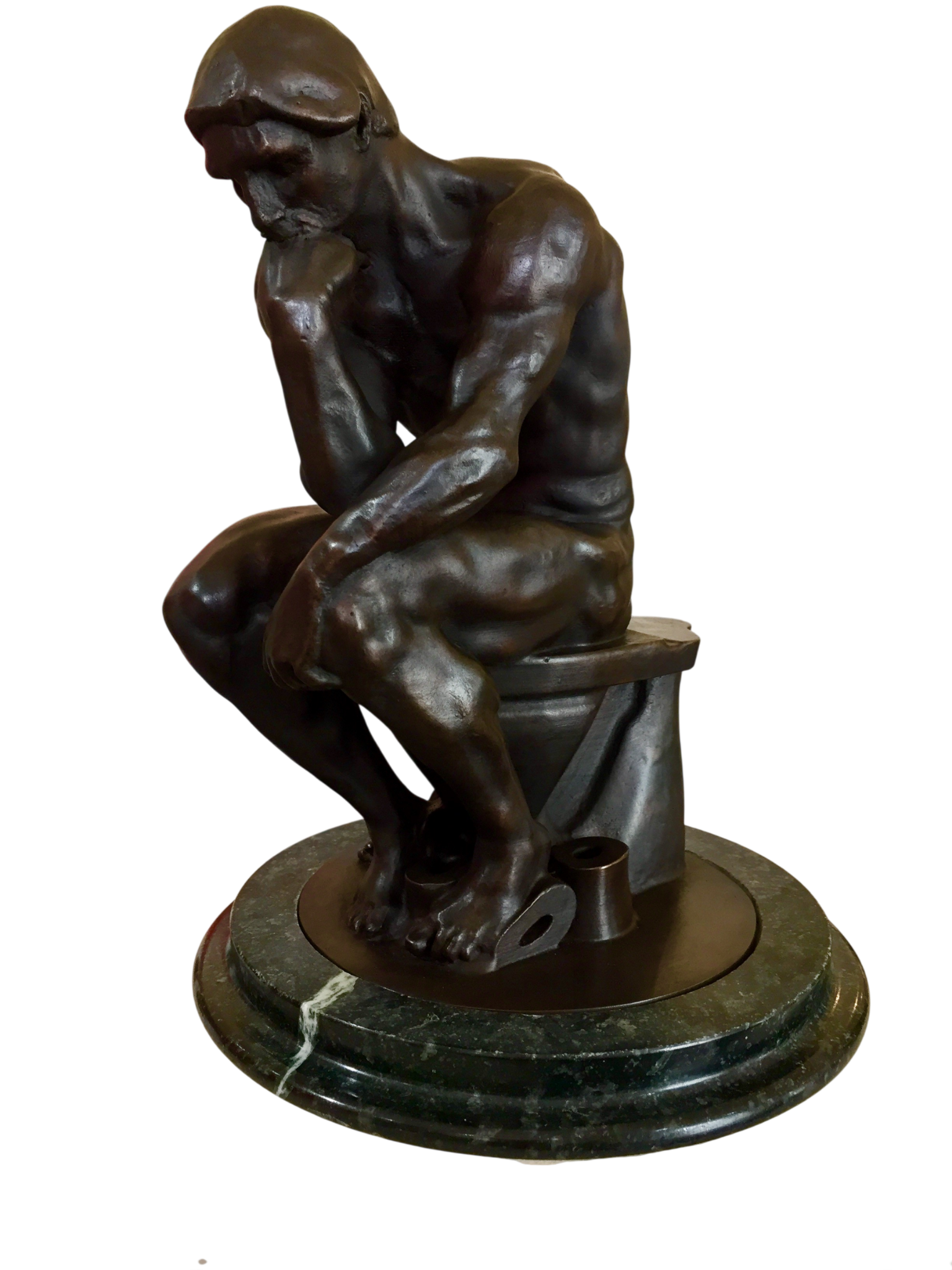
Long before either sculptor, the pose was present in ordinary behaviour and in the visual history of contemplation—wherever private thought might find us. The Stinker, a playful private commission for an Edinburgh client, makes the point with admirable irreverence: the thoughtful pose can turn up in the most unheroic of places. There is every reason to see Rodin and Rheinhold as independent responses to that enduring human—and primate—possibility.
References and further scholarship
[1] Jochen Richter and Axel Schmetzke, “Der philosophische Affe und die Eule der Minerva,” in Horst Kant and Annette Vogt (eds), Aus Wissenschaftsgeschichte und -theorie: Hubert Laitko zum 70. Geburtstag (Berlin, 2005).
[2] Musée Rodin, “The Thinker”; National Gallery of Art, collection note on Le Penseur.
[3] Metropolitan Museum of Art; Philadelphia Museum of Art; Vatican Museums, collection records and interpretive notes on The Thinker and The Gates of Hell.
[4] Grosse Berliner Kunstausstellung, exhibition catalogue (Berlin, 1893), entry 2359.
[5] On Rodin’s early circulation and German reception, see the discussion brought together by Richter and Schmetzke and the major museum chronologies in notes 2–3.
[6] Yen Lee Angela Kwok, Jan Gralton and Mary-Louise McLaws, “Face touching: A frequent habit that has implications for hand hygiene,” American Journal of Infection Control 43, no. 2 (2015): 112–114.
[7] J. Rahman, J. Mumin and B. Fakhruddin, “How Frequently Do We Touch Facial T-Zone: A Systematic Review,” Annals of Global Health 86, no. 1 (2020): 75.
[8] Martin Grunwald et al., “Number of Facial Hair Corresponds to Frequency of Spontaneous Face-Touch in Humans,” Advanced Biology (2024).
[9] S. Dimond and R. Harries, “Face touching in monkeys, apes and man: Evolutionary origins and cerebral asymmetry,” Neuropsychologia 22 (1984).
[10] “Effects of Cognitive Challenge on Self-Directed Behaviors by Chimpanzees,” American Journal of Primatology.
[11] “Evaluating Self-Directed Behaviours … in Bonobos” (2022).
[12] Institute for the Study of the Ancient World, NYU, The Lost World of Old Europe, note on the Thinker of Cernavodă.
[13] Metropolitan Museum of Art, Melian terracotta plaque with Penelope.
[14] Smarthistory, note on the gilt-bronze pensive Bodhisattva.
[15] Metropolitan Museum of Art, collection record for Dürer’s Melencolia I.
[16] R. Klibansky, E. Panofsky and F. Saxl, Saturn and Melancholy (1964).
[17] Rembrandt, Jeremiah Lamenting the Destruction of Jerusalem, Rijksmuseum.
[18] Domenico Fetti, Meditation / Melancholy; Raphael, School of Athens detail of Heraclitus; Michelangelo’s contemplative prophets and tomb figures.
[19] Metropolitan Museum of Art, collection note on Carpeaux’s Ugolino and His Sons.
[20] Van Gogh Museum and Metropolitan Museum of Art notes on At Eternity’s Gate.
[21] Musée Rodin and Munch scholarship on the contemplative figure in late nineteenth-century art.
[22] Mueller SM, Martin S, Grunwald M. “Self-touch: Contact durations and point of touch of spontaneous facial self-touches differ depending on cognitive and emotional load.” PLoS One. 2019 Mar 12;14(3):e0213677. doi:10.1371/journal.pone.0213677. PMID: 30861049; PMCID: PMC6413902.