Anton von Werner · Original German and English
Address at the Prize-Giving Ceremony
Ansprache bei Gelegenheit der Preisverteilungsfeier · 17 July 1889
English translation · Leaf 1
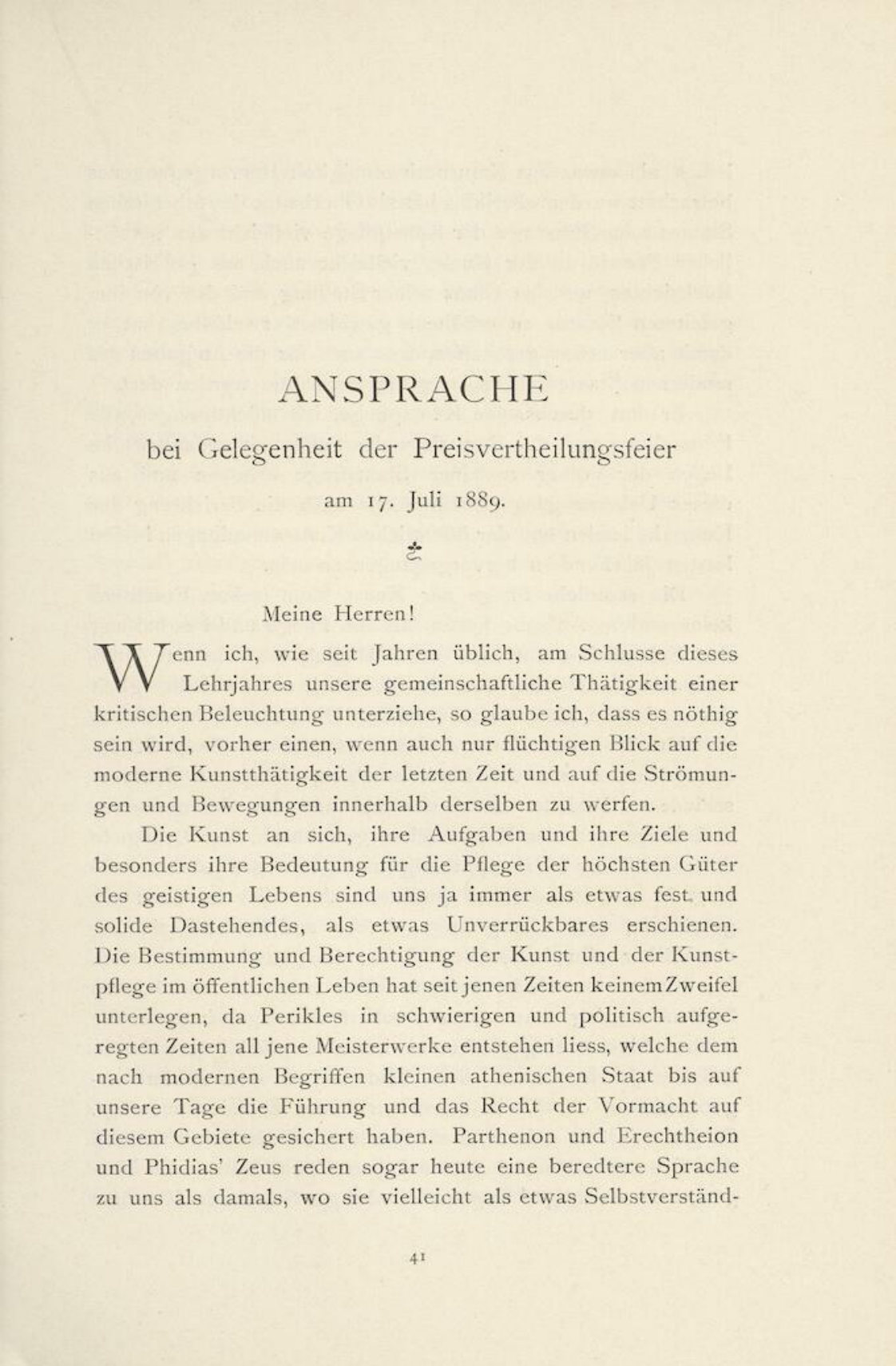
ADDRESS on the occasion of the prize-giving ceremony on 17 July 1889.
Gentlemen!
When, as has been customary for years, I critically review our joint activity at the close of this academic year, I believe it will first be necessary to cast even a fleeting glance at recent artistic activity and the currents and movements within it.
Art itself, its tasks and goals, and especially its significance for cultivating the highest goods of intellectual life, have always appeared to us as something firm and solid, something immovable. The purpose and legitimacy of art and its cultivation in public life have been beyond doubt ever since Pericles, in difficult and politically troubled times, caused all those masterpieces to be created which have secured for the Athenian state—small by modern standards—leadership and the right of pre-eminence in this sphere down to our own day. The Parthenon and Erechtheion and Phidias’s Zeus speak to us even more eloquently today than they did then, when they were perhaps regarded as something self-
English translation · Leaf 2
evident, something arising from natural necessity. As head of the Athenian state, Pericles may have devoted his care to fostering art out of personal delight in it, perhaps also from political considerations, to enhance the splendour of his own position and of the state he led; undoubtedly, however, he thereby created something which may be regarded as exemplary for the tasks of the modern state as well.
Through his cultivation of art he raised, I would say, the establishment and preservation of the idea of beauty in the life of nations to a matter of state; and the establishment of art academies and public art collections in recent centuries seems to me to have sprung from this conviction too.
In my view, state patronage of art can have no other task than cultivating and preserving the idea of beauty, rather as an international commission safeguards the security and certainty of the modern metre standard. The forms in which artists expressed this idea of beauty within the three sister arts have changed with the different periods of history and the habits and inclinations of civilised peoples. The impulse to be active in this direction at all has even receded for centuries, but this has only happened when disturbing fluctuations have occurred in the intellectual life and education of the peoples themselves. The influence of fashion, which formerly emanated only from the highest places, has often intervened very sharply and capriciously in artistic activity; fortunately, however, in earlier centuries even this fashion seldom did real harm to the idea of beauty in art. In Rubens’s day, just as late as the time of Frederick the Great, it was considered neither chic nor good taste to depict contemporary historical events, or even statues, in the dress
English translation · Leaf 3
of the time. Yet surely no one could maintain that Rubens’s Luxembourg Gallery or Schlüter’s Great Elector ran counter to that principle which already existed and was acknowledged in Phidias’s day.
Certainly art should and must be modern, and it would be sad if we had nothing else or better before us on our path through life than to arrange our daily artistic work according to an existing, officially approved pattern, such as the monks of Mount Athos have for their type of Madonna.
Michelangelo, Raphael and Titian in their day, despite their loudly declared endeavour to build further upon antiquity, were surely as modern as anyone today; so too were Holbein and Dürer, Rubens and Rembrandt, despite the enormous differences in their artistic expression. Certainly none of them would have denounced another as a heretic, since there could scarcely have been any disagreement among them concerning the doctrine of the idea of beauty.—
While architecture and sculpture in recent times show no particularly conspicuous outward currents or peculiarities, but continue to work upon the solid foundation of everything created over thousands of years, currents appear in modern painting which deserve attention if only because one side greets and celebrates them with jubilation as the newest and only truth, while the other attacks and rejects them.
If the task of the modern art academy is to equip its students with all the knowledge and ability that will enable them to follow their own paths well prepared in practical life, then its goal and curriculum are clearly and plainly laid down; for the overwhelming abundance and significance of the material which artistic activity, from classical Hellenic times to today,
English translation · Leaf 4
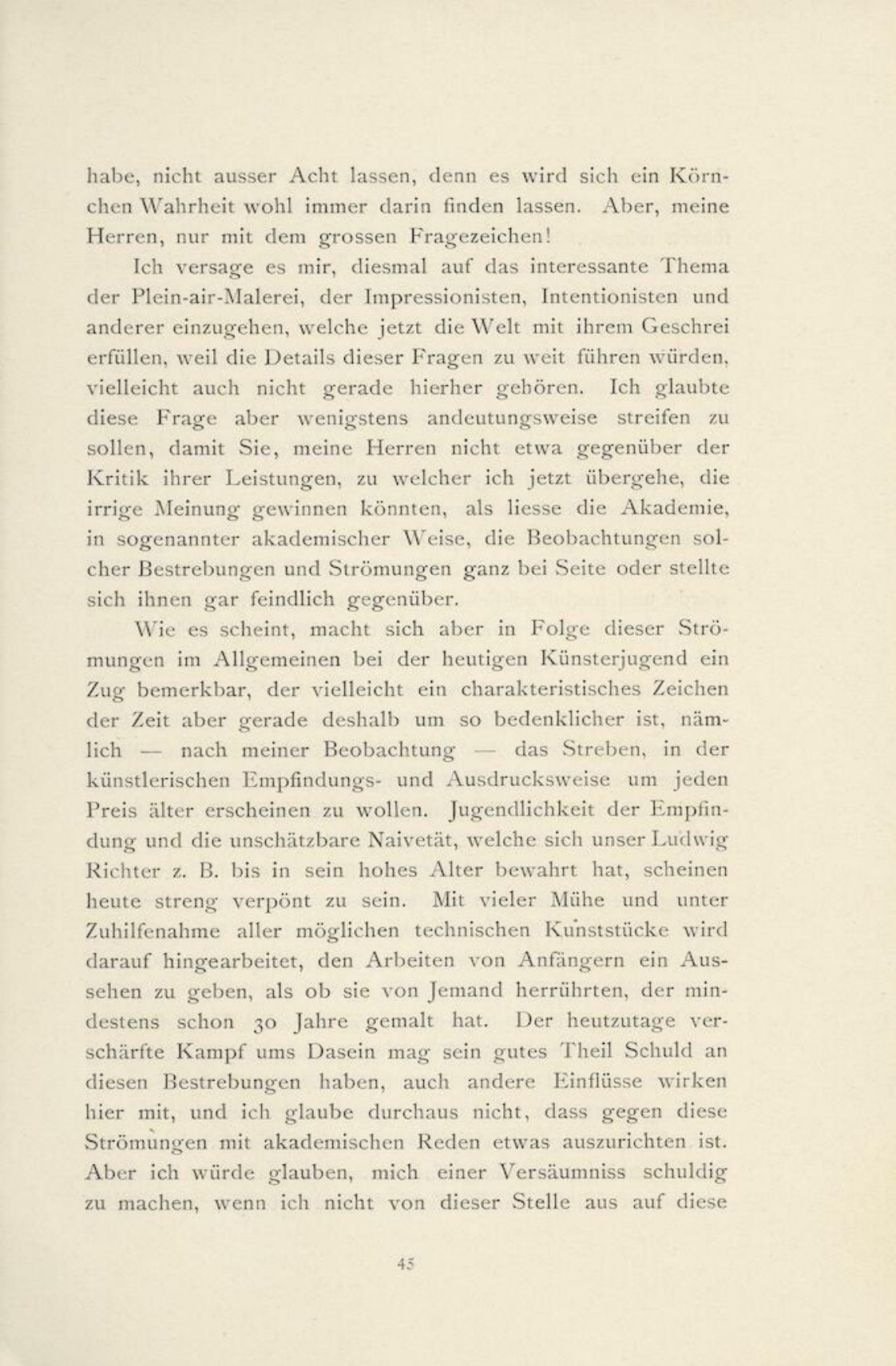
has assembled for the training of our ways of seeing leaves no room for doubt about our task or the ways to accomplish it. Nevertheless, the Academy should and must not leave such distinctive currents in modern art out of account or consideration, whether out of regard for our fast-moving and forcefully striving age, or to place at least a large question mark against certain fluctuations in concepts.
It is as natural as it is legitimate for youth to devote itself with particular zeal to new currents and phenomena, and to be especially eager to tread untrodden paths, just as it is legitimate and necessary for more deliberate age to approach them with caution, scrutiny and criticism. I think the sensible cooperation of these two elements and outlooks should yield the result we seek. But, gentlemen, the Academy must surely place that large question mark which I mentioned earlier when I consider what, referring to Pericles, I regard as the aim of state patronage of art: the cultivation of that certain something which a cultivated state of distinction must regard as the highest and most beautiful flowering of its existence and endeavours. Section 42 of our statutes admittedly says, very modestly: ‘The Academic College of Fine Arts aims at comprehensive education in the fine arts and their auxiliary disciplines … and specific preparation for the independent practice of the individual branches of fine art.’ That would be a somewhat meagre, scanty programme for a state college of fine arts, and I believe we actually have much more to do. Above all, we should surely keep in view the cultivation of the idea of beauty and the search for truth, much as do our colleges devoted to other purposes. Therefore, concerning those currents which I have previously described as the results of a prevailing fashion,
English translation · Leaf 5
we must not leave them out of account, for a grain of truth will surely always be found in them. But, gentlemen, only with that large question mark!
I shall refrain this time from discussing the interesting subject of plein-air painting, the Impressionists, Intentionists and others who now fill the world with their clamour, because the details of these questions would take us too far, and perhaps do not quite belong here. Yet I thought I should at least touch upon the question so that, gentlemen, when faced with the criticism of your achievements to which I now turn, you should not form the mistaken opinion that the Academy, in so-called academic fashion, entirely neglects to observe such endeavours and currents, or even adopts a hostile attitude towards them.
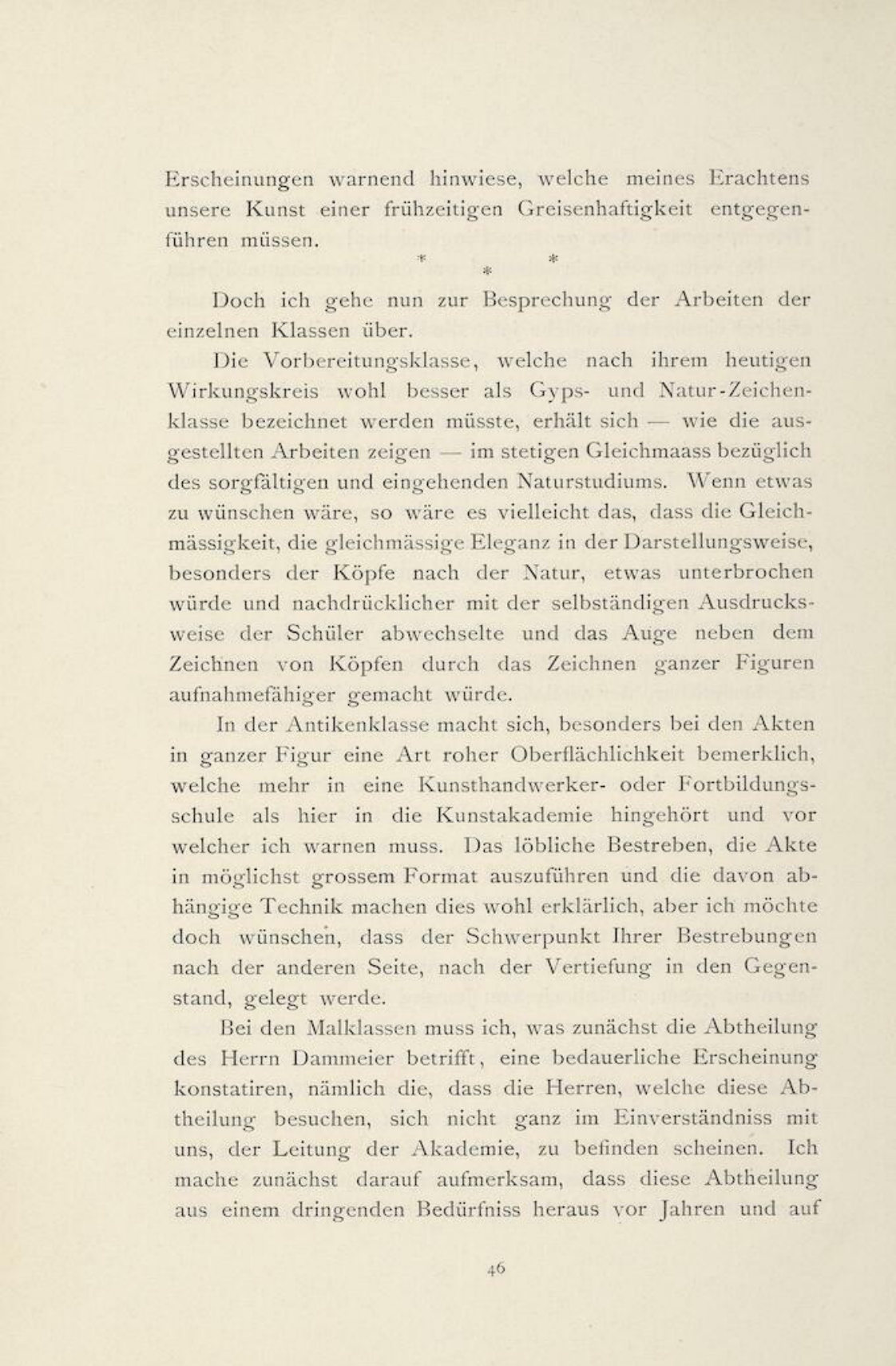
It seems, however, that as a result of these currents a tendency is generally becoming noticeable among today’s young artists which may be a characteristic sign of the times, but is all the more troubling for that very reason: namely, in my observation, the striving at any cost to appear older in artistic feeling and expression. Youthfulness of feeling and the priceless naïveté which our Ludwig Richter, for example, preserved into advanced old age seem strictly proscribed today. With much effort, and recourse to every possible technical trick, people endeavour to make beginners’ works look as though they came from someone who had been painting for at least thirty years. Today’s intensified struggle for existence may bear its fair share of responsibility for these endeavours, and other influences play a part too; I certainly do not believe academic speeches can accomplish anything against these currents. But I should think myself guilty of neglect if I did not from this place warn against these
English translation · Leaf 6
phenomena, which in my opinion must lead our art towards premature senility.
But I now turn to discussing the work of the individual classes.
The preparatory class, which according to its present sphere of activity should more properly be called the class for drawing from plaster casts and from life, maintains—as the exhibited works show—a steady consistency in careful, thorough study of nature. If anything were to be wished for, it would perhaps be that the uniformity, the uniform elegance of representation, particularly in heads drawn from life, should be interrupted somewhat and alternate more emphatically with the students’ independent expression, and that, alongside drawing heads, the eye should be made more receptive through drawing whole figures.
In the class drawing from the antique, a kind of crude superficiality is noticeable, particularly in full-length nude studies, which belongs in a school for craftspeople or a continuation school rather than here at the art academy, and against which I must warn you. The commendable endeavour to execute nude studies on the largest possible scale, and the technique dependent upon this, make it understandable; yet I should wish the centre of gravity of your endeavours to be shifted to the other side, towards deeper engagement with the subject.
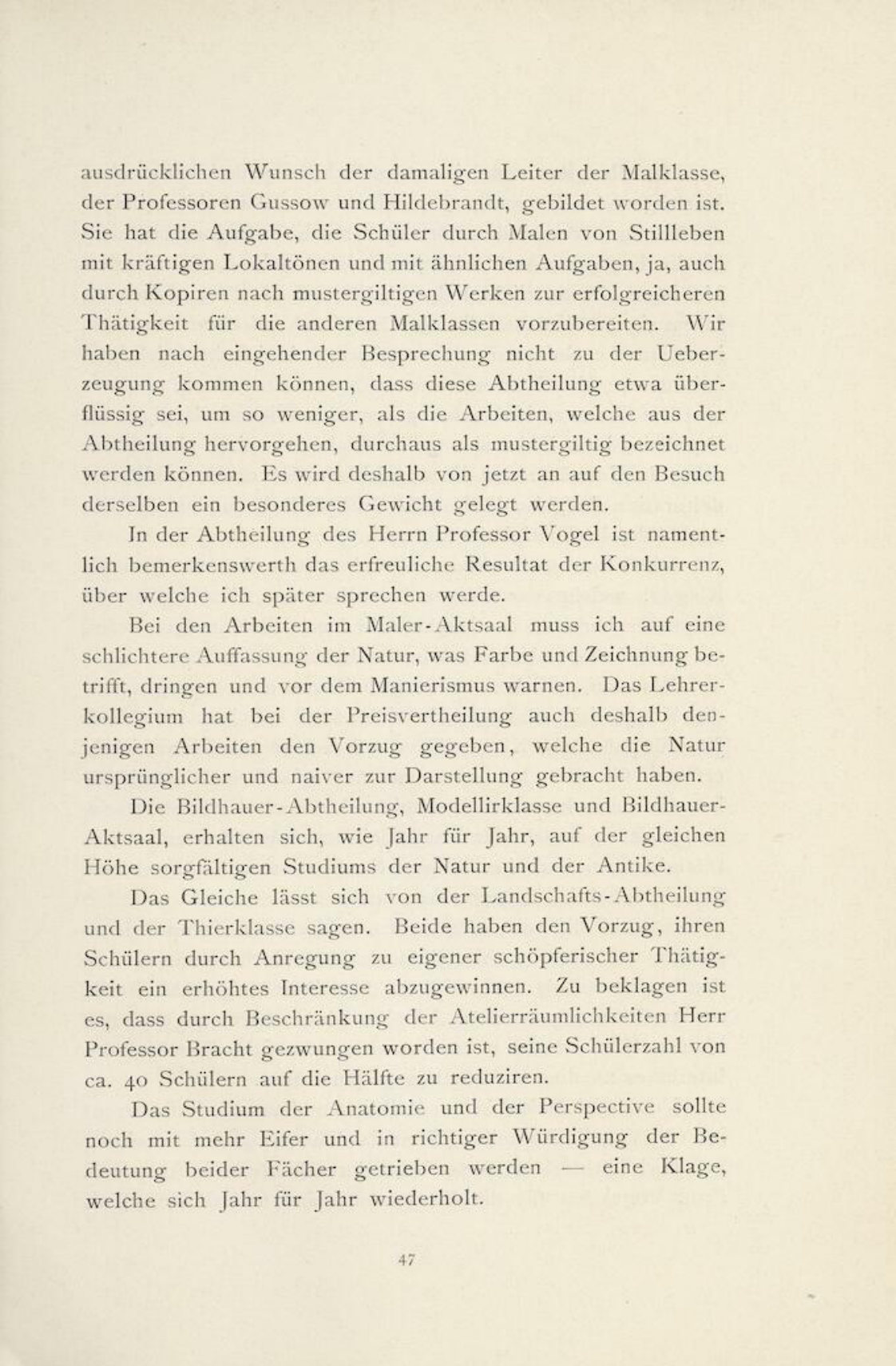
In the painting classes, concerning first Mr Dammeier’s section, I must note a regrettable phenomenon: the gentlemen attending this section seem not to be entirely in agreement with us, the Academy’s leadership. I would first point out that this section was established years ago out of an urgent need, and at the
English translation · Leaf 7
express wish of the then heads of the painting class, Professors Gussow and Hildebrandt. Its task is to prepare students for more successful work in the other painting classes through painting still lifes with strong local colours and similar exercises, indeed also through copying exemplary works. After detailed discussion we have been unable to conclude that this section is in any way superfluous, all the less because the works it produces may certainly be called exemplary. Henceforth particular importance will therefore be attached to attendance there.
In Professor Vogel’s section, especially noteworthy is the gratifying result of the competition about which I shall speak later.
As regards the work in the painters’ life room, I must insist upon a simpler interpretation of nature in colour and drawing, and warn against mannerism. For this reason too, in awarding the prizes the teaching staff gave preference to works which represented nature in a more direct and naïve way.
The sculpture department, the modelling class and the sculptors’ life room maintain, as they do year after year, the same high standard of careful study of nature and antiquity.
The same can be said of the landscape department and the animal class. Both have the advantage of eliciting heightened interest from their students by encouraging independent creative activity. It is regrettable that restricted studio accommodation has compelled Professor Bracht to reduce his number of students from about forty to half that figure.
The study of anatomy and perspective ought to be pursued still more zealously and with a proper appreciation of the importance of both subjects—a complaint repeated year after year.
English translation · Leaf 8
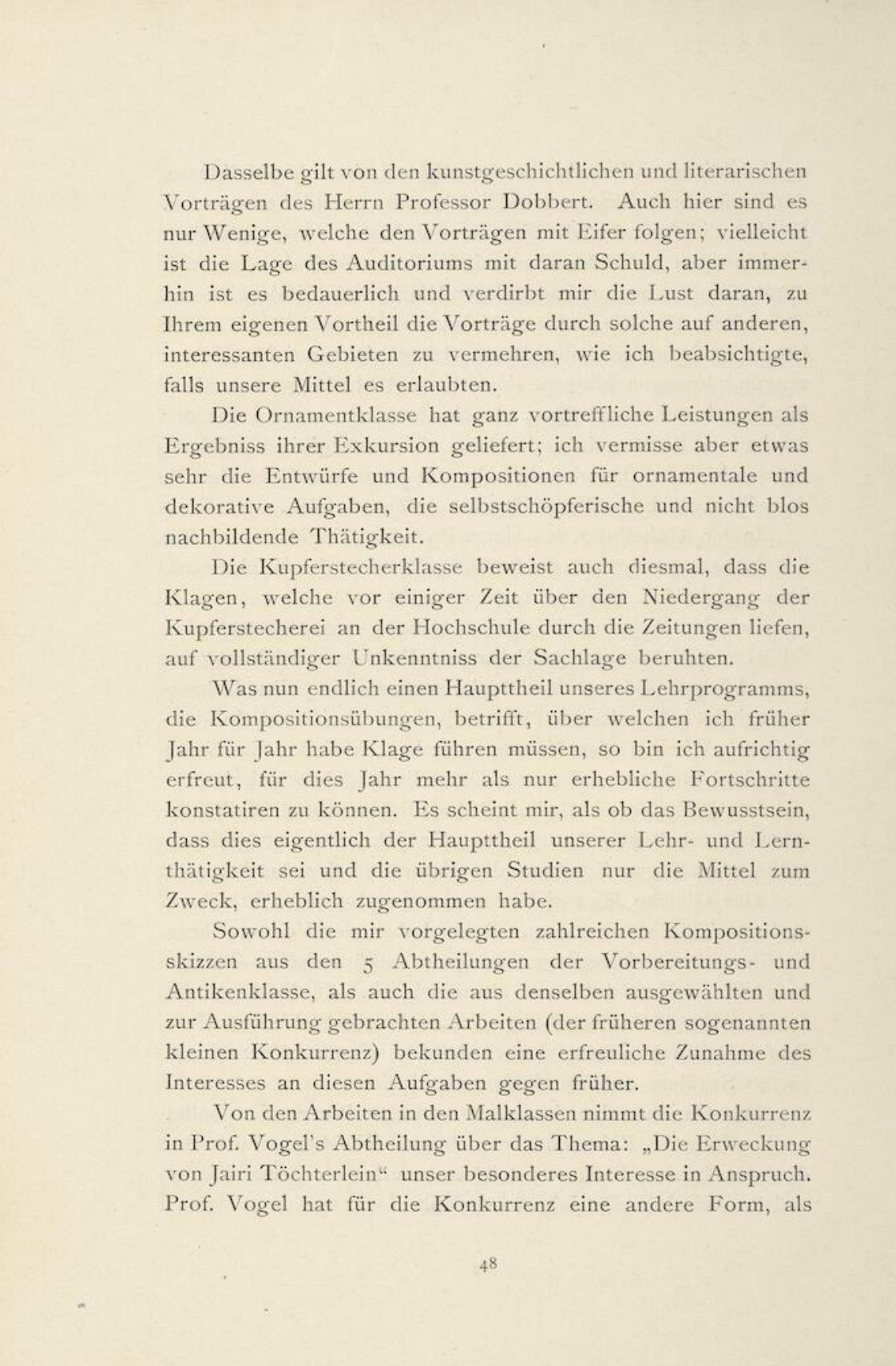
The same applies to Professor Dobbert’s art-historical and literary lectures. Here too, only a few follow the lectures with enthusiasm; the location of the lecture room may be partly to blame, but it is regrettable nonetheless and spoils my inclination to increase the lectures for your own benefit by adding others in interesting fields, as I had intended if our funds permitted.
The ornament class has produced quite excellent results from its excursion; but I very much miss designs and compositions for ornamental and decorative tasks: independently creative activity rather than mere reproduction.
The copper-engraving class proves again this time that the complaints circulating in the newspapers a while ago about the decline of copper engraving at the College rested upon complete ignorance of the facts.
Finally, concerning a principal part of our teaching programme, the composition exercises, about which in the past I have had to complain year after year, I am sincerely pleased to be able to report more than merely considerable progress this year. It seems to me that awareness has greatly increased that this is really the principal part of our teaching and learning, and the other studies only the means to that end.
Both the numerous composition sketches submitted to me from the five sections of the preparatory class and the class drawing from the antique, and the works selected from them and carried through to execution—the former so-called small competition—demonstrate a gratifying increase in interest in these tasks compared with earlier years.
Among the works in the painting classes, the competition in Professor Vogel’s section on the subject ‘The Raising of Jairus’s Daughter’ commands our particular interest. Professor Vogel chose a different form for the competition from
English translation · Leaf 9
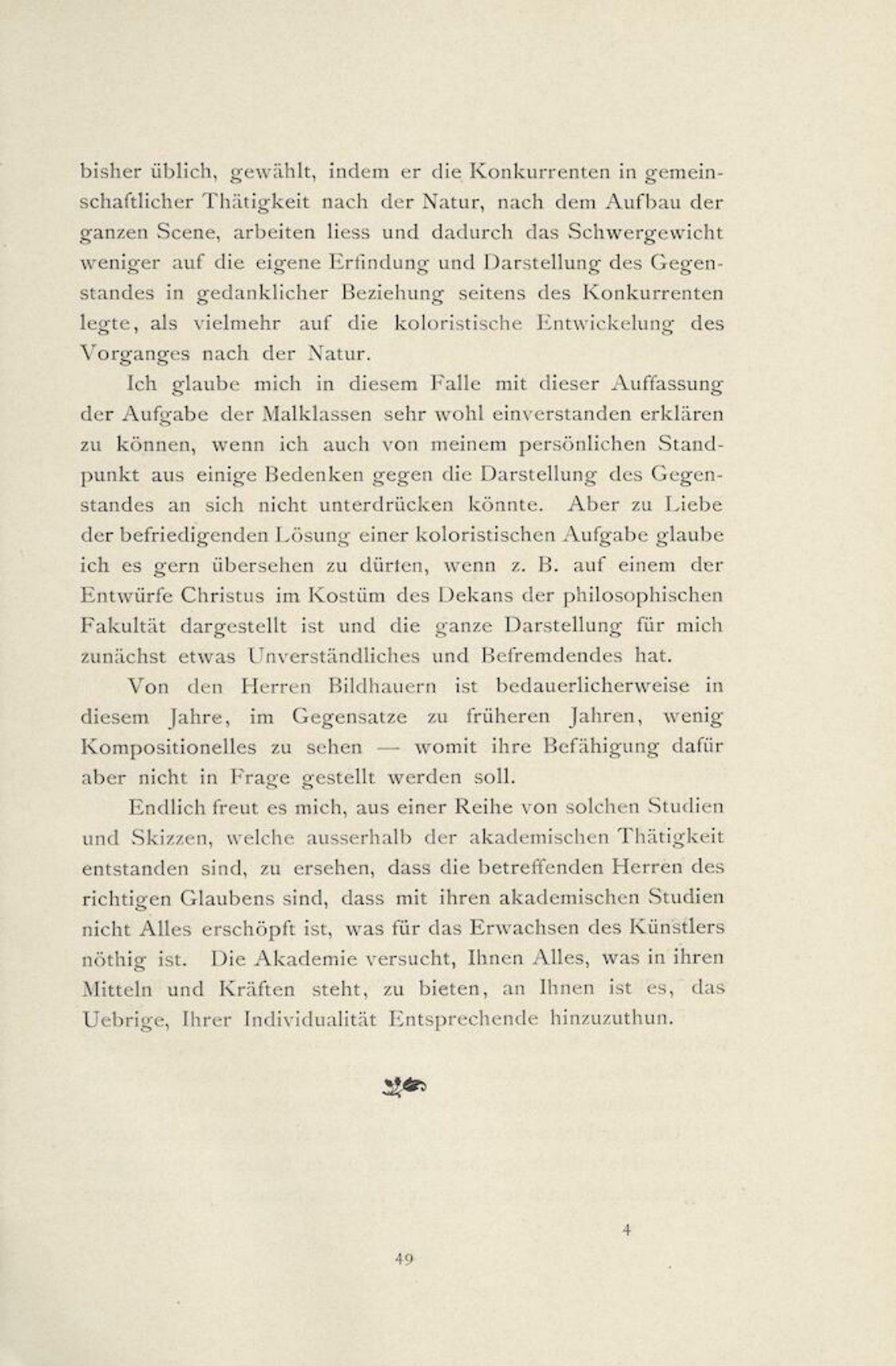
that customary hitherto, having the competitors work collectively from life, after the entire scene had been arranged. He thus placed the emphasis less upon the competitor’s own invention and representation of the subject in terms of its conception than upon the development of the scene’s colour from life.
I believe that in this instance I can quite readily agree with this view of the task of the painting classes, even though from my personal standpoint I could not suppress some reservations about the representation of the subject itself. But for the sake of a satisfactory solution to a problem in colour, I believe I may readily overlook it if, for example, Christ is depicted in one of the designs in the costume of the dean of the faculty of philosophy, and the whole representation initially seems to me somewhat incomprehensible and strange.
Regrettably, in contrast to earlier years, little compositional work by the sculptors can be seen this year—though this is not intended to call their ability for it into question.
Finally, I am pleased to see from a series of studies and sketches produced outside academic activity that the gentlemen concerned rightly believe their academic studies do not exhaust everything necessary for the artist’s growth. The Academy attempts to offer you everything within its means and powers; it is for you to add the rest, in keeping with your individuality.
Source: Anton von Werner, Ansprachen und Reden (1896). Original digitisation: Universitätsbibliothek Heidelberg / Akademie der Künste. Consult the source volume.