Hugo Rheinhold · Original German and English
Wie ich ein anderer Mensch geworden bin — How I Became Another Man
Hugo Rheinhold · 19 August 1893
Hugo Rheinhold’s witty autobiographical sketch appeared in Ethische Kultur in 1893 under the subtitle Ein Bekenntnis von H. Rheinhold (“A confession by H. Rheinhold”). His 1900 obituary singled it out as an example of the humour he combined with moral seriousness.
Rheinhold recalls a childhood escapade involving a locked drawer of family treasures, a tempting supply of chocolate and an unexpectedly fascinating book on the duties of motherhood. When his mother leaves the key behind, curiosity and appetite prove irresistible. What begins as a small act of mischief becomes a prolonged secret, as the stolen book opens up a world of adult knowledge that the boy only partly understands.
Gradually the book's descriptions of a child's dependence upon maternal care give his adventure a different complexion. His fear of discovery turns into shame, then into an extravagant resolution to reform his character. Rheinhold recounts this awakening of conscience with affectionate irony: even his most solemn promise of virtue leaves room for one final piece of chocolate.
The original German pages are presented alongside a complete English translation, preserving both the playful narrative voice and the moral questions that made the story memorable to his contemporaries.
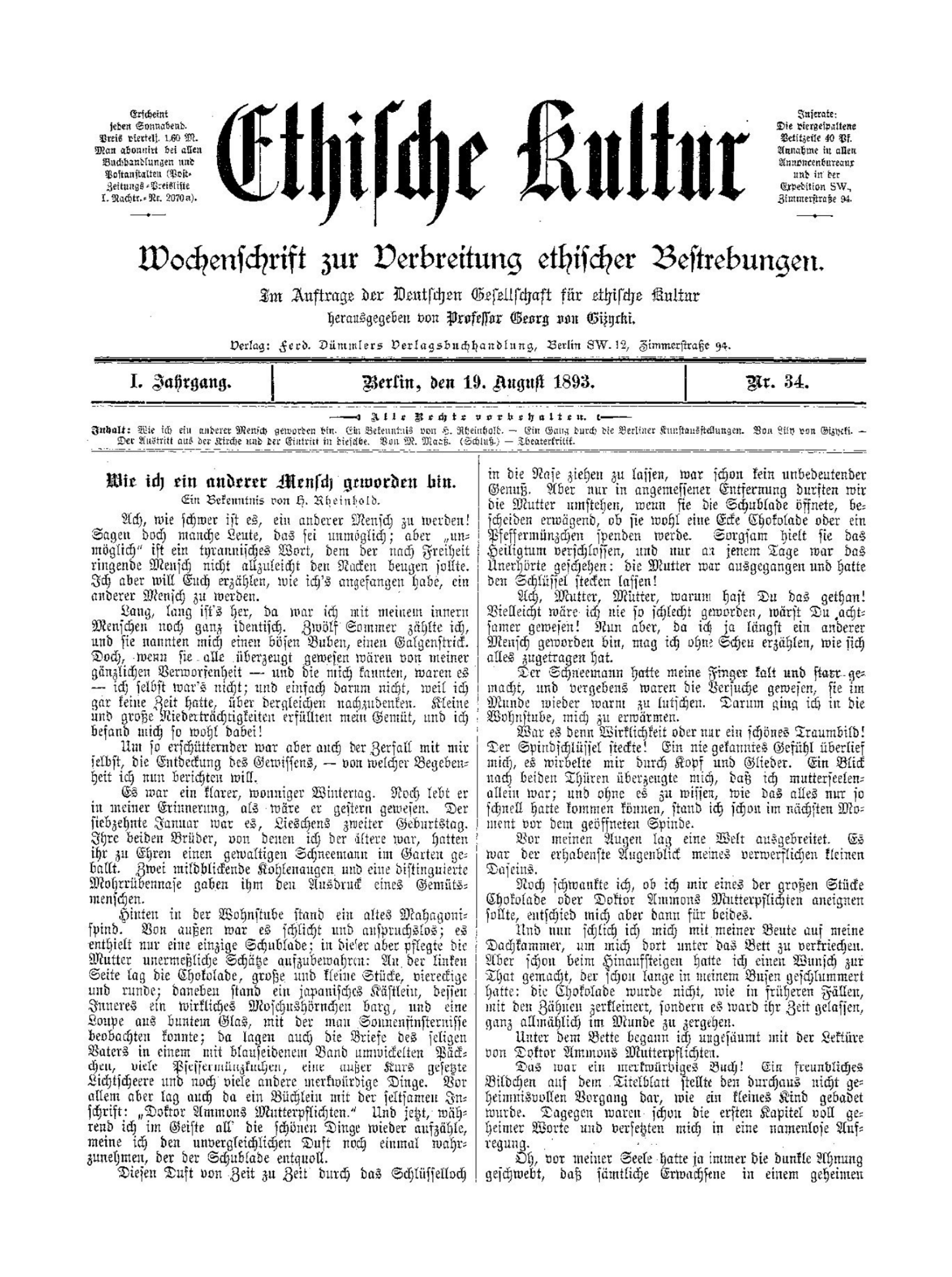
English translation · Page 267
How I Became Another Man
A confession by H. Rheinhold.
Ah, how difficult it is to become another person! Many people say it is impossible; but “impossible” is a tyrannical word, to which anyone striving for freedom ought not to bow his neck too readily. I, however, want to tell you how I once set about becoming another person.
It is a long, long time ago. In those days I was still quite at one with my inner being. I was twelve years old, and they called me a wicked boy, a gallows-bird. Yet even if they had all been convinced of my utter depravity — and those who knew me generally were — I myself was not; simply because I had no time to reflect on such matters. My mind was full of small and great naughtinesses, and I felt perfectly content.
All the more shattering, then, was the collapse within myself, the discovery of conscience, of which I must now speak.
It was a clear, delightful winter’s day; it still clings to my memory as though it were yesterday. It was the seventeenth of January, little Lieschen’s second birthday. Her two brothers, of whom I was the elder, had built in her honour a magnificent snowman in the garden. Two kindly coal-eyes and a distinguished carrot nose gave him the expression of a man of feeling.
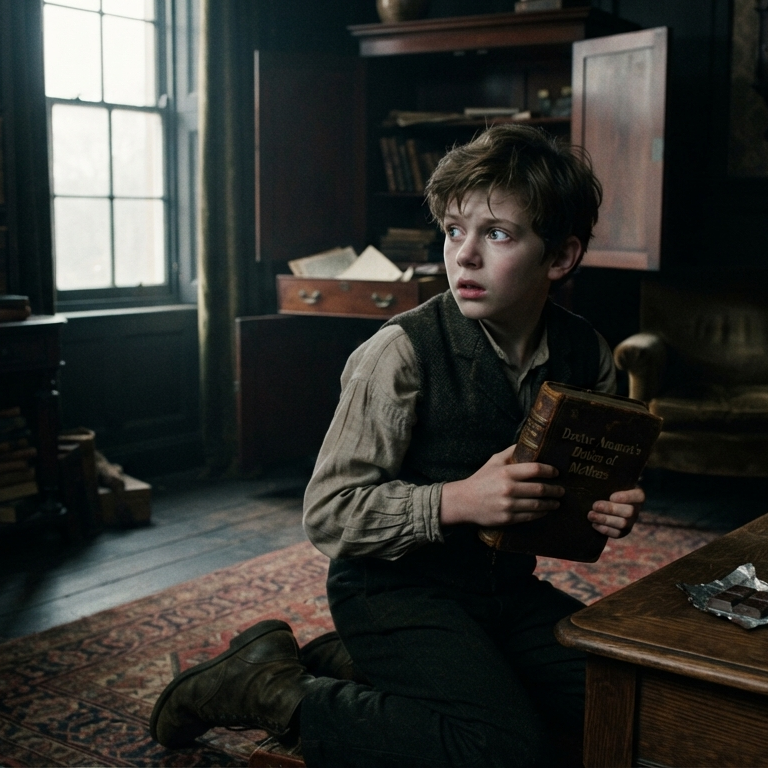
At the back of the sitting room stood an old mahogany cupboard. Outwardly it was plain and unassuming; but it contained a single drawer in which Mother kept immeasurable treasures. On the left lay chocolate, large and small, square and round. Beside it stood a Japanese box whose interior held a genuine musk-beetle, and a coloured-glass lens through which one could observe solar eclipses. There also lay the letters of our late father, tied up in blue silk ribbon, quantities of peppermint cakes that were no longer legal tender, a candle-snuffer, and many other marvellous things. Above all, there was a little book with the curious title Doctor Ammon’s Duties of Mothers. Even now, while I am listing all those beautiful objects in my mind, I imagine I can once more smell the incomparable fragrance that rose from the drawer.
To draw that fragrance through the keyhole into one’s nose from time to time was no small pleasure. Yet we were permitted to stand nearby only at a respectful distance when Mother opened the drawer, modestly wondering whether she might perhaps dispense a piece of chocolate or a peppermint sweet. She kept the sanctuary carefully locked, and only on that one day had the unheard-of occurred: Mother had gone out and left the key in the lock.
Ah, mothers, mothers — why did you do it? Perhaps I should never have become so bad if you had been more careful! But now that I have long since become another person, I may tell without shame how it all happened.
The snowman had made my fingers cold and stiff, and my attempts to warm them again in my mouth had been in vain. So I went into the sitting room to warm myself.
Was it reality, or only a beautiful dream? The cupboard key was there. A feeling I had never known ran through me; it whirled through my head and limbs. One glance at both doors convinced me that I was entirely alone, and before I knew how it had all happened so quickly, I found myself standing before the opened cupboard.
Before my eyes lay an entire world. It was the most exalted moment of my depraved little existence.
I still hesitated whether I should appropriate one of the large pieces of chocolate or some of Doctor Ammon’s motherly instruction, but in the end I decided in favour of both.
And so I slipped away with my booty to the attic room, to hide beneath the bed. But already as I climbed the stairs I carried out a wish that had long slumbered in my breast: instead of crushing the chocolate with my teeth, as on former occasions, I let it melt quite slowly in my mouth.
Under the bed I began at once to read Doctor Ammon’s Duties of Mothers. It was a remarkable book. A friendly little picture on the title page showed the by no means mysterious process of bathing a small child. But the very first chapters were full of secret words and plunged me into nameless excitement. I had always vaguely suspected that all grown-ups belonged to some secret league against their little fellow human beings; here it seemed proved beyond doubt.
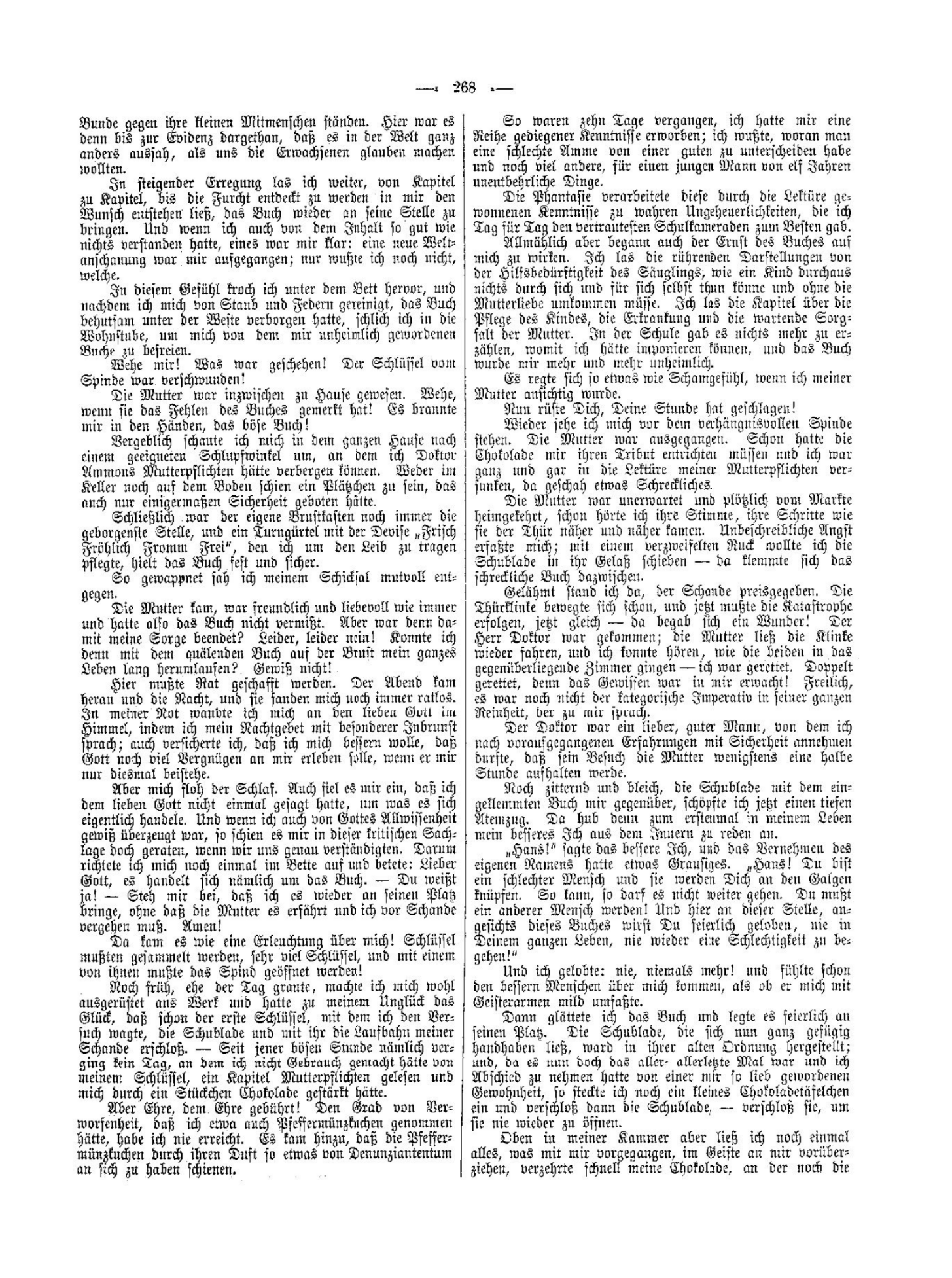
English translation · Page 268
In mounting agitation I read on from chapter to chapter, until my fear of being discovered made me wish to put the book back in its place. And though I had understood almost nothing of its actual content, one thing was clear to me: a new view of the world had opened before me, though I did not yet know exactly what sort of view it was.
With that feeling I crawled out from under the bed, brushed the dust and feathers from myself, hid the book carefully beneath my waistcoat, and slipped into the sitting room to rid myself of the uncanny volume.
Woe unto me! What had happened? The key to the cupboard had disappeared.
Mother, meanwhile, had been home. Suppose she had noticed the missing book! It burned in my hands, that wicked book. I looked in vain through the whole house for a suitable hiding place where I could conceal Doctor Ammon’s Duties of Mothers. Neither cellar nor loft seemed to offer even the least security. In the end my own chest remained the safest place, and a gymnastic belt, bearing the motto “Fresh, cheerful, pious, free,” which I wore around my body, held the book firm and secure.
Thus armed, I faced my fate with courage. Mother came; she was kind and loving as ever, so she had not missed the book. But was my anxiety over? Alas, no. Was I to go about for the rest of my life with that tormenting book pressed against my breast? Certainly not.
Counsel had to be found. Evening came, and night, and still they found me perplexed. In my distress I turned to the dear God in heaven and said my nightly prayer with particular fervour. I even assured Him that I intended to improve, and that He still had many pleasures in store from me, if only He would come to my aid this once. Yet sleep would not come. Again I sat up in bed and prayed: “Dear God, You know it is about the book. Stand by me, so that I may return it to its place without Mother noticing and without my having to perish of shame. Amen.”
Then it came upon me like an illumination: keys must be collected, very many keys, and with one of them the cupboard must surely be opened.
Before daybreak I set to work, well prepared, and to my misfortune had the good fortune that the very first key I tried opened the drawer and with it the whole course of my disgrace. For since that evil hour not a day passed in which I did not make use of my key, read a chapter of Duties of Mothers, and fortify myself with a little piece of chocolate. But honour where honour is due: I never descended to the degree of depravity that would have led me also to take peppermint cakes. Besides, they seemed by their very smell to have something of the informer about them.
So ten days passed. I had acquired a whole series of solid pieces of knowledge: I knew how to distinguish a bad wet nurse from a good one, and many other things indispensable to a young man of eleven. My imagination transformed what I had gained from reading into monstrous fantasies, which day after day I retailed to my closest school-friends. Yet gradually the serious side of the book began to affect me as well. I read the moving passages about the helplessness of the infant, about a child’s inability to do anything for itself, and its utter dependence on a mother’s love. I read the chapters on the care of children, on illness, and on the mother’s anxious attentiveness. At school there was now nothing left with which I could truly impress anyone, and the book became more and more uncanny to me. Something like shame stirred in me whenever I found myself in Mother’s presence.
Then came the decisive hour. Mother had gone out again. The chocolate had once more received its tribute, and I was wholly absorbed in my motherly studies, when something terrible happened. Mother returned unexpectedly from the market. I could already hear her voice, her footsteps coming nearer and nearer to the door. Unspeakable fear seized me. With a desperate jerk I tried to shove the drawer shut — and the dreadful book jammed in it.
I stood there paralysed, delivered over to disgrace. The door handle was already moving; the catastrophe would happen in the next instant — when a miracle occurred. The doctor had arrived. Mother released the handle, and I heard the two of them go into the adjoining room. I was saved — doubly saved, for conscience had awakened within me.
True, it was not yet the categorical imperative in its full purity that spoke to me. Yet the doctor was a kind and good man, of whom, from earlier experience, I could safely assume that he would keep Mother occupied for at least half an hour. Trembling and pale, I pushed the book back into the drawer and sank down with the deepest relief. For the first time in my life I had learned to listen to my conscience. “Hans!” I said to my better self, and the very sound of my own name had something terrible in it. “Hans, you are a bad boy, and they will hang you from the gallows. This cannot, must not, go on. You must become another person. And here, in the presence of this book, you shall solemnly vow never again in your whole life to commit another wicked deed.”
And I vowed it: never, never again. I already felt the better human being descending upon me, as if embracing me with ghostly arms.
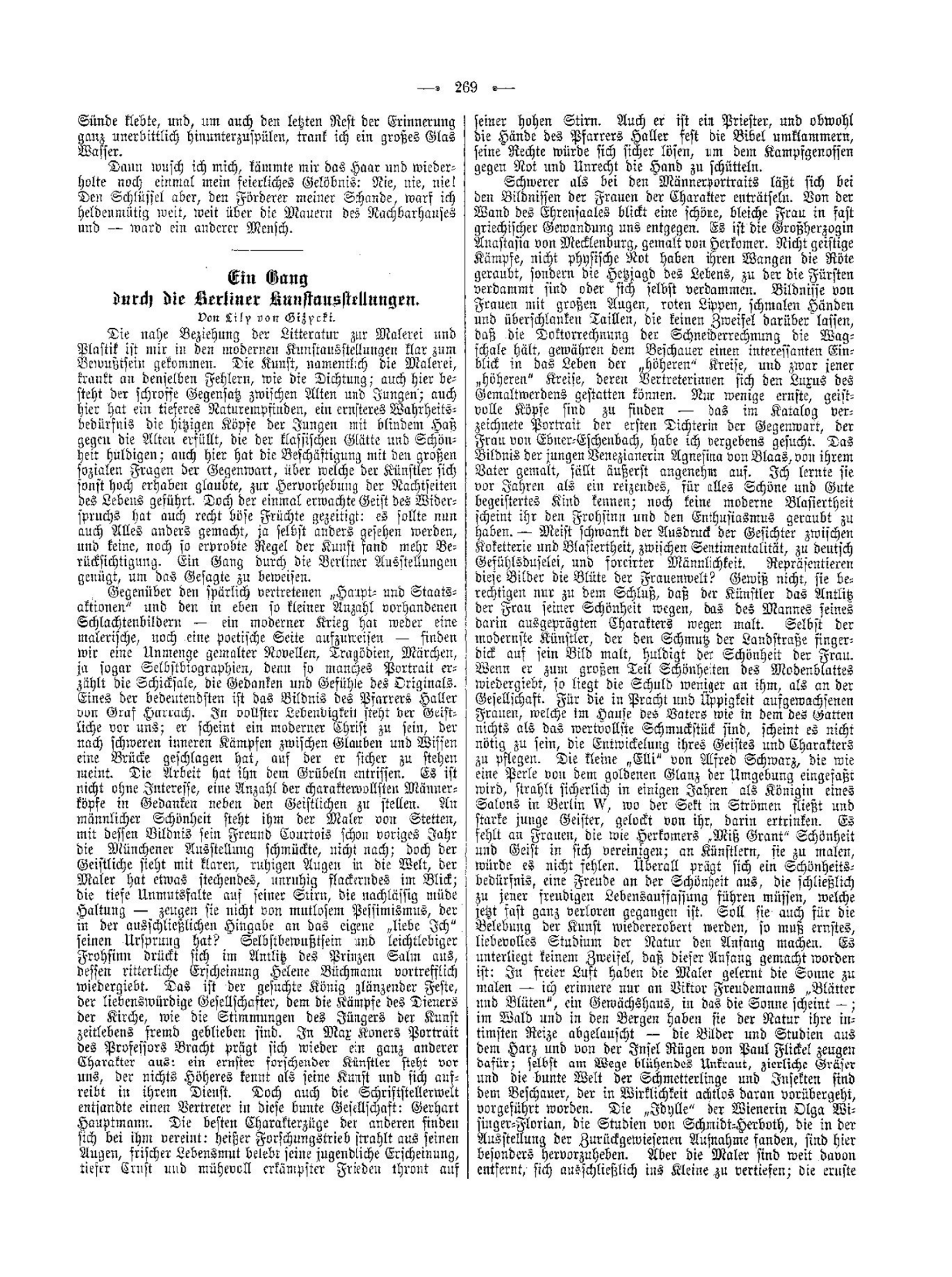
English translation · Page 269
Then I smoothed the book and solemnly laid it back in its place. The drawer, which now obediently opened and closed again, was restored to its former order; and since it was, after all, the very last time, and I had to take leave of a habit that had become dear to me, I slipped in one more little piece of chocolate, closed the drawer — and closed it never to open it again.
Back in my attic room I let the whole course of events pass once more before my mind, quickly ate the chocolate on which the stain of sin still clung, and, in order to wash away the very last trace of memory pitilessly, drank a large glass of water.
Then I washed myself, combed my hair, and repeated my solemn vow once more: never, never, never. The key, however — that promoter of my shame — I heroically threw far, far over the wall of the neighbouring house. And thus I became another man.
Hugo Rheinhold, “Wie ich ein anderer Mensch geworden bin. Ein Bekenntnis von H. Rheinhold”, Ethische Kultur: Wochenschrift zur Verbreitung ethischer Bestrebungen, I (1893), no. 34, 19 August 1893, pp. 267–269.