Anton von Werner · Original German and English
Address at the Prize-Giving Ceremony
Ansprache bei Gelegenheit der Preisverteilungsfeier · 14 July 1888
English translation · Leaf 1
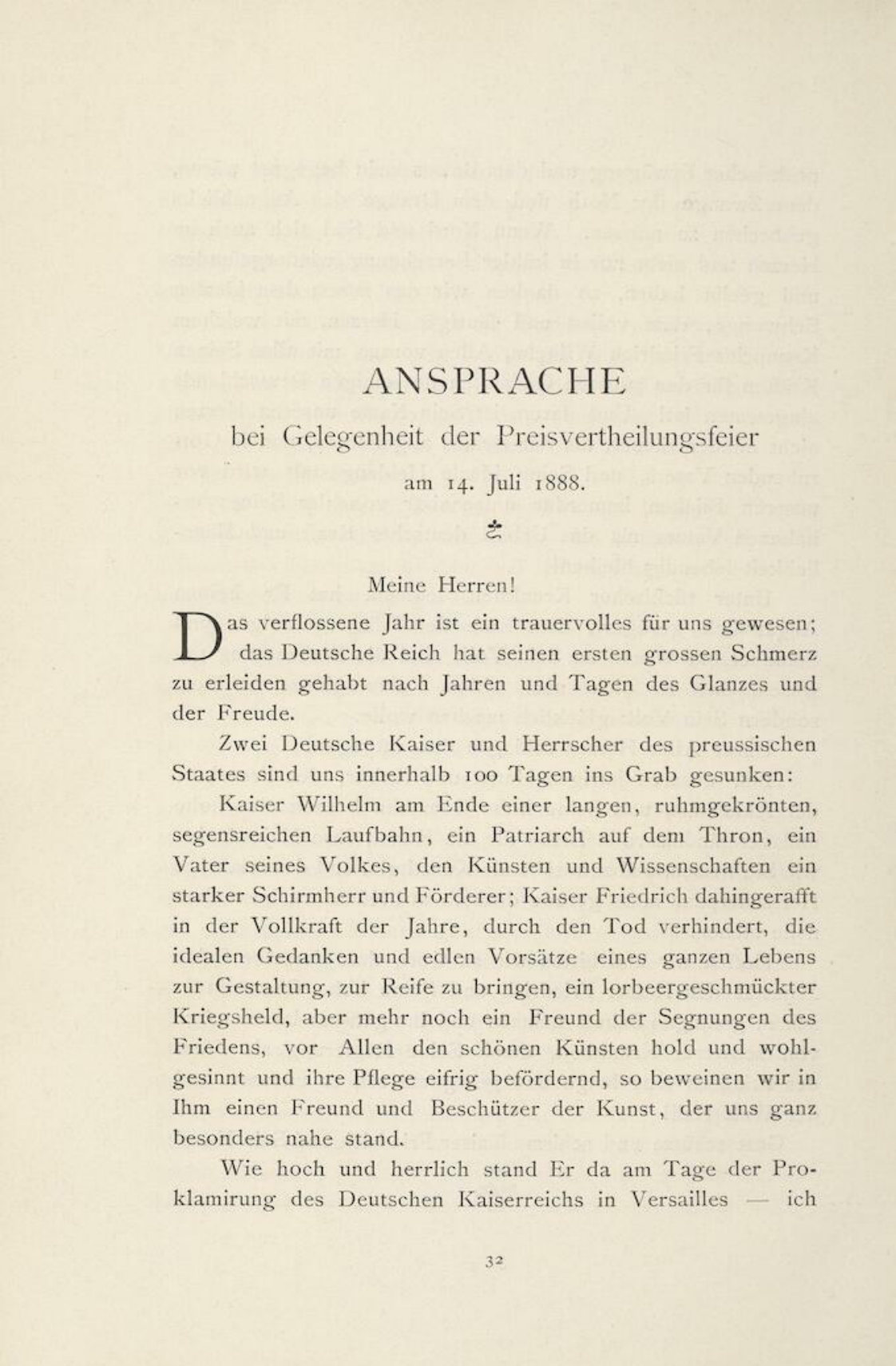
ADDRESS on the occasion of the prize-giving ceremony on 14 July 1888.
Gentlemen!
The past year has been a sorrowful one for us; after years and days of splendour and joy, the German Empire has had to suffer its first great grief.
Two German Emperors and rulers of the Prussian state have sunk into the grave within a hundred days:
Emperor Wilhelm at the end of a long, glorious, beneficent career, a patriarch upon the throne, a father to his people, a strong protector and patron of the arts and sciences; Emperor Friedrich carried off in the full vigour of his years, prevented by death from giving form and maturity to the ideal aspirations and noble intentions of an entire lifetime. A warrior crowned with laurel, but still more a friend of the blessings of peace, favourable and well disposed above all to the fine arts and eagerly promoting their cultivation, he is mourned by us as a friend and protector of art who was especially close to us.
How tall and magnificent he stood on the day of the proclamation of the German Empire at Versailles—I
English translation · Leaf 2
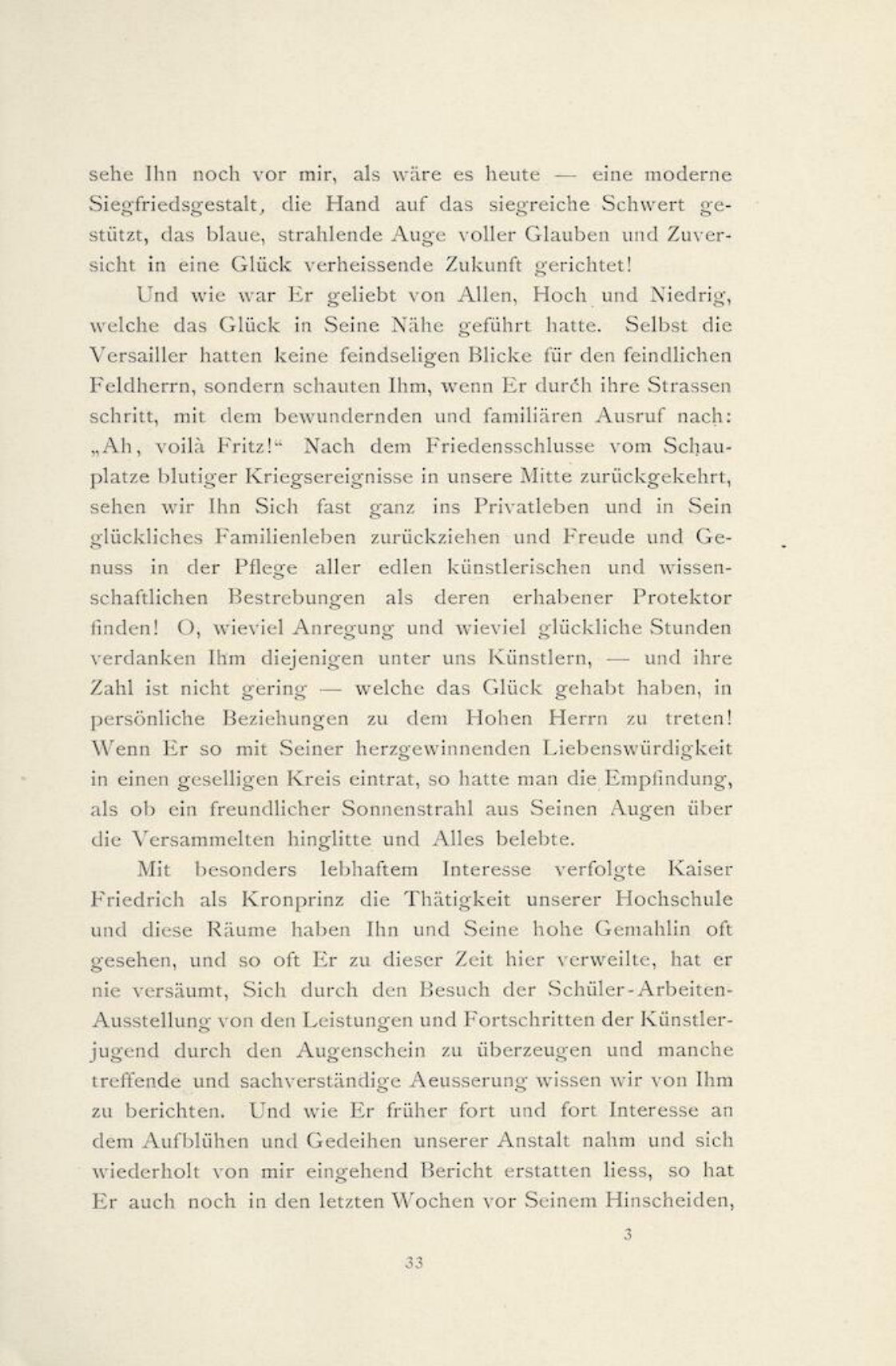
still see him before me as though it were today—a modern Siegfried, his hand resting upon his victorious sword, his radiant blue eyes turned in faith and confidence towards a future promising happiness!
And how he was loved by all, high and low, whom good fortune had brought near him. Even the people of Versailles had no hostile glances for the enemy commander, but watched him as he walked through their streets with the admiring, familiar exclamation: ‘Ah, voilà Fritz!’ Returning to our midst after the conclusion of peace, from the scene of bloody warfare, we see him withdraw almost entirely into private life and his happy family life, finding joy and pleasure as the exalted Protector of every noble artistic and scholarly endeavour! Oh, how much inspiration and how many happy hours those among us artists—and they are not few—who were fortunate enough to enter into personal relations with that august gentleman owe to him! When he entered a social gathering with his winning graciousness, one felt as though a friendly sunbeam from his eyes swept over those assembled and brought everything to life.
As Crown Prince, Emperor Friedrich followed the work of our College with particularly lively interest; these rooms often saw him and his august consort, and whenever he stayed here at this time of year he never failed to visit the exhibition of students’ work and see for himself the achievements and progress of the young artists. We can recount many an apt and knowledgeable remark of his. Just as he had continually taken an interest in the flourishing and prosperity of our institution, repeatedly asking me to report to him in detail, so, even in the last weeks before his passing,
English translation · Leaf 3
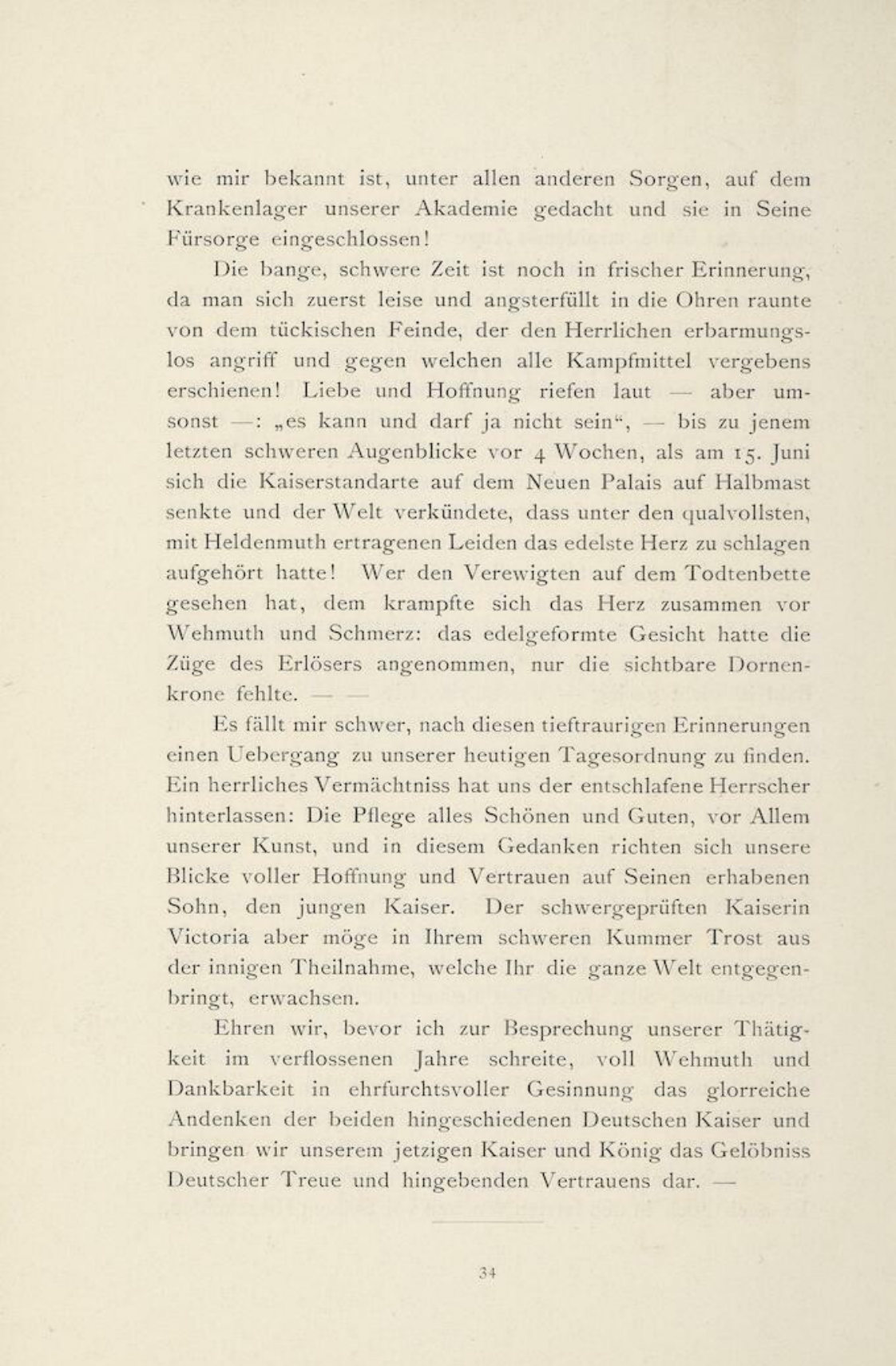
as I know, amid all his other cares he remembered our Academy on his sickbed and included it in his concern!
That anxious, difficult time is still fresh in our memory: when people first whispered quietly and fearfully to one another of the insidious enemy that attacked that magnificent man without mercy, against which every means of fighting seemed futile! Love and hope cried aloud—but in vain—‘It cannot, it must not be!’—until that final, grievous moment four weeks ago, when on 15 June the imperial standard above the Neues Palais sank to half-mast and announced to the world that, amid the most agonising sufferings borne with heroic courage, the noblest heart had ceased to beat! Whoever saw the departed one upon his deathbed felt his heart contract with sorrow and pain: that nobly formed face had assumed the features of the Redeemer; only the visible crown of thorns was missing.—
After these profoundly sorrowful recollections, I find it difficult to turn to today’s proceedings. The departed ruler has left us a glorious legacy: the cultivation of all that is beautiful and good, above all our art; and with this thought our eyes turn in hope and confidence to his exalted son, the young Emperor. May the sorely tried Empress Victoria find consolation in her deep sorrow through the heartfelt sympathy which the whole world extends to her.
Before I proceed to discuss our work during the past year, let us, with sorrow and gratitude and in a spirit of reverence, honour the glorious memory of the two departed German Emperors and offer our present Emperor and King the pledge of German loyalty and devoted trust.—
English translation · Leaf 4
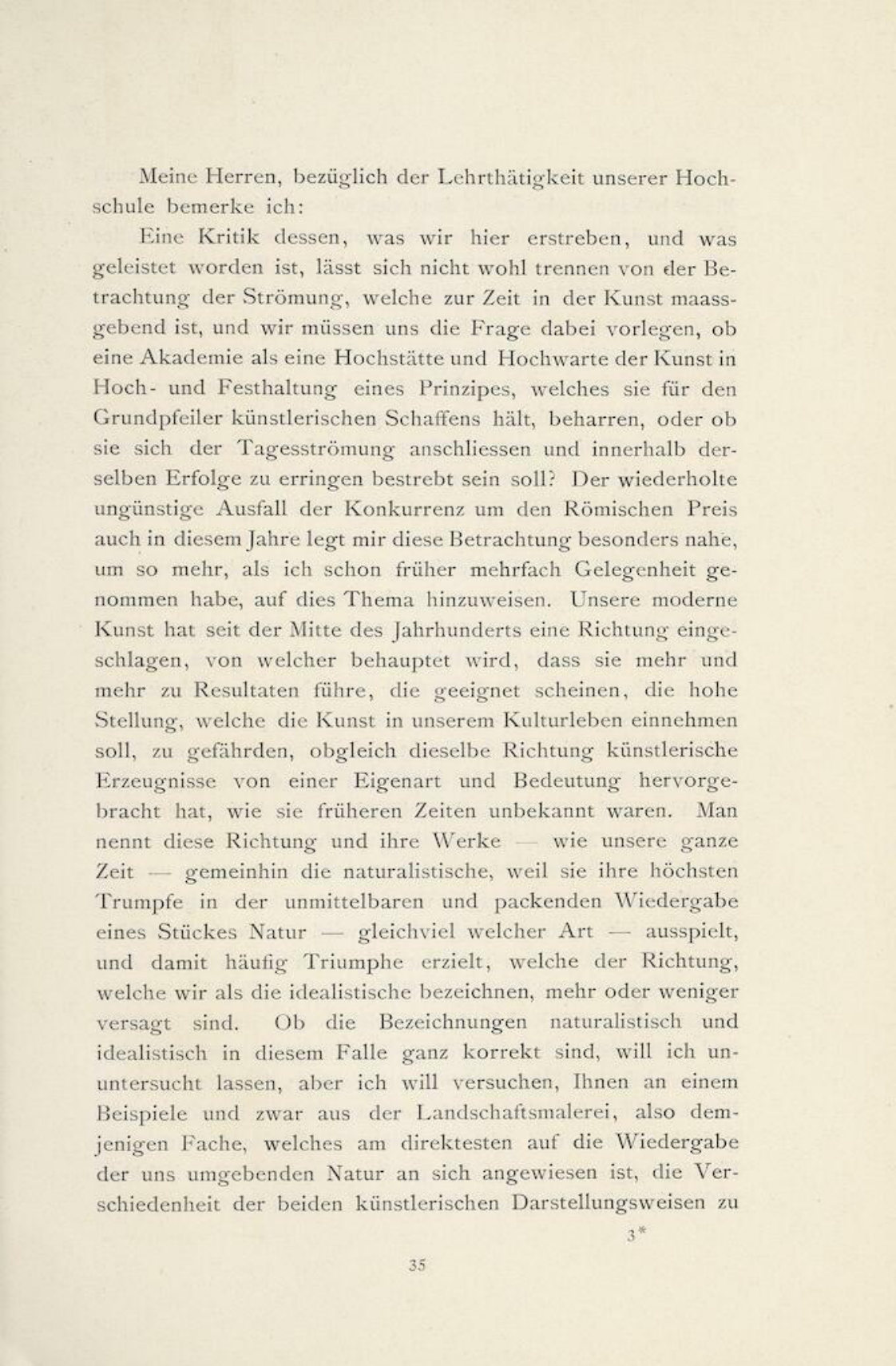
Gentlemen, concerning the teaching at our College, I would observe:
An assessment of what we strive for here and what has been achieved can hardly be separated from consideration of the prevailing tendency in art at present. We must ask ourselves whether an Academy, as a high seat and watchtower of art, should persist in upholding and adhering to a principle it regards as the cornerstone of artistic creation, or whether it should join the current of the day and seek success within it. The repeatedly unfavourable outcome of the competition for the Rome Prize again this year makes this consideration especially pressing for me, particularly since I have already taken several opportunities to refer to the subject. Since the middle of the century our modern art has taken a direction which, it is claimed, leads increasingly to results that seem liable to endanger the high position art ought to occupy in our cultural life, although that same direction has produced works of an individuality and significance unknown in earlier times. This direction and its works, like our entire age, are commonly called naturalistic, because it plays its strongest cards in the immediate and compelling rendering of a piece of nature—of whatever kind—and often thereby achieves triumphs more or less denied to the direction we describe as idealistic. Whether the terms naturalistic and idealistic are entirely correct here I shall leave unexamined. But I shall try, through an example from landscape painting, precisely the field most directly dependent upon the rendering of the nature surrounding us in itself, to
English translation · Leaf 5
explain to you the difference between these two modes of artistic representation. I choose three landscape painters of whom even you must know that, like few others, they penetrated the secrets of nature through close and comprehensive study: C. F. Lessing, J. W. Schirmer and Fr. Preller. They used their studies and their intimate knowledge of nature as material with which their genius and imagination worked freely and independently, creating artistic forms bearing the distinctive stamp of their minds, their artistic natures. These were thoroughly subjective creations, in which the ‘I’, the personality of the artist, came to the fore. Yet it can scarcely be disputed that, in compelling effect and immediate truth to nature, their creations cannot in any way compare with our modern achievements in this field. The simplest little piece of nature, apparently the most worthless artistically, depicted with understanding and close study, will in this respect have an advantage over the best composed or stylised landscape by Lessing, Schirmer or Preller. And yet they were artists of whom we could only wish to have very many!
With today’s way of seeing, we seem to be approaching an ever more purely objective representation of nature; the subjectivity of the creative artist recedes more and more, and the final outcome of our artistic endeavours would therefore ultimately be—as has often been pointed out—colour photography. Can and should this really be the task of our artistic studies, the ultimate goal of our endeavours? Surely, I think, no! Artists and public alike are indeed nowadays under the almost overwhelming influence of photography; photography solves artistic problems for us of which we had not previously thought, and we see outstanding artists using photography to an extent we would formerly have considered impossible—and, we must
English translation · Leaf 6
not conceal it from ourselves, with striking success in one respect. All those endeavours, those manifestations of the artistic spirit in which the artistic creation of past centuries, of art’s periods of flowering, was rooted and reached its culmination, are becoming increasingly rare—at least at our exhibitions. These observations compel us to ask: must art submit to the current of the age, or should it hold fast to what has been recognised for centuries as the highest goal of artistic endeavour? In my view, the Academy must in any event, without ignoring the currents of the age, but equally without lapsing into ossified imitation of earlier periods, build upon what has emerged from the sum of the endeavours of past artistic epochs and from the works of their great artists as sound, authoritative and classical. In your studies, gentlemen, whatever field may one day be allotted to your activity, you must keep this perspective, this goal, unswervingly in view; our endeavours are directed towards giving you this solid foundation for your artistic activity. We know very well that the demands of practical life make our position difficult: to master, overcome and convince an age that simply has little feeling for classical quality and classical subjects in art is not easy, and perhaps exceeds our powers! But when, in the composition exercises, we encourage you to tackle what I shall call such classical subjects, however remote they may seem from our modern sensibility, do not forget that this is no lifeless imitation and reworking of old, long familiar, so-called academic subjects. Rather, these very tasks contain everything useful for training the artistic mind; they open to you a
English translation · Leaf 7
field offering the widest and most unrestricted scope for the development of all your artistic powers and abilities, and from this training of the mind you will derive incalculable benefit in every field in which you may one day work.
I am therefore pleased to be able to state that in the composition exercises during the past school year you have made a commendable effort to familiarise yourselves with this outlook, although I must still expect more active diligence and lively interest from you in this direction. You must strive still more to have or seek artistic ideas and give them easy and fluent expression; the study of nature, however zealous, cannot be the purpose and ultimate end of your activity in itself, but only a means to the goal. Especially in the competitions for the Rome Prize, painters have for some time displayed an astonishing awkwardness in expressing an artistic idea and sluggishness in reflection and imaginative formation. I readily admit that the unfamiliar and uncomfortable conditions of work under supervision bear much of the blame for the unfavourable results, as does, on the other hand, the fact that most of the young artists entering these competitions have never seriously tested their powers in this direction and rely rather on a lucky chance. Yet even from these one ought to be able to expect better after the efforts we make, and I hope that the present extension of composition exercises, compared with earlier practice, will have a salutary influence. I have discussed this part of our teaching first because henceforth it is to be a principal element of study in every class. Of the results of instruction in the other branches
English translation · Leaf 8
of our studies, it may be said that the drawing classes—the preparatory class and the class drawing from the antique—have again produced exceptionally good results, which those of the painting classes perhaps do not quite equal; indeed, a certain decline in eagerness to learn is generally noticeable in the later semesters. The sculpture department continues to maintain and demonstrate the traditional quality and high achievement of the Berlin school. Gentlemen might still devote somewhat more sympathetic interest and goodwill to the laborious but highly necessary study of anatomy and perspective, and likewise to that of ornament and decorative architecture, which may later prove of incalculable benefit to some of you. The animal class shows noteworthy achievements in independent study, and the landscape department, as in previous years, the most gratifying results, from initial studies to finished pictures. The copper-engraving school has awakened to new life and shows some very promising works in pure line engraving; for the etching exercises I would wish—if time permits—still livelier participation on your part. Gentlemen, you still do not make sufficiently comprehensive use of everything offered to you—we older men did not have it so good!
For the future I must express the wish that particularly those gentlemen enrolled as studio students with the various professors should participate in this exhibition with works demonstrating their successful practical activity in those studios. Admittedly, the absence of their works is excused by the fact that the large academic art exhibition coincides with ours, and I should not leave unmentioned that I have granted about thirty Academy students permission to submit works to the academic art
English translation · Leaf 9
exhibition. Nevertheless, I must emphasise this wish most particularly.
I conclude these reflections with a ‘Glückauf’—good fortune to you—and the best wishes and hopes for the coming academic year, and give the floor to Mr Teschendorf to present the annual report.
Source: Anton von Werner, Ansprachen und Reden (1896). Original digitisation: Universitätsbibliothek Heidelberg / Akademie der Künste. Consult the source volume.