Anton von Werner · Original German and English
Commemorative Address for Emperor Wilhelm I
Rede zur Gedächtnisfeier Kaiser Wilhelms I. · 22 March 1888
English translation · Leaf 1
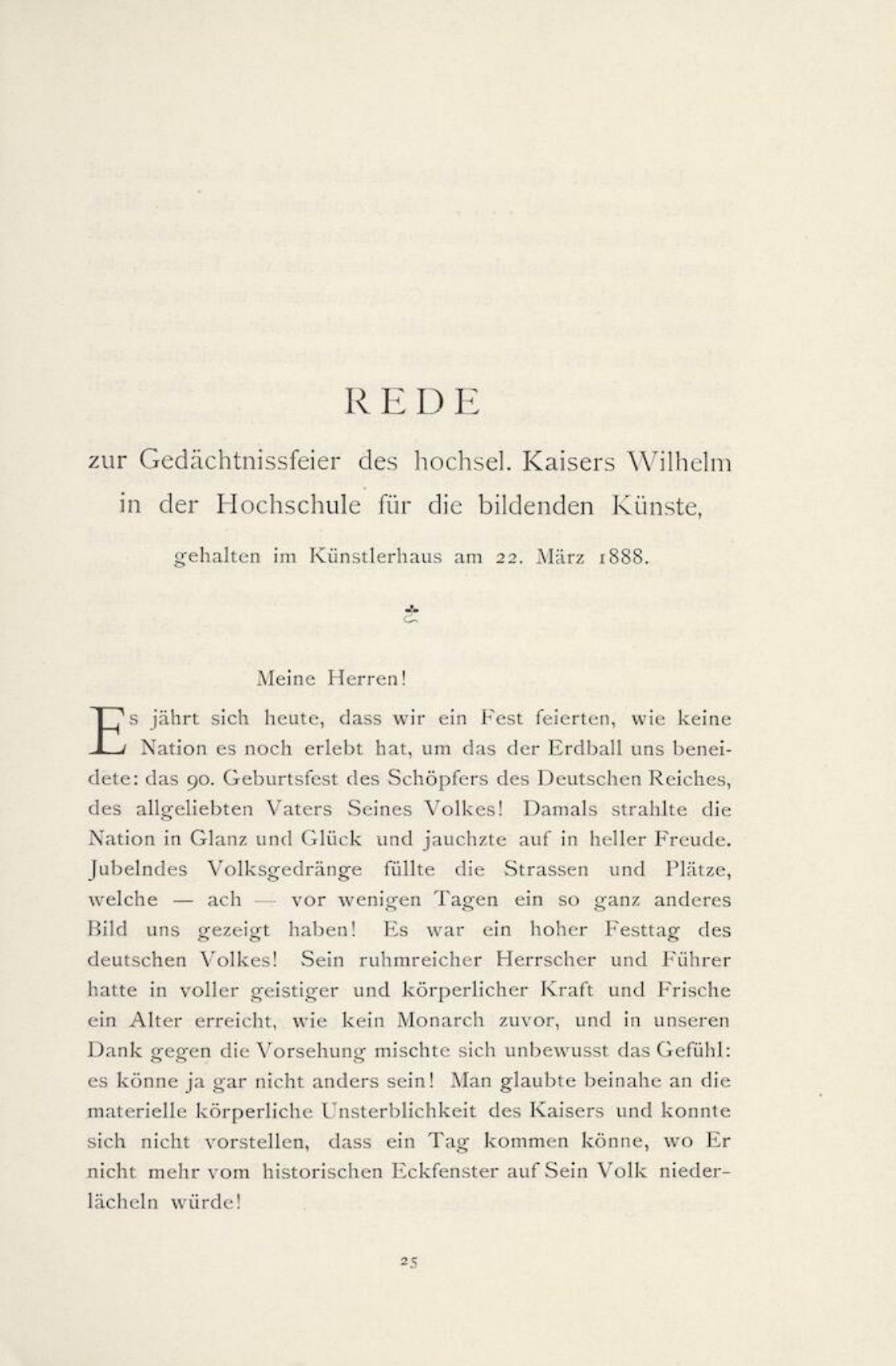
ADDRESS commemorating the late Emperor Wilhelm at the College of Fine Arts, delivered in the Künstlerhaus on 22 March 1888.
Gentlemen!
Today marks the anniversary of a celebration such as no nation had ever experienced, for which the whole world envied us: the ninetieth birthday of the creator of the German Empire, the universally beloved father of his people! Then the nation shone in splendour and happiness and exulted in unclouded joy. Jubilant crowds filled the streets and squares which—alas—only a few days ago presented us with so very different a scene! It was a great festival of the German people! Its glorious ruler and leader had reached an age attained by no monarch before him, in full mental and physical vigour and freshness; and, unconsciously, our gratitude to Providence was mingled with the feeling that things could not possibly be otherwise! People almost believed in the Emperor’s material, bodily immortality and could not imagine that a day might come when he would no longer smile down upon his people from the historic corner window!
English translation · Leaf 2
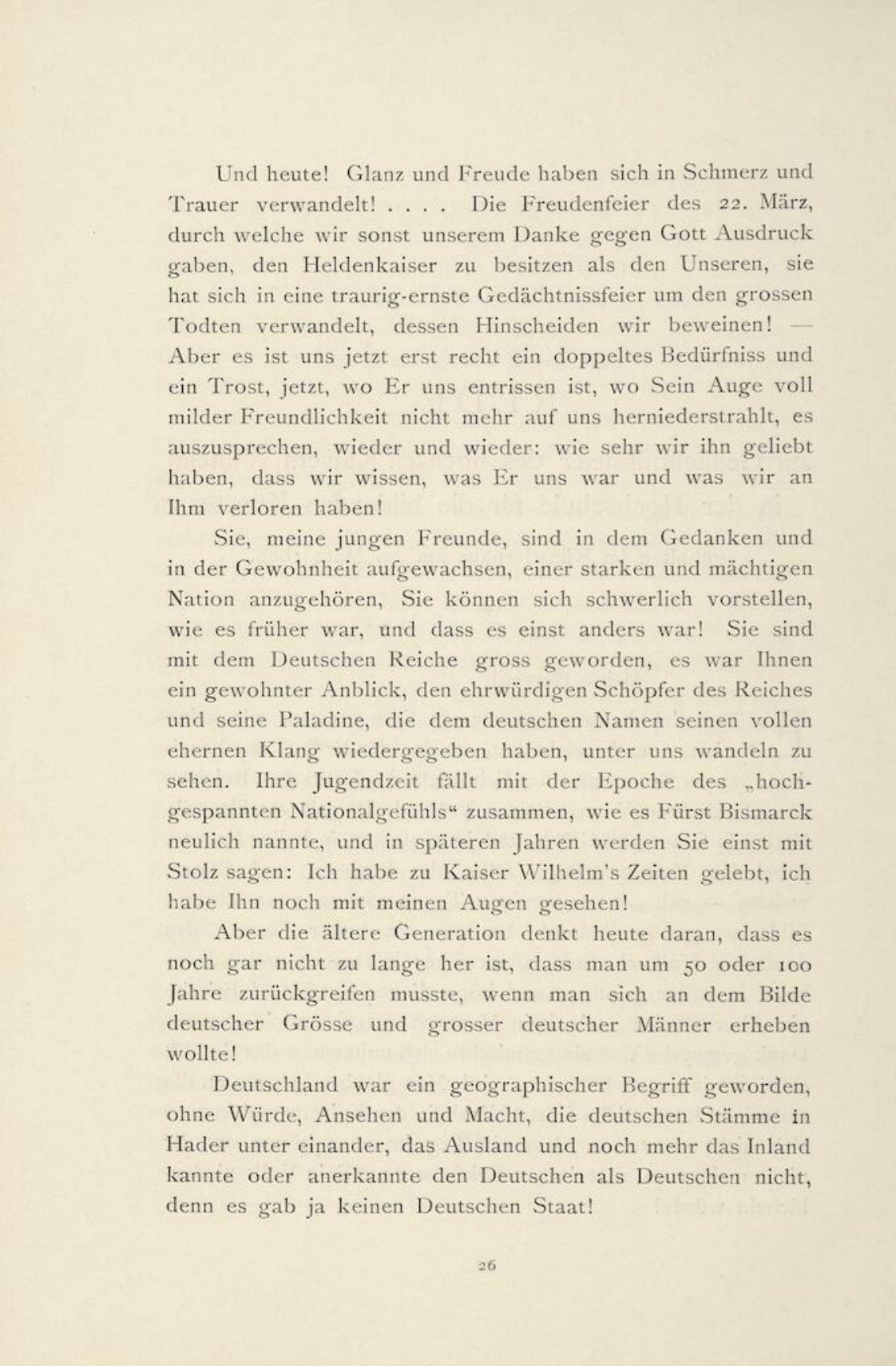
And today! Splendour and joy have turned into pain and mourning! … The joyful celebration of 22 March, through which we formerly expressed our gratitude to God that the heroic Emperor was ours, has become a sombre, solemn commemoration of the great departed one whose passing we lament! Yet now, when he has been taken from us, when his eye, so full of gentle kindness, no longer shines down upon us, we feel a doubly strong need, and find consolation, in saying it again and again: how greatly we loved him, that we know what he was to us and what we have lost in him!
You, my young friends, have grown up with the idea and habit of belonging to a strong and powerful nation; you can scarcely imagine how things used to be, or that they were once different! You grew up with the German Empire; it was a familiar sight to see among us the venerable creator of the Empire and his paladins, who restored to the German name its full, brazen resonance. Your youth coincides with the age of ‘heightened national feeling’, as Prince Bismarck called it recently, and in later years you will proudly say: I lived in Emperor Wilhelm’s time; I still saw him with my own eyes!
But the older generation remembers today that it is not so very long since one had to look back fifty or a hundred years to draw inspiration from the image of German greatness and great German men!
Germany had become a geographical expression, without dignity, standing or power; the German peoples were at odds with one another; abroad, and still more at home, the German was neither known nor acknowledged as a German, for there was no German state!
English translation · Leaf 3
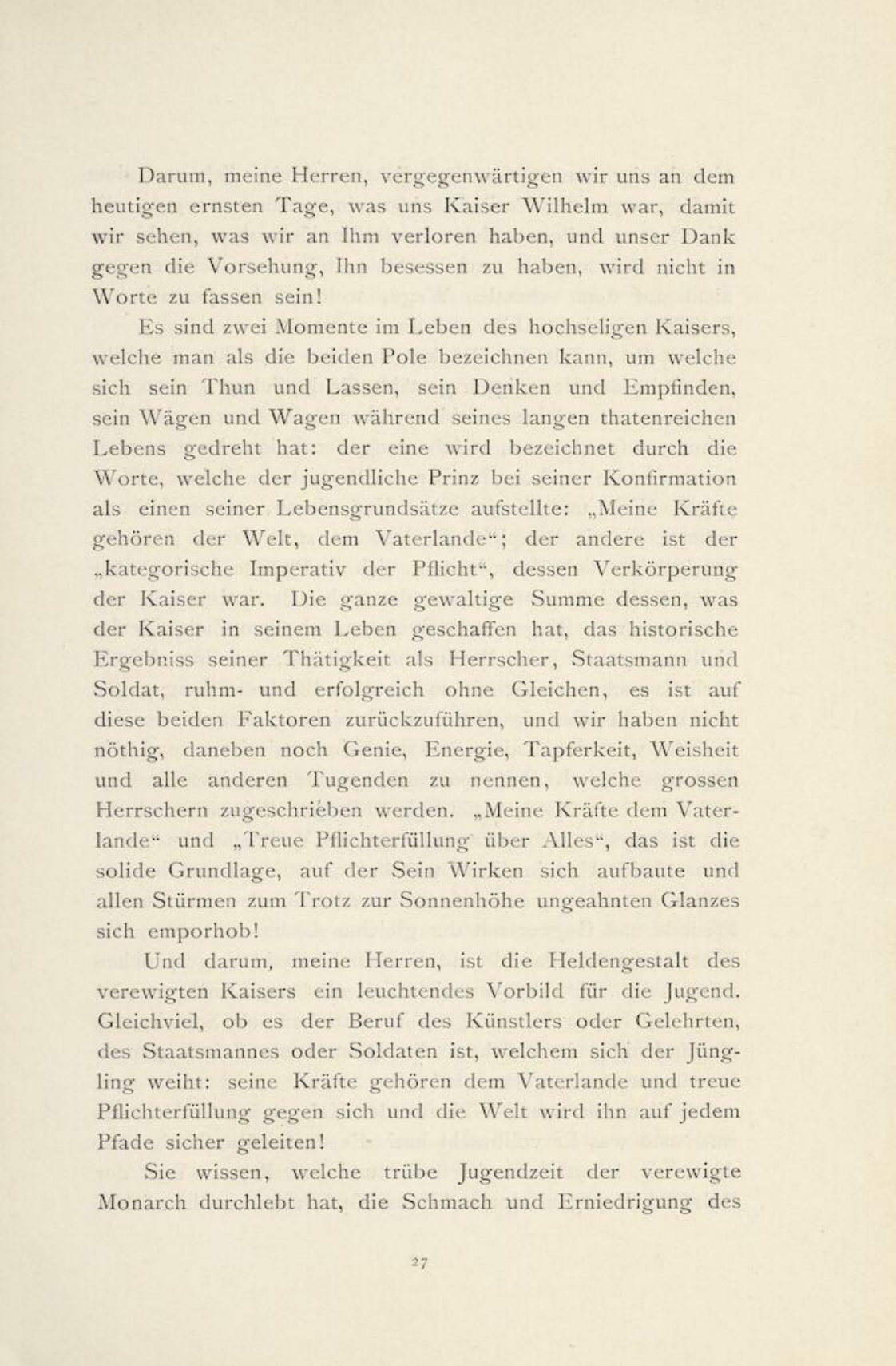
Therefore, gentlemen, on this solemn day let us recall what Emperor Wilhelm was to us, so that we may see what we have lost in him; and our gratitude to Providence for having possessed him will be beyond words!
There are two elements in the late Emperor’s life which may be called the two poles around which his action and inaction, his thought and feeling, his weighing and venturing revolved throughout his long, eventful life. One is expressed in the words which the young prince laid down at his confirmation as one of his principles for living: ‘My powers belong to the world, to the fatherland’; the other is the ‘categorical imperative of duty’, of which the Emperor was the embodiment. The whole immense sum of what the Emperor created in his lifetime, the historical result of his activity as ruler, statesman and soldier, unparalleled in glory and success, can be traced to these two factors; we need not add genius, energy, courage, wisdom and all the other virtues attributed to great rulers. ‘My powers to the fatherland’ and ‘Faithful fulfilment of duty above all’: this is the solid foundation upon which his work was built, rising despite every storm to the sunlit heights of unimagined splendour!
And therefore, gentlemen, the heroic figure of the departed Emperor is a shining example for the young. Whether a young man dedicates himself to the calling of artist or scholar, statesman or soldier, his powers belong to the fatherland, and faithful fulfilment of duty towards himself and the world will guide him safely on every path!
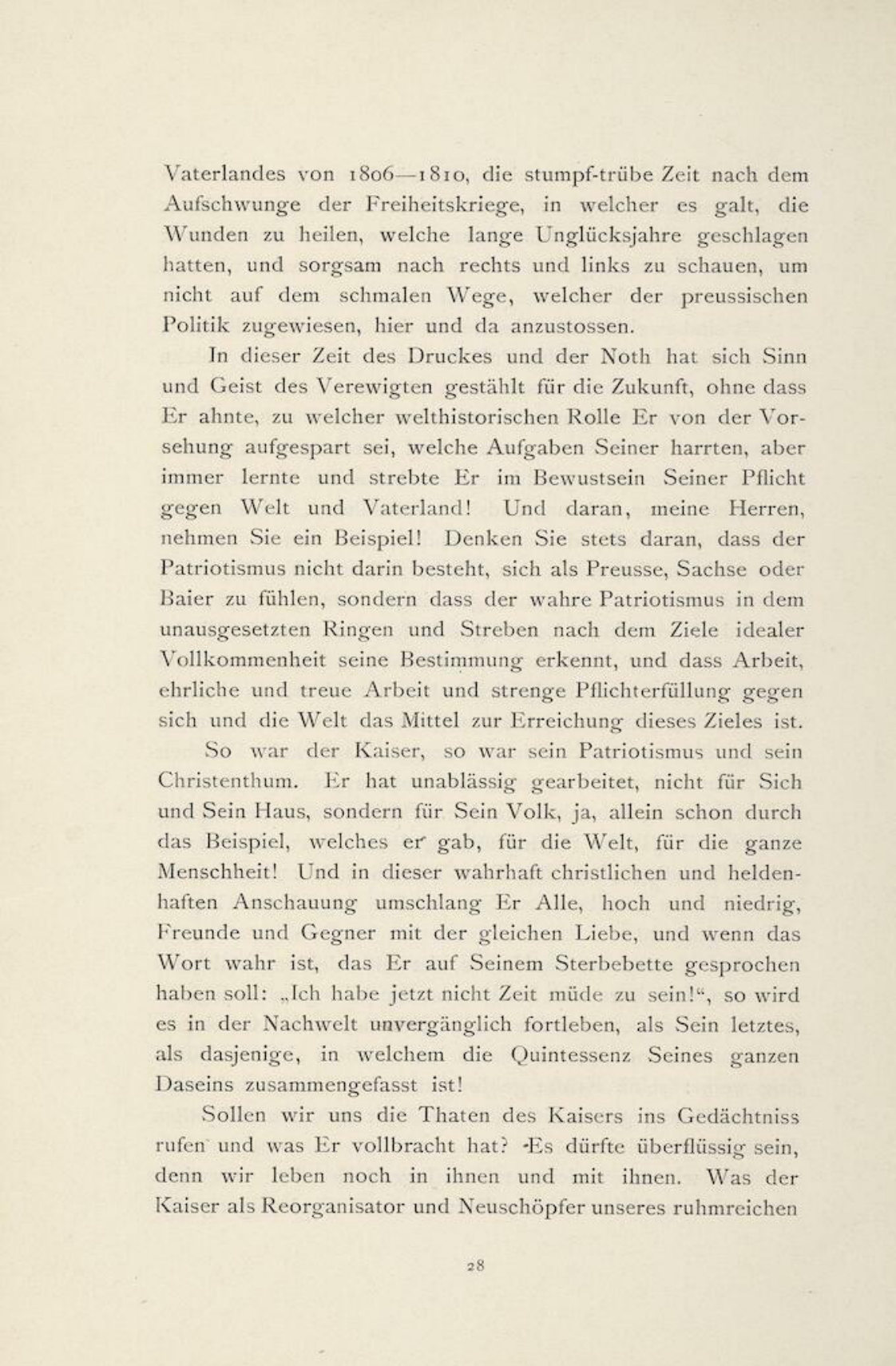
You know what a troubled youth the departed monarch lived through: the disgrace and humiliation of the
English translation · Leaf 4
fatherland from 1806 to 1810, the dull, dismal period after the upsurge of the Wars of Liberation, when the task was to heal the wounds inflicted by long years of misfortune and look carefully to right and left, lest one offend on either side of the narrow path allotted to Prussian policy.
In this time of oppression and distress, the mind and spirit of the departed one were tempered for the future, though he did not suspect what role in world history Providence had reserved him for, or what tasks awaited him; but he always learned and strove, conscious of his duty towards the world and the fatherland! Take that as your example, gentlemen! Always remember that patriotism does not consist in feeling oneself a Prussian, Saxon or Bavarian; true patriotism recognises its purpose in the unceasing struggle and striving towards ideal perfection, and work—honest, faithful work—and strict fulfilment of duty towards oneself and the world are the means of attaining that goal.
Such was the Emperor; such were his patriotism and his Christianity. He worked unceasingly, not for himself and his house, but for his people—indeed, through the example he gave alone, for the world, for all humanity! In this truly Christian and heroic outlook he embraced all alike with love, high and low, friends and opponents; and if the words he is said to have spoken on his deathbed are authentic—‘I have no time to be tired now!’—they will live imperishably in posterity as his last words, as those in which the essence of his whole existence is summed up!
Shall we recall the Emperor’s deeds and what he accomplished? That would surely be superfluous, for we still live in and with them. What the Emperor achieved as the reorganiser and refounder of our glorious
English translation · Leaf 5
army; how, as a commander undefeated in a hundred battles, he won the name of ‘the Victorious’; that he created the German Empire and, on 18 January 1871, in the palace at Versailles, at the pinnacle of power and in the most radiant splendour of military glory, spoke these modest words: ‘But may God grant us and our successors to the imperial crown always to be increasers of the Empire, not through warlike conquests, but through the blessings and gifts of peace in the sphere of national welfare, freedom and civilisation’—all this you know!
Full of wisdom, strong and powerful, though indeed with his hand upon his sword, he knew how to preserve peace for his people until his death, for seventeen years since the French war; and amid that peace the energies of the German people blossomed splendidly and impressively in national welfare and in the development of the blessings and gifts of peace. His blessing and protecting hand fostered every sphere equally, and no estate or profession in the German Empire can say: he favoured me, or he neglected me!
The heroic strength which raised Germany to heights of power and standing never previously imagined was also a fertilising source for the flourishing of the arts in our fatherland. The powerful advance made by art and the applied arts during the last twenty years, the monumental buildings and works of art created under Emperor Wilhelm’s rule, bear eloquent witness that, even amid the iron duties of his high office, the great monarch never lost his eye and his sound feeling for the significance of art and the more ideal aspects of our existence.
And so, in our lamentation and mourning for him who has been taken from us, let us mingle gratitude to Providence
English translation · Leaf 6
for all the good it has done us by giving us a man such as Emperor Wilhelm as leader and ruler, and through him bestowing upon the German people the most brilliant span of time they have lived through for centuries.
Emperor Wilhelm has raised a monument to himself in the hearts of his people which will outlast every monument of bronze and stone erected to him; and not Germany alone, but the whole world—we have seen the proofs—mourns him!
May he rest in peace!
But today, gentlemen, let us at the same time raise our eyes in trust and hope to the throne of the Most High and implore him not to let our hopes come to nothing!
Although ‘Hail to thee in the victor’s wreath’, which on this day used to resound throughout the German fatherland, is today drowned by the mourning peal of bells, let us nevertheless cry with all our hearts: ‘Hail to thee in the victor’s wreath, Emperor Friedrich!’
For he too, the successor to the throne of the great monarch whom we commemorate, is surrounded by the radiance of victory and crowned with the victor’s wreath! On the battlefields of Weissenburg and Wörth, of Sedan and Paris, he fought and conquered for Germany’s glory and Germany’s unity!
But he won for us a still more brilliant and joyful victory, far more important for Germany’s future than those upon the bloody battlefields, when he took the hearts of our southern German brothers by storm, after his august father had appointed him their leader in the great struggle. He truly bridged the Main line and, through the magic of his personality, knew how to inspire love, devotion and enthusiasm for the great cause where otherwise we might perhaps have encountered only cold
English translation · Leaf 7
practical calculation and the consciousness of having to obey the compulsion of necessity and the pressure of the moment. If North and South have found one another and united in their hearts as well as through cool calculation, we owe it first to the idealistic ardour, the full and fiery heart with which Crown Prince Friedrich Wilhelm, foremost among all, devoted all his powers to the great idea of a united Germany! That is why his name is no less dear to our hearts than that of his universally beloved father, now resting in God; and his ideal heroic figure will always remain alive before our eyes, inseparable from that of his exalted father, as the archetype of German strength and manliness!
Suffering from an insidious illness, he did not hesitate for a moment to follow the call of duty, and his first words to his people were the assurance that he would seek no vain splendour of glory, but wished to make his people happy.
All our hearts go out to him!
He, our present sovereign and Emperor, the Protector of the Academy, and his august consort are animated by an elevated and discerning love of art; Her Majesty, as you know, is herself a practising artist, and for that very reason the illustrious ruling couple must be especially close to us artists.
Let us hope and pray to God that he will take His Majesty Emperor Friedrich and his august consort into his gracious protection and allow him to recover from his grave illness, so that his reign as a prince of peace may be long and blessed, for our welfare and that of the world!
May God protect and shelter Emperor Friedrich and his house!
Source: Anton von Werner, Ansprachen und Reden (1896). Original digitisation: Universitätsbibliothek Heidelberg / Akademie der Künste. Consult the source volume.