Anton von Werner · Original German and English
Address at the Prize-Giving Ceremony
Ansprache bei Gelegenheit der Preisverteilungsfeier · 18 July 1891
English translation · Leaf 1
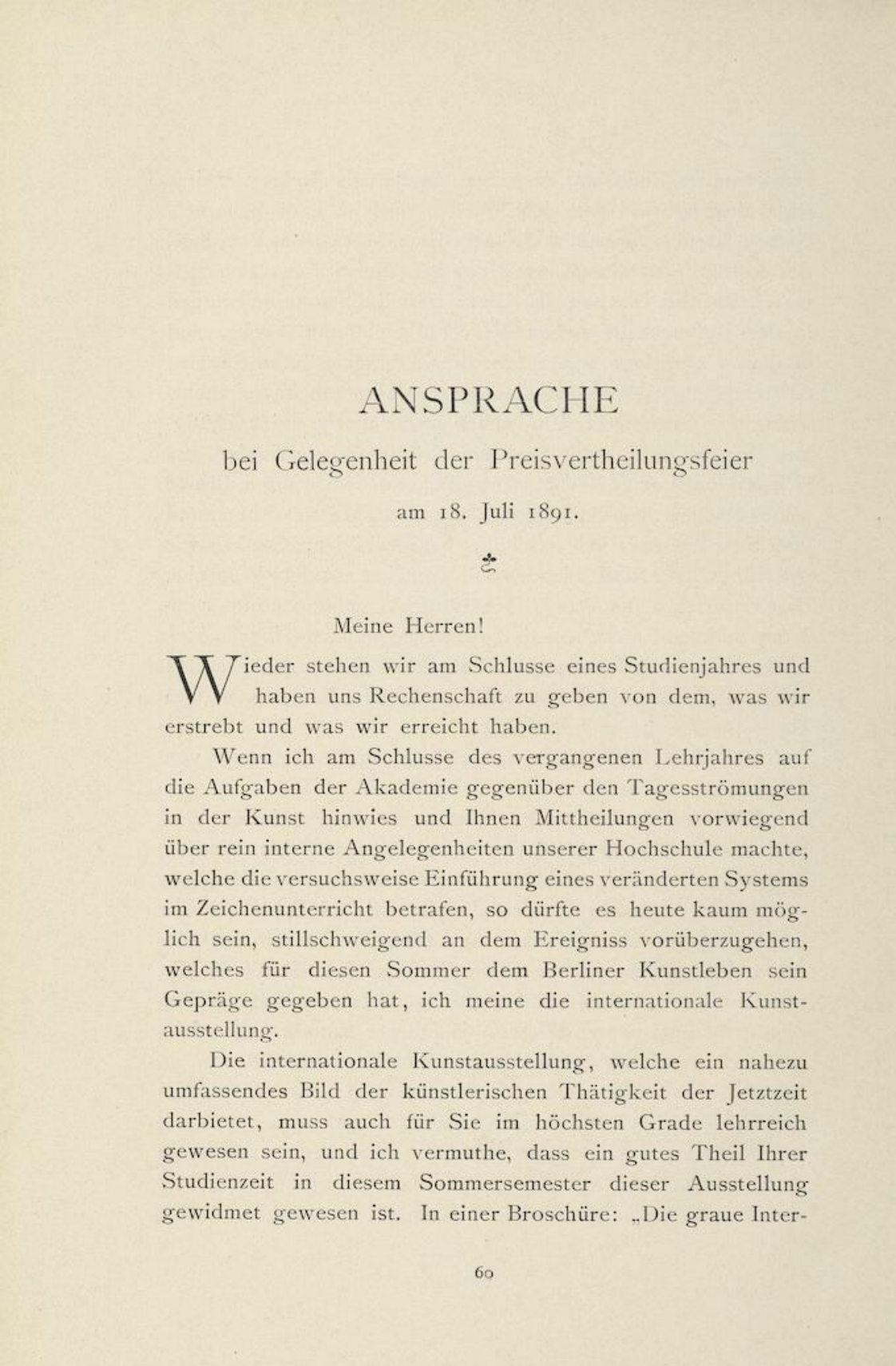
ADDRESS on the occasion of the prize-giving ceremony on 18 July 1891.
Gentlemen!
Once again we stand at the close of an academic year and must account for what we have striven for and what we have achieved.
At the close of the last academic year I referred to the Academy’s tasks in relation to the currents of the day in art, and informed you predominantly about purely internal matters at our College concerning the experimental introduction of a changed system of drawing instruction. Today, however, it would scarcely be possible to pass over in silence the event which has given Berlin’s artistic life its character this summer: I mean the international art exhibition.
The international art exhibition, which offers an almost comprehensive picture of artistic activity today, must also have been instructive to you in the highest degree, and I suspect that a good part of your study time this summer semester has been devoted to it. In a pamphlet, ‘The Grey Inter-
English translation · Leaf 2
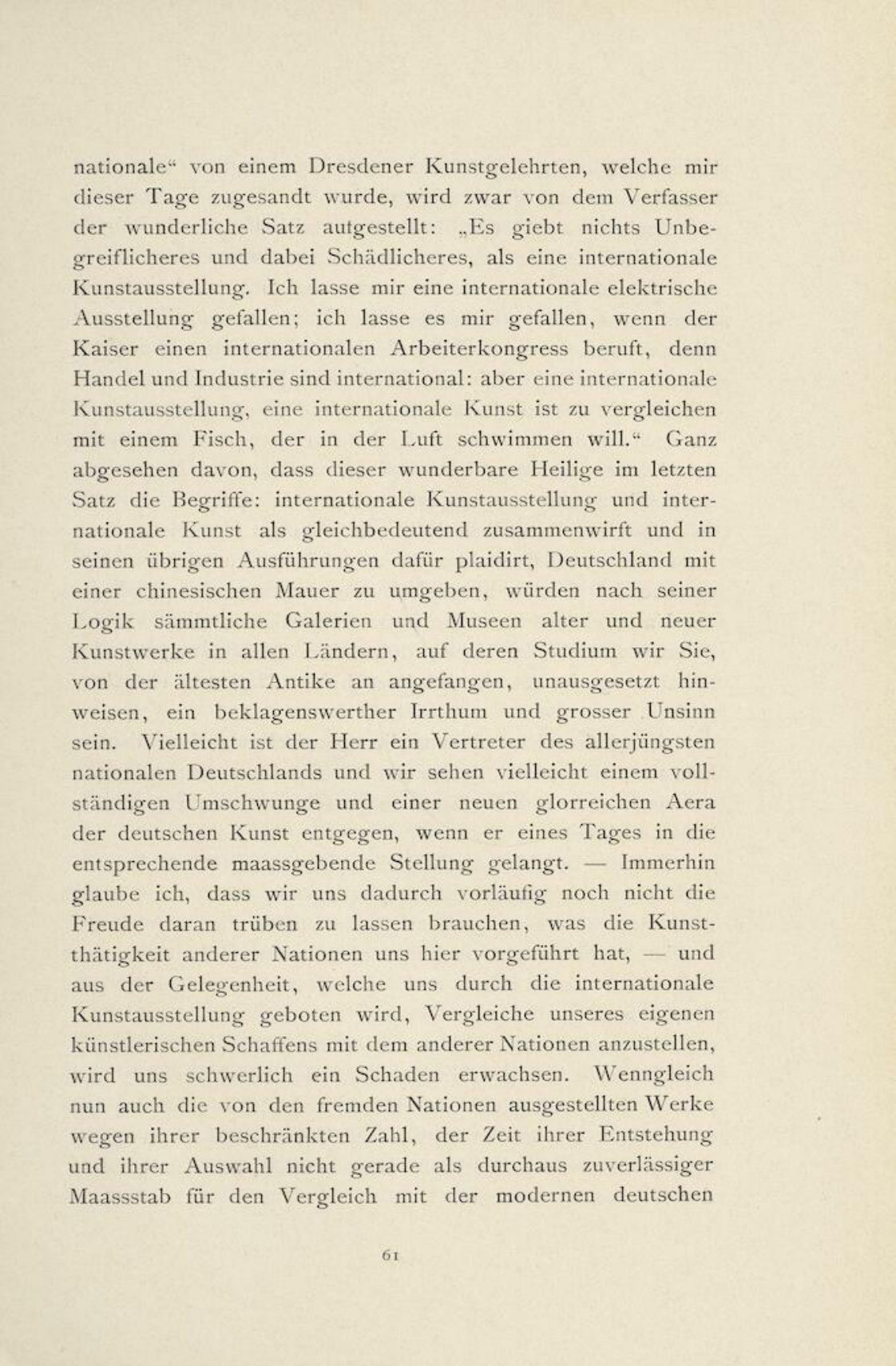
national’, by a Dresden art scholar, sent to me a few days ago, the author admittedly advances the curious proposition: ‘There is nothing more incomprehensible, and at the same time more harmful, than an international art exhibition. I can accept an international electrical exhibition; I can accept the Emperor convening an international workers’ congress, for trade and industry are international; but an international art exhibition, an international art, is comparable to a fish that wants to swim in the air.’ Quite apart from this strange eccentric’s conflation in his last sentence of the concepts of international art exhibition and international art as equivalent, and his pleading elsewhere for Germany to be surrounded by a Chinese wall, by his logic all galleries and museums of old and new works of art in every country, to the study of which, beginning with the most ancient antiquity, we continually direct you, would be a lamentable error and great nonsense. Perhaps the gentleman represents the very youngest national Germany, and perhaps we face a complete transformation and a new glorious era of German art when one day he reaches a suitably authoritative position.—For the present, at any rate, I believe we need not let this spoil our pleasure in what the artistic activity of other nations has shown us here; and the opportunity the international art exhibition offers to compare our own artistic creation with that of other nations will hardly do us harm. Although, because of their limited number, their dates of creation and their selection, the works exhibited by foreign nations cannot be considered an entirely reliable yardstick for comparison with modern German
English translation · Leaf 3
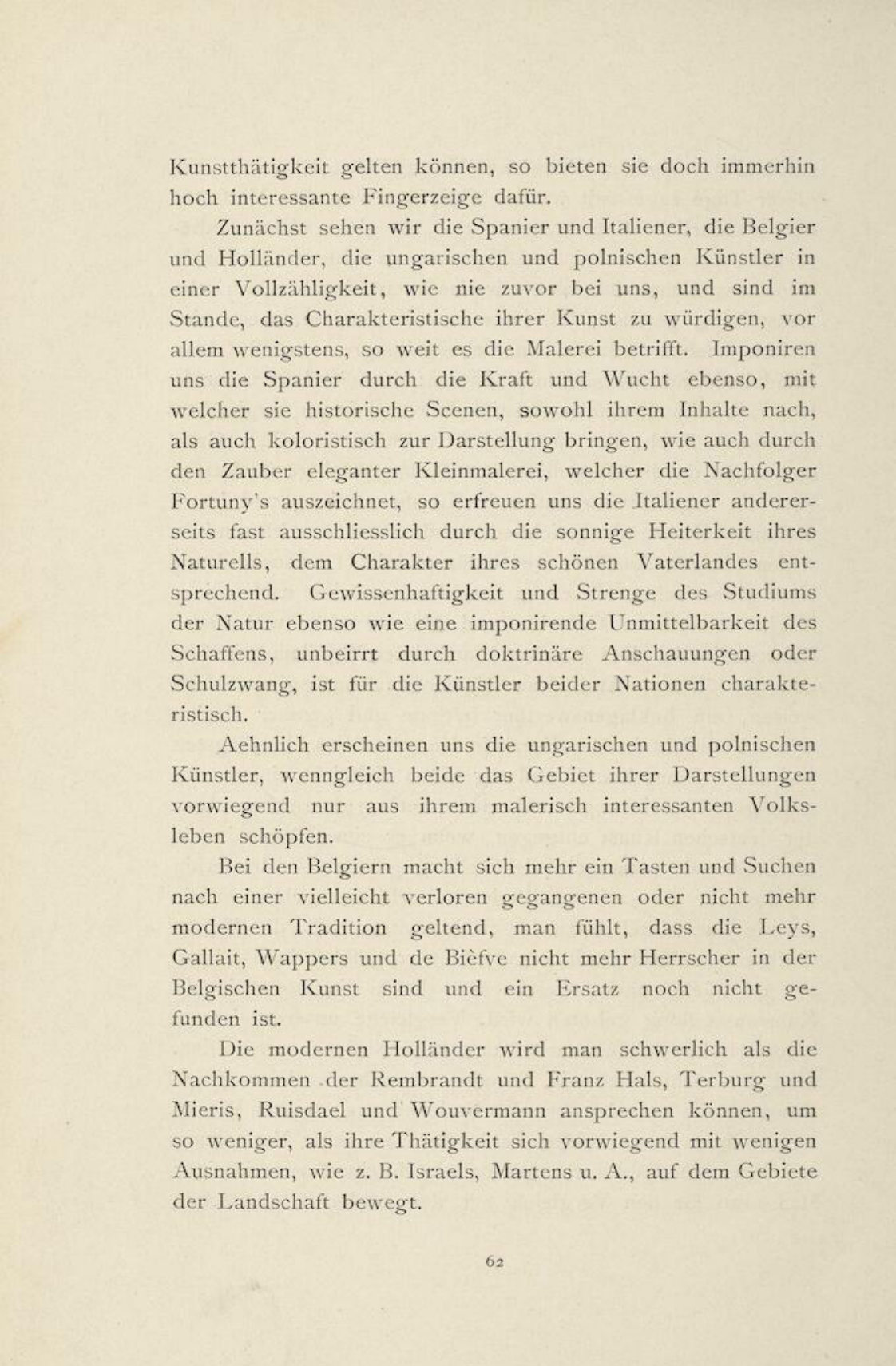
artistic activity, they nevertheless offer highly interesting indications of it.
First we see the Spaniards and Italians, Belgians and Dutch, Hungarian and Polish artists represented here more fully than ever before, and can appreciate the characteristics of their art, at least above all as far as painting is concerned. If the Spaniards impress us by the strength and force with which they depict historical scenes, both in content and in colour, as well as by the charm of elegant small-scale painting which distinguishes Fortuny’s successors, the Italians, on the other hand, delight us almost exclusively through the sunny cheerfulness of their temperament, corresponding to the character of their beautiful fatherland. Conscientiousness and rigour in studying nature, as well as an impressive immediacy of creation, undisturbed by doctrinaire views or the constraints of a school, characterise the artists of both nations.
The Hungarian and Polish artists appear similar to us, although both predominantly draw the subjects of their representations only from the picturesquely interesting life of their peoples.
Among the Belgians, there is more of a groping and searching for a tradition perhaps lost or no longer modern; one feels that Leys, Gallait, Wappers and de Biefve no longer rule Belgian art, and no replacement has yet been found.
The modern Dutch can scarcely be called descendants of Rembrandt and Frans Hals, Terburg and Mieris, Ruisdael and Wouvermann, all the less since, with a few exceptions such as Israels, Martens and others, their activity lies predominantly in landscape.
English translation · Leaf 4
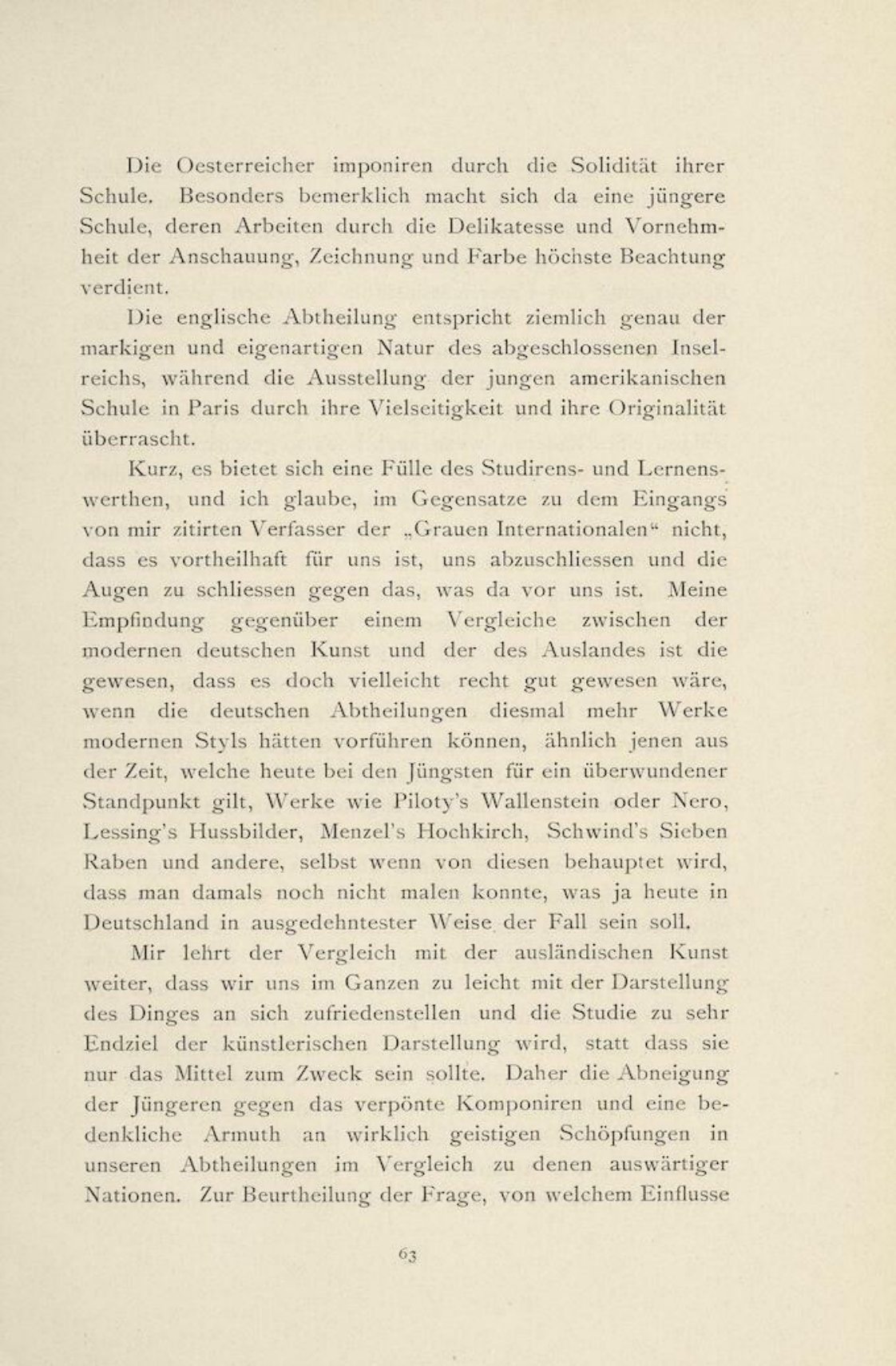
The Austrians impress through the soundness of their school. Particularly noticeable is a younger school whose works merit the highest attention for the delicacy and distinction of their conception, drawing and colour.
The English section corresponds fairly closely to the vigorous and distinctive nature of that self-contained island realm, while the exhibition of the young American school in Paris surprises through its versatility and originality.
In brief, there is an abundance worth studying and learning, and, unlike the author of ‘The Grey International’ whom I quoted at the outset, I do not believe it advantageous for us to shut ourselves off and close our eyes to what is before us. My feeling on comparing modern German art with that of other countries was that it might perhaps have been very good if the German sections had this time been able to show more works in a modern style similar to those from the period which the youngest artists now regard as superseded: works such as Piloty’s Wallenstein or Nero, Lessing’s Huss pictures, Menzel’s Hochkirch, Schwind’s Seven Ravens and others, even if it is claimed that people could not yet paint then—something they are now supposedly able to do in Germany to the most extensive degree.
Comparison with foreign art further teaches me that on the whole we are too easily satisfied with representing the thing itself, and that the study becomes too much the ultimate goal of artistic representation, instead of being merely the means to an end. Hence the younger artists’ aversion to the proscribed practice of composing, and a disturbing poverty of truly intellectual creations in our sections compared with those of foreign nations. To assess the question of what influence
English translation · Leaf 5
study at the Academy can or cannot have in this instance, a recent stay in London gave me a welcome opportunity through visiting the Royal Academy’s exhibition and closely inspecting its teaching institution. At the exhibition I was first struck, in the most agreeable way, by the strength of each individual artist’s artistic conviction. I could find no example of an artist attempting to adapt his manner of seeing or representation to that of another artist, however highly esteemed, let alone imitate it. However highly Sir Frederic Leighton, Herkomer, Alma Tadema, Sir Millais, Orchardson, Ouless, Leader, Graham, Pettie and others are esteemed, I found no example of even an attempt to imitate one or another in feeling or manner of painting. Sir Frederic Leighton, the Academy’s president, said to me in a conversation on this point: ‘My God, that is the best thing about it: my nose belongs to me and no one else, and everyone speaks as he naturally does.’
The course of study at the English Academy is the plainest and simplest imaginable, but most is left to the individual’s ambition, diligence and striving; and these qualities seemed to me far more intensely developed there than among us. Admission to the Academy takes place without any precondition, even without knowledge of the applicant’s name, solely on submission of a drawing from the antique and a drawn study, head or half-length nude, from life, with, though not absolutely necessary, an anatomy sheet. I had the opportunity just then to see these works by some fifty to sixty such applicants, only about thirty of whom could be admitted to the vacant places; they already demonstrated as much ability as can only be achieved here after the third or fourth
English translation · Leaf 6
semester. Studies in the Academy’s teaching rooms are confined to drawing, painting and modelling from life; a select collection of antique casts and some very good material for anatomy are available to students for independent study. Compositions on themes from the Bible, Iliad and Odyssey are set at regular intervals and executed as small grisaille sketches in three days’ work under supervision; examinations in anatomy and perspective are held every three months, although these subjects are not separately taught. There are no master studios such as we have, and all drilling towards a particular tendency or school is excluded. Moreover, the Academy is a private institution, and the English minister Earl Granville once said in a toast to the Academy: ‘The only request the Academy has to address to the government is simply that it should leave it alone.’ Despite, or perhaps precisely because of, this plainness, simplicity and uniformity of academic study, English art develops a versatility and originality scarcely matched by that of any other country; from this one might conclude that the influence of academic study has no effect on the artist’s ultimate development.
But, as I told you here a year ago, ‘Academic instruction can only supply you with the crutches on which you learn to walk; once you can walk, you may throw them away and go your ways unsupported.’ What I have seen in London, as well as the comparison of our German artistic activity with that of other countries, teaches me this:
Your guiding principle in study must be the unprejudiced, objective study of nature and the life surrounding you, undisturbed by any attempts to work in this or that manner of representation, tonality or
English translation · Leaf 7
atmosphere, or to see nature through this or that pair of spectacles foreign to you. Then, above all else, the training of the mind through zealous attempts at independent creation, the now so widely proscribed practice of composing.
Study at the Academy should be pursued in this spirit; and to this end some modifications to the previous teaching system were introduced last year, whose success will, we hope, be still more noticeable at the close of the next academic year than at the close of the present one.
The composition exercises have not turned out as satisfactorily this year as in recent years; the result of the von Biel-Kalkhorst competition for fresco painting has also not quite maintained the level of the previous two occasions. By contrast, all the painting classes show very gratifying progress and improvement.
It is regrettable that the inclination towards landscape compositions, in which the landscape department formerly distinguished itself so particularly, seems to be declining; likewise I miss the drive towards independent creations in the architecture and ornament department. The sculpture department maintains its traditional high standard, and I believe that, despite the above criticisms, teachers and students alike may look back with satisfaction upon the results of the past academic year.
Just as last year, through the passing of the oldest member of the teaching staff, Professor Bellermann, so this year too the College has been plunged into mourning by a painful loss. On 24 March this year the head of the painters’ life room, Professor Max Michael, died suddenly of a heart attack, after celebrating his sixty-eighth birthday cheerfully with his family the previous evening. Born in Hamburg and trained at the academies in Dresden and Paris, Professor Michael had lived abroad, predominantly in Paris
English translation · Leaf 8
and Italy, until 1870, and then in Berlin, until on 15 April 1875 he was appointed teacher in the painters’ life room at our College, a position he retained until his death. To characterise his activity as a teacher, I can refer here to what I once wrote about him on another occasion: ‘Throughout his work at the College, Professor Michael has made it his task to cultivate an idealistic outlook among his students through reference to the old masters, undisturbed by other currents, and has consistently carried this out. During his many years in France and Italy he was able to familiarise himself closely with the old masters and gather experience which, combined with a comprehensive scholarly education and outstanding technical ability, gave his teaching particular significance for the College. Above all, Professor Michael strives to make students conscious of the nature of colour in nature, and of the subject as a phenomenon of colour, in contrast to form and line. Professor Michael has always shown outstanding, untiring devotion and zeal in his teaching activity.’
Following this characterisation of his work as a teacher, I believe I may also recall to your memory his personality as a man and colleague. Gracious and amusing in the best sense of the word, full of wit and spirit in conversation, astonishingly well read in every field of knowledge and full of subtle self-irony, recognising everything good without envy and never boasting of his own ability, he was a good and faithful colleague to us, a devoted teacher and adviser to his students, whose work at the College will not be forgotten. His memory will live on in friendly remembrance among us all, for I believe that, just as he never intentionally offended anyone, neither did he ever have an enemy.
English translation · Leaf 9
I ask you to rise in his memory.
Professor Scheurenberg has taken his place, a highly esteemed and proven artistic talent, whose work as a teacher I look forward to with the fullest confidence. Mr Max Koner has replaced Mr Dammeier; the exhibition of his class’s work testifies to the energetic and purposeful leadership of his section. Finally, Professor Herter has taken over the teaching post in the sculptors’ life room held for fifteen years by Professor Fritz Schaper; I am convinced he will continue to cultivate the traditions whose foundations his predecessor laid.
Welcoming these three gentlemen here for the first time on this occasion, I thank them for their willingness to take on the teaching office, and ask their friendly support in our endeavours.
At the same time I express my warmest thanks to the other members of the teaching staff for the devotion and self-sacrifice with which they exercised their teaching office during the past academic year, and now request Professor Teschendorff to present the customary statistical annual report and the list of prize-winners.
Source: Anton von Werner, Ansprachen und Reden (1896). Original digitisation: Universitätsbibliothek Heidelberg / Akademie der Künste. Consult the source volume.