Anton von Werner · Original German and English
Address at the Prize-Giving Ceremony
Ansprache bei Gelegenheit der Preisverteilungsfeier · 16 July 1892
English translation · Leaf 1
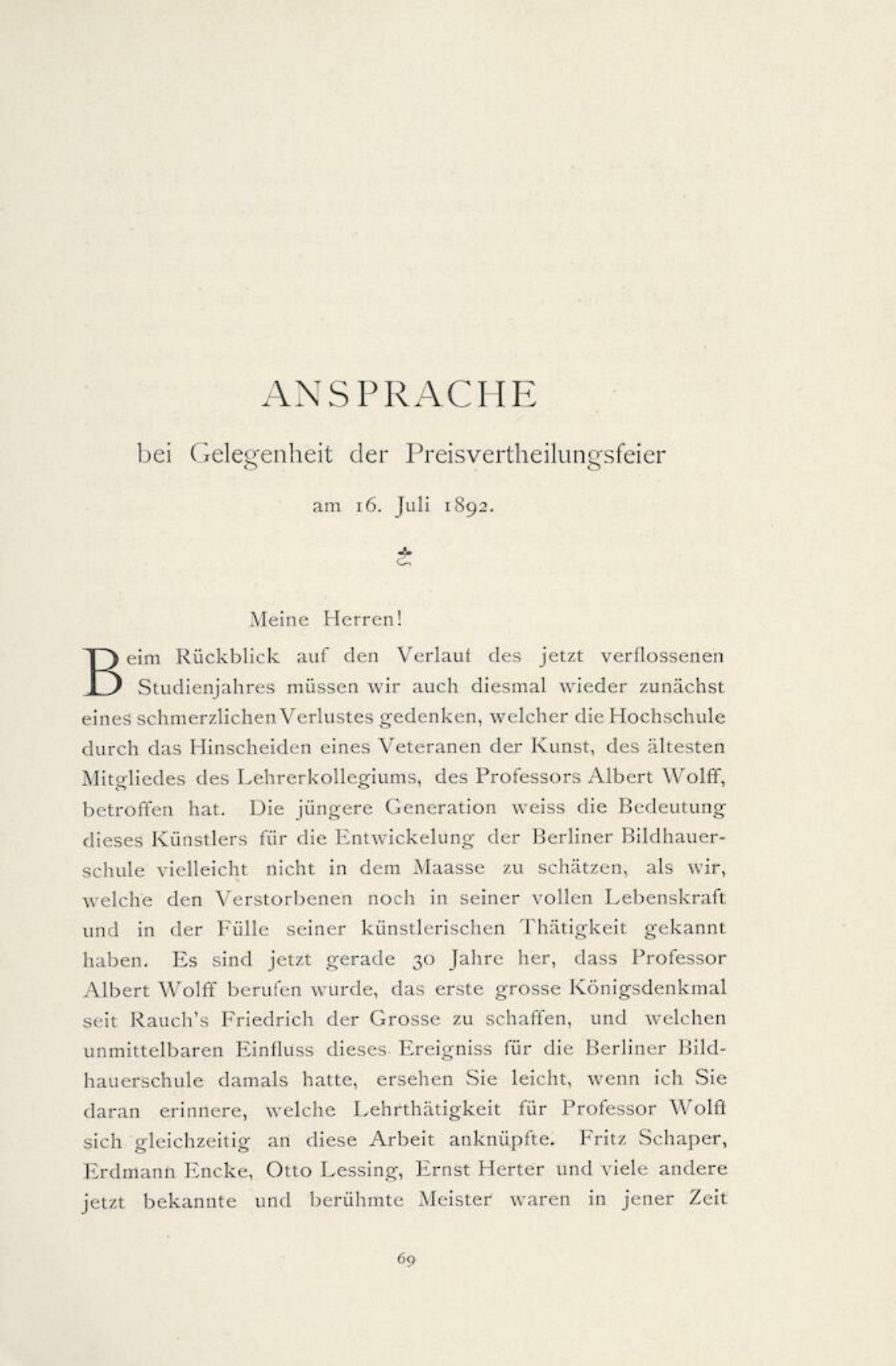
ADDRESS on the occasion of the prize-giving ceremony on 16 July 1892.
Gentlemen!
In looking back over the course of the academic year just ended, we must once again first commemorate a painful loss suffered by the College through the passing of a veteran of art, the oldest member of the teaching staff, Professor Albert Wolff. The younger generation perhaps cannot appreciate this artist’s significance for the development of the Berlin school of sculpture as fully as we who knew the deceased in his full vitality and at the height of his artistic activity. It is now precisely thirty years since Professor Albert Wolff was called upon to create the first great royal monument since Rauch’s Frederick the Great. You will easily see the immediate influence this event then had upon the Berlin school of sculpture if I remind you of the teaching activity which this work simultaneously brought Professor Wolff. Fritz Schaper, Erdmann Encke, Otto Lessing, Ernst Herter and many other now well-known and famous masters were at that time
English translation · Leaf 2
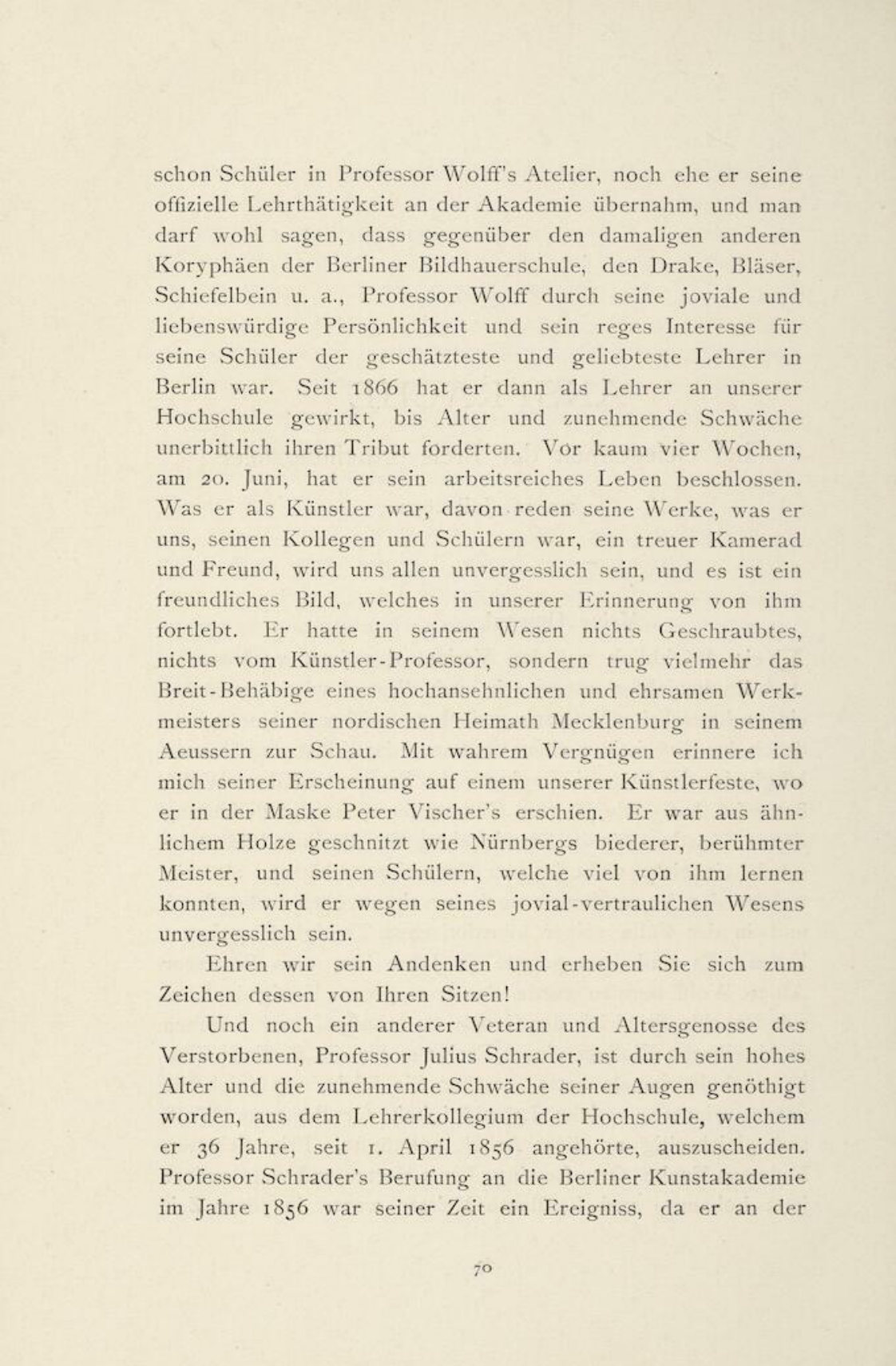
already students in Professor Wolff’s studio, even before he took up his official teaching work at the Academy. One may well say that, compared with the other leading figures of the Berlin school of sculpture at the time—Drake, Bläser, Schiefelbein and others—Professor Wolff, through his jovial and gracious personality and lively interest in his students, was Berlin’s most esteemed and beloved teacher. From 1866 he then worked as a teacher at our College, until age and increasing frailty inexorably demanded their tribute. Barely four weeks ago, on 20 June, he ended his industrious life. His works speak of what he was as an artist; what he was to us, his colleagues and students—a faithful comrade and friend—will remain unforgettable to us all, and a kindly image of him lives on in our memory. There was nothing affected in his manner, nothing of the artist-professor; rather, his appearance displayed the broad, comfortable bearing of a highly respectable and honourable master craftsman from his northern homeland of Mecklenburg. With real pleasure I remember his appearance at one of our artists’ festivities, where he came in the guise of Peter Vischer. He was carved from similar wood to Nuremberg’s upright, famous master, and to his students, who could learn much from him, he will remain unforgettable for his jovial familiarity.
Let us honour his memory; rise from your seats as a sign of this!
And another veteran, a contemporary of the deceased, Professor Julius Schrader, has been compelled by advanced age and the increasing weakness of his eyes to leave the College’s teaching staff, to which he belonged for thirty-six years, since 1 April 1856. Professor Schrader’s appointment to the Berlin art academy in 1856 was an event in its day, since at the
English translation · Leaf 3
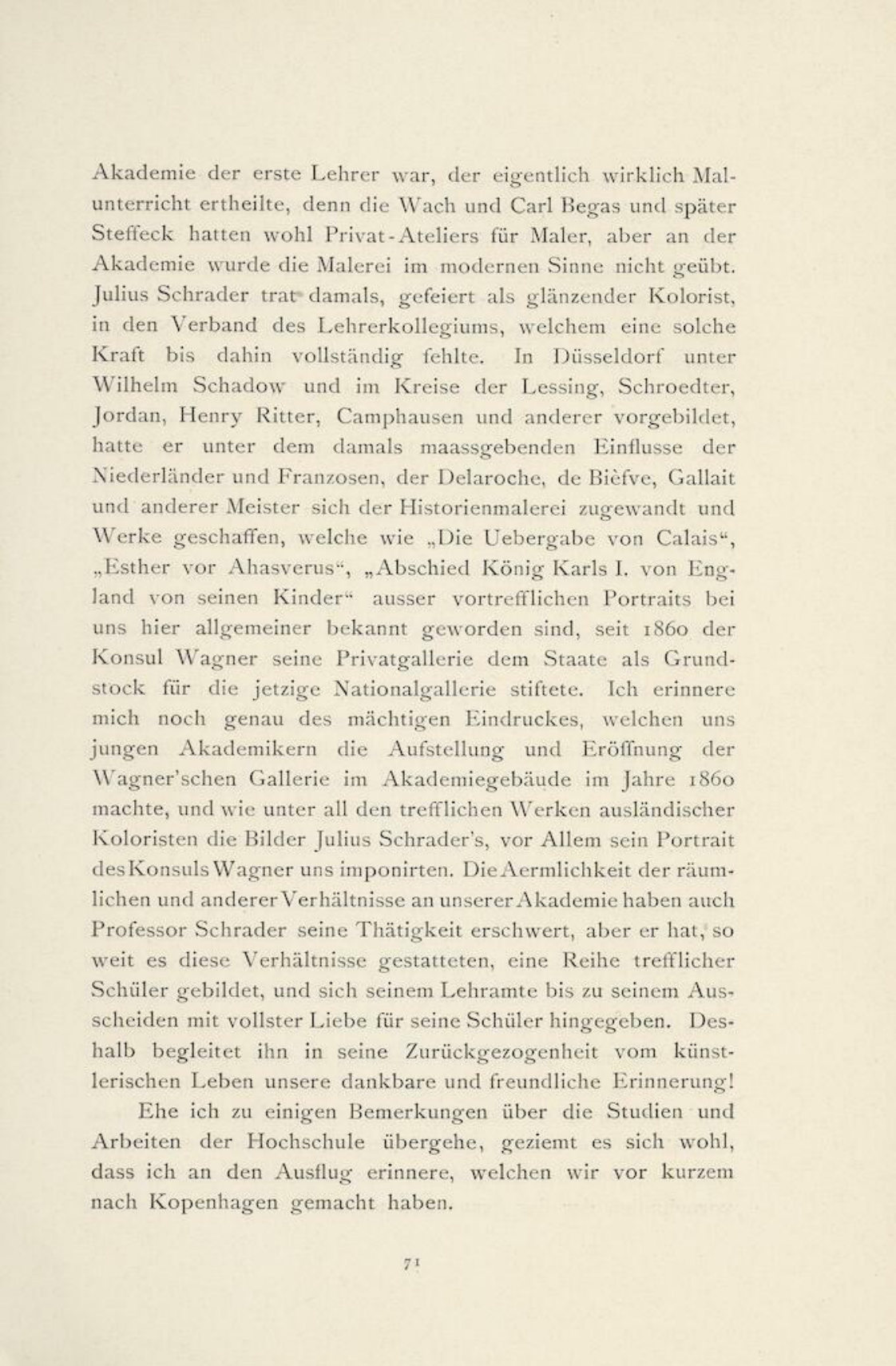
Academy he was the first teacher who actually gave painting instruction proper. For Wach and Carl Begas, and later Steffeck, indeed had private studios for painters, but painting in the modern sense was not practised at the Academy. Julius Schrader joined the teaching staff then, celebrated as a brilliant colourist, bringing a talent of a kind it had completely lacked. Trained in Düsseldorf under Wilhelm Schadow and in the circle of Lessing, Schroedter, Jordan, Henry Ritter, Camphausen and others, he had turned to history painting under the then prevailing influence of the Netherlandish and French painters, Delaroche, de Biefve, Gallait and other masters, and created works such as ‘The Surrender of Calais’, ‘Esther before Ahasuerus’, and ‘King Charles I of England’s Farewell to His Children’. Alongside excellent portraits, these became more generally known here after Consul Wagner donated his private gallery to the state in 1860 as the foundation of the present National Gallery. I still remember precisely the powerful impression which the installation and opening of the Wagner Gallery in the Academy building in 1860 made upon us young Academy students, and how, amid all the excellent works by foreign colourists, Julius Schrader’s pictures, above all his portrait of Consul Wagner, impressed us. The poverty of accommodation and other circumstances at our Academy also made Professor Schrader’s work difficult. But as far as those circumstances permitted, he trained a succession of excellent students and devoted himself to his teaching office with the fullest affection for his students until his departure. Our grateful and friendly remembrance therefore accompanies him into his retirement from artistic life!
Before turning to some remarks on the College’s studies and works, it is fitting to recall the excursion we recently made to Copenhagen.
English translation · Leaf 4
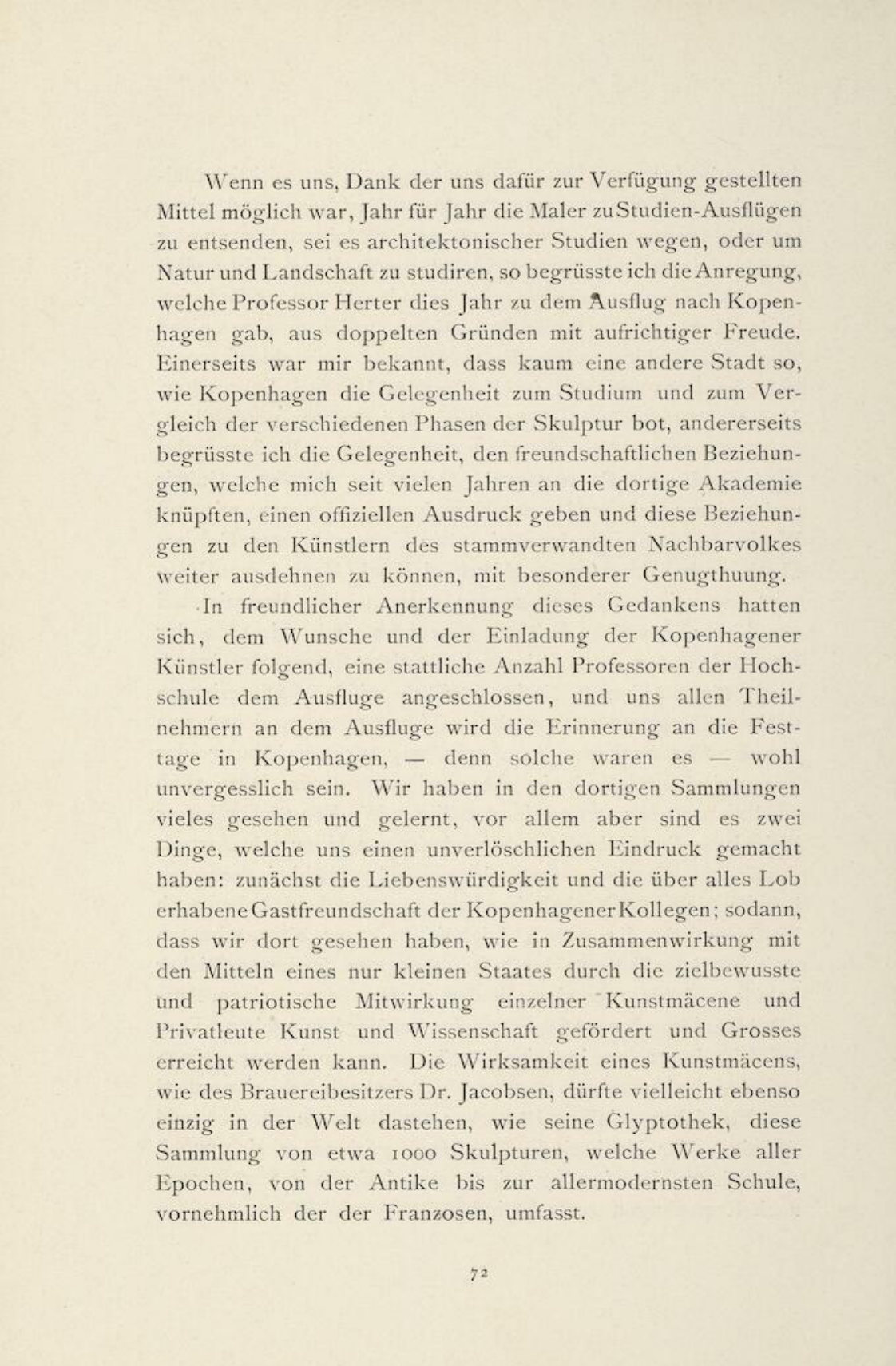
Whereas, thanks to the funds made available to us for the purpose, we have been able year after year to send painters on study excursions, whether for architectural studies or to study nature and landscape, I welcomed Professor Herter’s suggestion this year of the excursion to Copenhagen with sincere pleasure for two reasons. On the one hand, I knew that scarcely any other city offered, as Copenhagen did, the opportunity to study and compare the different phases of sculpture; on the other, I welcomed with particular satisfaction the opportunity to give official expression to the friendly relations which had linked me for many years with the Academy there, and to extend these relations further with the artists of our kindred neighbouring people.
In friendly recognition of this idea, and in response to the wishes and invitation of the Copenhagen artists, a considerable number of the College’s professors joined the excursion; and for all of us who participated, the memory of the festive days in Copenhagen—for that is what they were—will surely remain unforgettable. We saw and learned much in the collections there; above all, however, two things made an indelible impression upon us: first, the graciousness and hospitality beyond all praise of our Copenhagen colleagues; and then, that we saw there how, in cooperation with the resources of only a small state, art and scholarship can be advanced and great things achieved through the purposeful and patriotic participation of individual patrons of art and private citizens. The work of a patron such as the brewery owner Dr Jacobsen may perhaps be as unique in the world as his Glyptothek, that collection of about a thousand sculptures comprising works of every period, from antiquity to the very latest school, chiefly the French.
English translation · Leaf 5
Nor can it be common in Europe for an art lover such as Privy Councillor of State Tietgen to complete a mighty marble church at his own expense in the public interest. But alongside these gentlemen, special mention should be made here of my esteemed colleague, the Academy’s vice-president, the architect and chamberlain Meldahl, who is the soul of all artistic endeavours there and has worked successfully for artistic life for years, undeterred by every resistance. We inspected with the greatest interest the spatial arrangements of the Copenhagen art academy: the practically arranged sculptors’ studios, the comprehensive collection of plaster casts, the splendid, comfortable library, the teaching rooms and the spacious, excellently lit exhibition halls—all creations of Mr Meldahl. We, belonging to one of Europe’s most powerful states, could scarcely suppress a justified feeling of quiet envy. I therefore believe I may once again officially express here our warmest thanks to Mr Meldahl, his colleagues and Messrs Jacobsen and Tietgen for the exceedingly friendly reception they gave us and for everything they do and strive for on behalf of art. For such civilising activity benefits not merely one state but all humanity, and one can only wish it would find many imitators in every other country!
If, finally, I recall how exceedingly graciously His Majesty the King of Denmark took notice of the presence of the German artists, and with what goodwill the Minister of Education and Ecclesiastical Affairs, Dr Goos, and his chief of cabinet, Mr von Stemann, lent their active support to the German artists’ visit, I may surely be justified in describing this study excursion as a significant and highly gratifying event for our College.
English translation · Leaf 6
It was also of great interest to me that we could still see the Copenhagen Academy’s students’ work, since the academic year there was just ending at the beginning of June; and the exhibited works in some subjects, particularly architecture and ornament, for example, can serve us as models. In any event, every work exhibited testified to very serious and zealous activity.
Turning now with a few remarks to our study work, I am first pleased to be able to state today, in contrast to the regret I expressed here a year ago that the landscape painters’ pleasure in compositional activity seemed to be declining, that the exceedingly abundant exhibition of the landscape department brilliantly refutes the fears voiced then.
The extension of the drawing classes’ activity to every field of drawing, without the formerly customary restriction, likewise seems to bear good fruit by bringing students more quickly to their goal. For my part, I must continually encourage the students towards the greatest possible independence in conception and representation.
Yet the treatment of form in many works of the painting classes exhibited here stands in painful contrast to the soundness so gratifyingly evident in the careful development of form in the drawing sections. It is understandable that, for beginners confronted by the subject’s general appearance in colour, form recedes somewhat and is neglected; but such neglect is certainly neither absolutely necessary nor, moreover, beautiful. A human arm cannot and must not be treated in drawing and manner of painting like a cudgel of oak or birch, for the human form in
English translation · Leaf 7
general is distinguished as much by a pleasing precision and clarity as by an undeniable delicacy in its outward appearance, and the manner of painting should in any event express this. If there is absolutely no doubt that one can also paint with a pencil, of which Ad. Menzel’s pencil studies now exhibited give you the most splendid proof, it is equally beyond doubt that the most brilliant appearance in colour can be combined with the utmost precision of drawing without producing hardness of line. As modern examples at our exhibition, you need only look, among others, at the works of Passini and Pradilla.
Concerning compositional activity, I should like to draw particular attention to the branch of architectural-decorative and ornamental composition, in which, in my view, too little is achieved, and for which the students seem to have very little inclination. I regret this, since I know from experience how valuable practice and experience in precisely this field are for today’s artist.
The competitions in composition have led to satisfactory results in all sections. Only, I would recommend that in future the gentlemen, particularly the sculptors, should not choose too large a format for their works, because this compels them to devote the time, already scant in itself, to elaborating details which are worthless for the compositional idea itself.
Source: Anton von Werner, Ansprachen und Reden (1896). Original digitisation: Universitätsbibliothek Heidelberg / Akademie der Künste. Consult the source volume.